Food Processing Machinery for Snack and Bakery Production Lines
- Engineer-reviewed quote within 24 working hours
- Machine trial with your own recipe before you order
- Output from 6 kg/h to 5,000 kg per 24 hours
- Natural gas, LPG or all-electric heating
UDTECH develops food processing equipment for egg roll, wafer roll, waffle, crisp cracker, sachima, and mini-bun production. The range includes single units for in-store use and progresses to continuous tunnel lines and complete bakery systems. The food and baking guides below include more details for each family. These guides are meant for production plants and bakery equipment size engineers rather than people shopping for a countertop waffle iron.
Your design and recipe drawings will be kept confidential. We can sign a confidentiality agreement before we do any trials.
System Specifications
Quote turnaround
Engineer-reviewed reply within 24 working hours
Before you order
Machine trial with your own recipe, run at our facility with our technicians, with the trial samples returned to you
Output range
6 kg/h in-store unit to 5,000 kg per 24 hours continuous
Heat sources
Natural gas, LPG or all-electric, specified per configuration
Power supply
Three-phase four-wire, 380 V ±10%
Compressed air
0.2 m³/min at 0.6 MPa or above
Three Production Families and the Guides Behind Them
Each family has its own guide hub, written for the people who run the line rather than for a catalog. The most applicable guide for your situation is: the product guide if you are still describing the product to yourself, and the output ladder if you know the volume you want to achieve. The three families cover the processing solutions we build, from a single forming unit to a line that ends at the packaging interface.
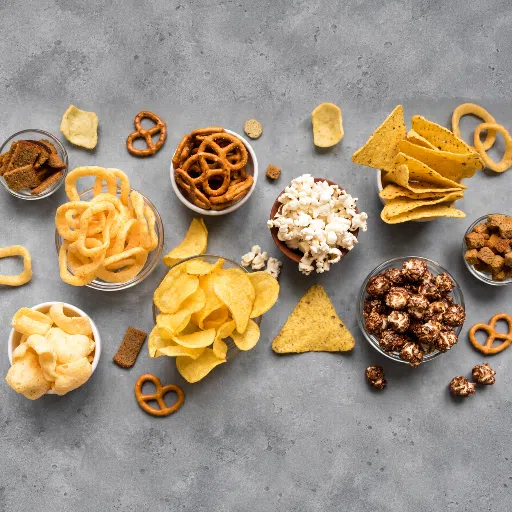
Crispy Snack Guides
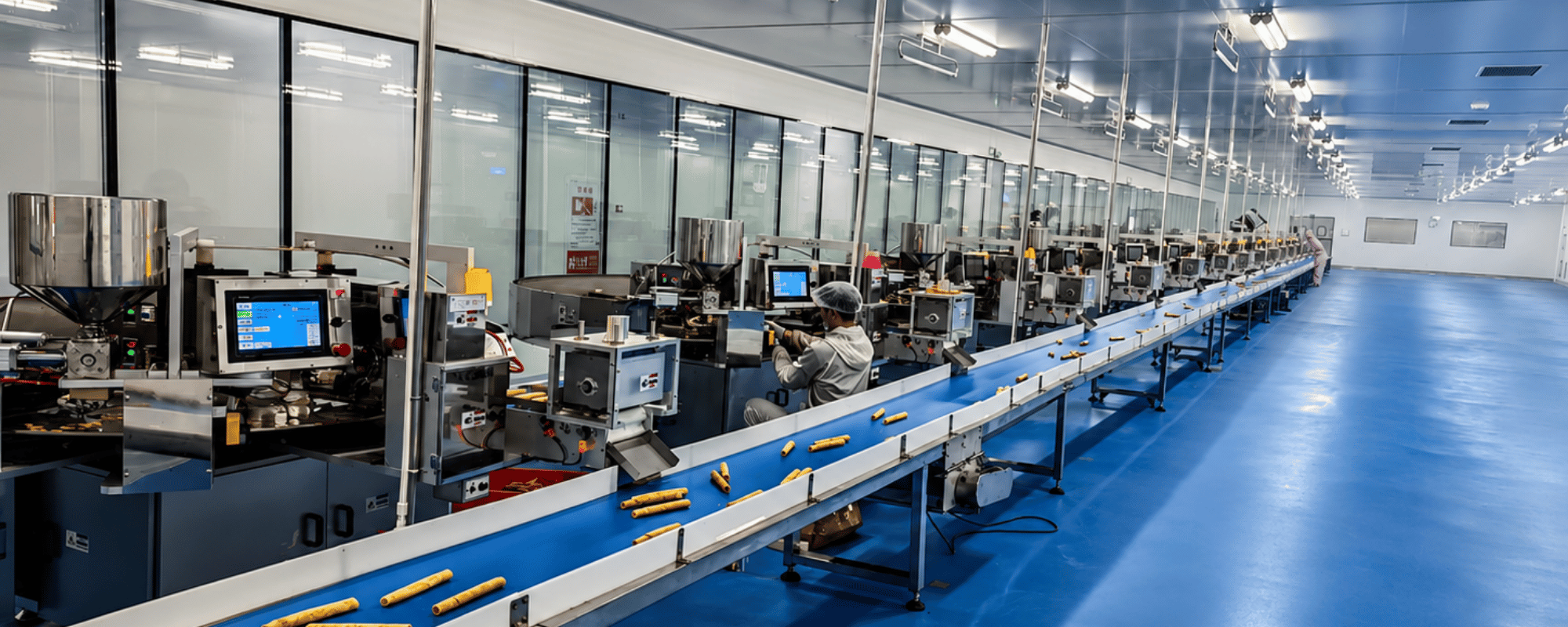
Egg roll, wafer roll, phoenix roll, sachima and biscuit forming. Rotary machines from 6 kg/h for in-store production, gas-fired multi-line machines at 600 to 900 kg per shift, and a full sachima process line at 1,000 kg/h.
- Snack naming and category boundaries
- Crisp and crunchy texture language
- How a crispness target routes to a processing choice
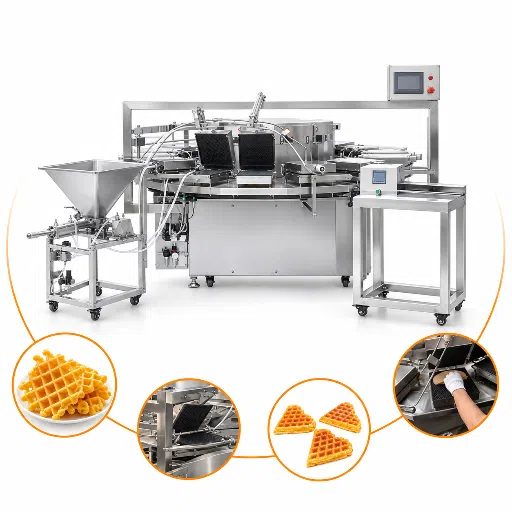
Waffle and Pancake Guides
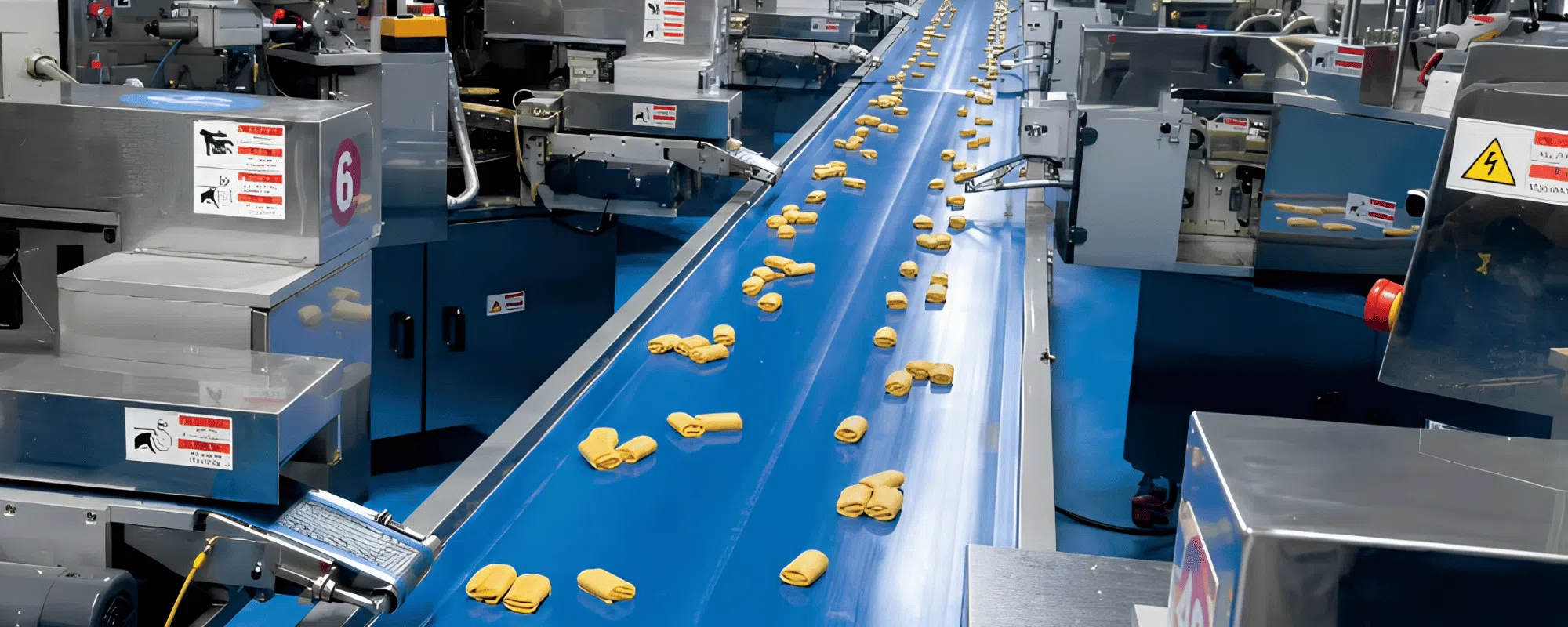
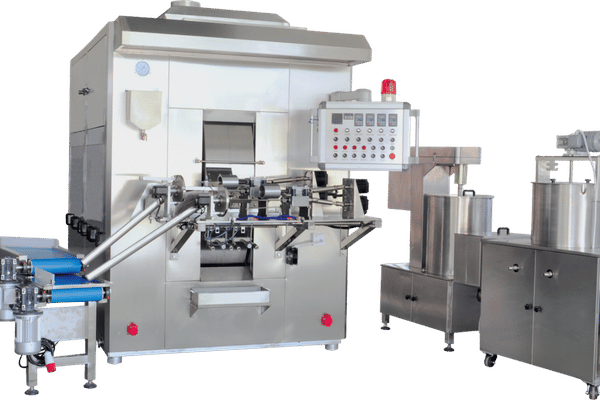
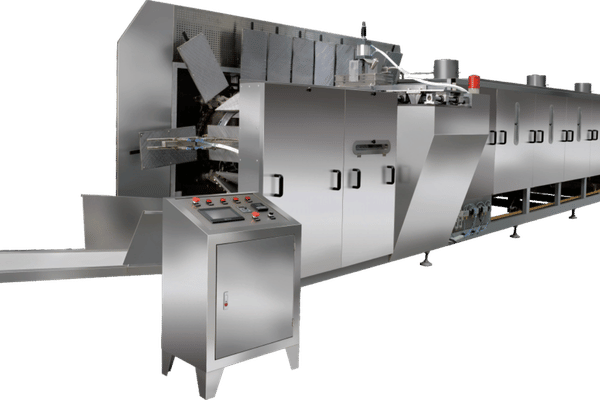
Eight-pan rotary waffle baking and continuous tunnel lines at 32, 60 and 80 moulds. Two demoulding technologies are offered on the continuous lines: needle rolling and air blowing.
- Formula and context inputs worth recording
- Process interactions behind texture and release
- A batter context capture sheet

Baking Science: Ingredients and Texture
The control side of the same equipment. Interchangeable steel baking templates change what a line makes, and high-precision raw-material dosing holds the flour, oil and sugar ratio constant batch to batch.
- Building an operating window rather than a universal setpoint
- Interaction-aware formulation and process validation
- Variables that define an automation project
Output Ladder from In-Store Units to Continuous Lines
Oven Capacity usually limits output in industrial bakeries. Equipment capacity is organized on the diagram that follows, therefore sizing discussion can initiate at a number rather than at the name of a product.
If you have already set your shift target, you can use the Output-to-Line Size Calculator to transform this information to the hourly capacity a line must contain and to indicate which band of this ladder this hourly capacity falls within.
| Configuration | Output | Heat source | Footprint | Where it fits |
|---|---|---|---|---|
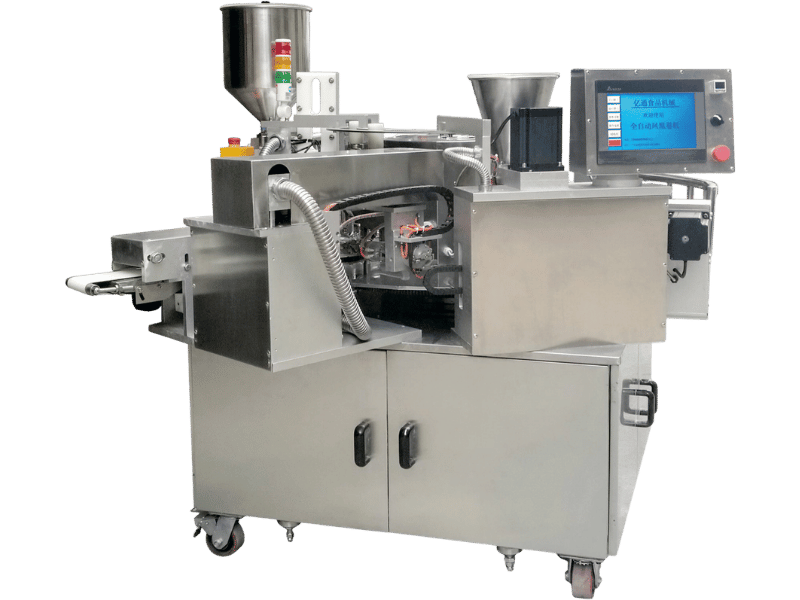
| In-store rotary unit | 6 kg/h, about 300 pieces per hour | Electric, 2 × 2.5 kW heating | 1,400 × 900 × 1,480 mm | Bakery shopfronts and mall food zones where production is visible to customers |
| Plant rotary unit | 12 kg/h, about 600 pieces per hour | Electric, 4 × 2.5 kW heating | Confirmed at quotation | Small factory lines and pilot production |
| Nori-laminating rotary unit | About 500 pieces per hour | Electric, 4 × 2.5 kW heating | Confirmed at quotation | Seaweed-wrapped rolls, with lamination synchronised to baking |
| Nine-mould rotary table | 500 to 600 sticks per hour | Electric, 9 × 2.5 kW heating | 2,700 × 2,100 × 1,500 mm | Patterned and filled rolls, with optional cut-off and sesame sprinkling |
| Gas-fired dual-line | 600 kg per 8-hour shift | Natural gas about 8 m³/h, or LPG about 6 kg/h | 4.2 × 3.7 m floor area | Mid-volume plants with a stable gas supply |
| Gas-fired three-line | 900 kg per 8-hour shift | Natural gas about 10 m³/h, or LPG about 8 kg/h | 4.2 × 3.7 m floor area | Higher output on the same floor area as the dual-line |
| Continuous tunnel line, 32 moulds | 1,800 kg per 24 hours | Natural gas 8 m³/h, or LPG 4 kg/h | 6 × 1.6 × 1.9 m | Entry point to continuous production |
| Continuous tunnel line, 60 moulds | 3,500 kg per 24 hours | Natural gas 14.5 m³/h, or LPG 8 kg/h | 9.8 × 1.6 × 1.9 m | The most common continuous configuration |
| Continuous tunnel line, 80 moulds | 5,000 kg per 24 hours | Natural gas 19 m³/h, or LPG 14 kg/h | 12 × 1.6 × 1.9 m | Highest continuous output in the range |
| Sachima process line | 1,000 kg per hour | Natural gas 30 m³/h | 70 × 1.3 × 3.5 m | Mixer, sheeting, cutting, frying, secondary proofing and sugar mixing through to the packaging interface |
| Mini-bun and baby-biscuit line | 4,000 kg per 24 hours | All-electric | 55 × 1.9 × 3.0 m | Mixer, dough pressing and cutting, rounding drum, handling conveyor and arranging; the only all-electric line in the range |
Control and Build Standards Across the Range
The same control architecture runs across the rotary machines and the continuous lines. It is what closes the plate temperature window that wafer batter requires, and what allows one operator to run a line as opposed to controlling it.
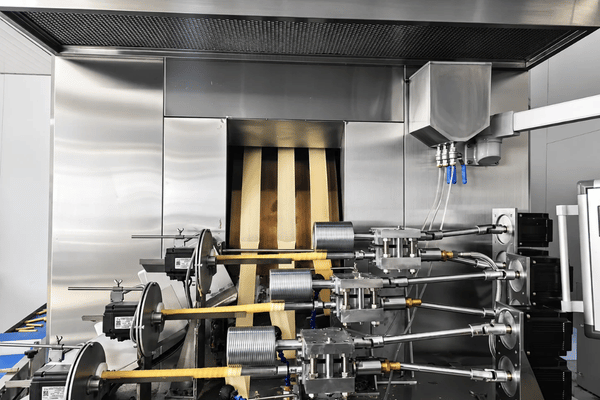
Control and sensing
- PLC numerical control
- Multi-channel servo linkage
- Fibre-optic photoelectric precision sensing
- Intelligent temperature control with synchronised forming
Construction
- Stainless-steel enclosure with aluminium-alloy structural components
- Interchangeable special-steel baking templates
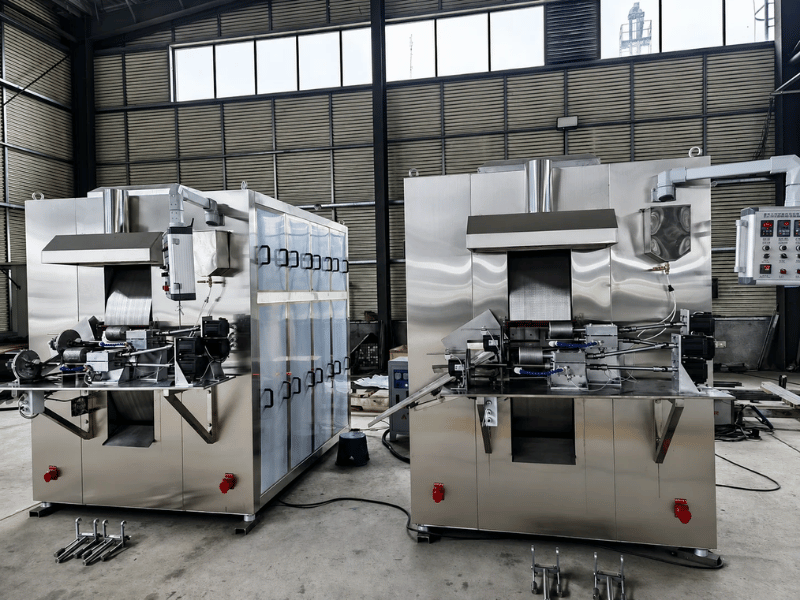
- Rotary workstations which accomplish automatically grouting, heating, folding, rolling, demoulding and conveying.
- Customizable rotary machine thickness and time for each stage of the baking process
What the published benchmarks say about food-contact surfaces
Hygienic design has a measurable value. A buyer can check it on-site with a handheld profilometer, unlike other design assumptions. 3-A Sanitary Standards sets 32 micro inches (0.8 microns) Ra as the usual maximum for surfaces in contact with food, and notes that the value is accepted across 3-A, USDA guidance and EHEDG. Other published works from a related field of study also state the same maximum value from EHEDG and the American Meat Institute.
The three-part design test in United States federal law
Each step of the regulation is phrased in a way to make it immediately clear to a prospective machine buyer:
- Equipment must be designed to allow adequacy of cleaning.
- Seams on food-contacting surfaces need to have a bond that prevents food particles from accumulating in them.
- Food-contact materials must be nontoxic and able to withstand the attack of food and cleaning chemicals.
Where air-blow demoulding becomes a food-safety question
Needle rolling and air blowing are both offered on the continuous lines, and they are usually discussed as a texture and breakage decision. There is a second dimension. United States federal law requires that compressed air mechanically introduced into food, or used to clean food-contact surfaces or equipment, be treated so the food is not contaminated.
If you choose air blowing, the air treatment specification would be included in the same discussion as the mould count, because it would fall within your food safety plan rather than adjacent to it. We will disclose which demoulding technology a corporation is offering along with the air spec, so the decision is based on the design in the layout rather than post design.
Gas, LPG and All-Electric Heat Sources
Each configuration includes a heating source and these figures tend to be the most misinterpreted numbers on all specifications of food processing equipment. There are three clear facts published from the baking industry which explain why these values are so significant, and how each fact changes the assessment for a given quotation.
First: the oven is paying to evaporate water
Each wafer batter may contain between 52 to 60 percent water. At least half of the input mass must leave as steam and that is what the burner purchases. The low limit to evaporate one kilogram of water is 2,257 kJ, or 0.627 kWh, prior to any oven loss.
My Evaporation Energy Floor Calculator determines this floor for your batter and product moisture. You can then see how much of a stated fuel cost is unavoidable physics and how much is oven inefficiency.
Second: hourly fuel rate is the wrong unit for comparison
Dryer and oven performance is usually expressed as the heat input per kg of water evaporated rather than fuel input per hour. Two machines quoted in m3/h cannot be compared until the output is adjusted to fall under the fuel cost. The numbers below use same published output and gas figures from the machines in the ladder above, so you can check the calculation.
To run it against your own tariff, the Heat-Source Running Cost Calculator puts gas and electric on one axis: cost per 100 kg, using your consumption, your price and your output.
The risk here is an intuition rather than a number. An LPG buyer assuming that the larger the line the greater the efficiency would size the line incorrectly, as in these cases the intuition is the opposite.
| Configuration | Output | Natural gas | Gas per 100 kg of product | LPG per 100 kg of product |
|---|---|---|---|---|
| Continuous tunnel, 32 moulds | 75 kg/h | 8 m³/h | 10.7 m³ | 5.3 kg |
| Continuous tunnel, 60 moulds | 146 kg/h | 14.5 m³/h | 9.9 m³ | 5.5 kg |
| Continuous tunnel, 80 moulds | 208 kg/h | 19 m³/h | 9.1 m³ | 6.7 kg |
| Sachima process line | 1,000 kg/h | 30 m³/h | 3.0 m³ | Not offered on LPG |
For natural gas, the gas figure per 100 kg falls as the tunnel gets longer, from 10.7 to 9.1 cubic metres, while the LPG figure per 100 kg moves the other way, from 5.3 to 6.7 kilograms.
Third: these are nameplate figures, not a running-cost forecast
- Idle draw is separate from baking draw. The US EPA’s ENERGY STAR program for commercial ovens defines idle draw as the energy consumption of an oven holding a stabilized temperature. It notes that a high-efficiency oven with a higher idle draw can in fact use less energy than a low-efficiency oven. While their program is designed to test foodservice ovens as opposed to continuous industrial lines, this gives you the principle to apply, not a specific number.
- Loading has a bigger impact on the result than the model does. Thermal efficiencies of tunnel ovens in the market range from 16 to 21 percent, so a half empty tunnel oven consumes almost as much as a full oven. The same applies to a tunnel oven during a proof or traditional idle tunnel oven (idle proof changeover).
- Plant practice moves it again. An energy audit of six bakeries in 2021 found best practice example bakeries used 0.124 kWh of electrical energy per kilogram of product, while worst example bakeries used 0.315 kWh, with a mean value for all bakeries audited of 0.204 kWh.
- Fuel is not the same everywhere. The US Energy Information Administration states that the heat content of fuels can differ between countries, so a cubic metre of gas on your supply is not equivalent to a cubic metre of gas on ours.
Gas against electric: the honest version
There is no universal answer here, and the trade-off is stated clearly in the reviewed journals and not by us.
- Electric buys you control and costs you radiant heat. Resistance heating eliminates combustion losses and offers better control than gas heated systems, while reduced radiant heat can change surface crust development.
- Gas sends most of the fuel up the chimney. In one modeled industrial tunnel oven, only about 16 per cent of the heat supplied to the oven reached the product, with 55 per cent lost to chimney gases and 28 per cent to heated walls.
- The answer is site-specific, not product-specific. In the same review, feasibility was attributed to grid carbon intensity, energy prices, and retrofit constraints, three site specific conditions as opposed to machine specific conditions.
From Enquiry to Installed Line
Six distinct steps in sequence. The trial is before the contract, since this is the step that determines if your product is able to run on this equipment.
01
Enquiry
Send the product application, the target output and your plant’s gas and power conditions. You get an engineer-reviewed reply within 24 working hours.
02
Machine trial with your own recipe
Bring or send your ingredients. The trial covers batter preparation and the baking window, runs at our facility with our technicians, and the trial samples come back to you.
03
Configuration and Quotation
The Mould count, heat source, demoulding technology and line length are fixed against the trial result and the quotation is made accordingly.
04
Manufacture
In this step, we decline to publish the conflicting figures and pin them to a drawing with the agreed configuration.
05
Shipment
The international transport packing list is configured to what you have signed.
06
Installation and operator training
This step is the installation of the equipment for your use, a run on your specified recipe and training for your operation, disassembly and cleaning of the equipment.
How price is worked out
Price is determined by configuration: line, cavity output, heat and level of automation between forming and packing. Longer tunnels/moulds with more positions cost more; gas-fired lines as well as fully-electric lines with the same output are not the same price.
Quotes are based on the configuration the trial gave us, not on a list.
Lead time is set with the finalized contract once configuration is complete.
Because no standard lead time is given, it must refer to a specific machine.
What to put in the purchase contract
This is the buyer’s responsibility, and a safety regulator has already prepared the list. According to the Health and Safety Executive’s guidance on the purchase of machinery in food processing, the buyer must provide three elements.
- The requirements for health, safety, and hygienic design should include the upper limit for noise levels, preferably stated by the buyer.
- Where a published machine standard exists for that particular machine, the purchaser is expected to name the published standard in the purchase contract and cite it as a reference, for example, for equipment used in baking, the European series of machine standards begins with BS EN 453 for dough mixers, extends to BS EN 12041 for moulders, and ends with BS EN 1673 for rotary rack ovens.
- Upon arrival, confirm that what was delivered meets your requirement(s) and check the declaration of conformity; do not assume that conformity mark indicates the end of the question.
Build Quality Checks and What a Buyer Can Verify
A bakery equipment standards body states the purpose of certification is to give the purchaser the assurance of not having to rely on the supplier’s marketing claims. The same body advises purchasers to mandate the submission of supporting documentation which the purchaser can verify the extent of coverage of the documentation at the model and configuration levels.
The standards that actually govern this machine class
- There are two American National Standard for baking industry equipment within the United States: ANSI Z50.1 for safety and ANSI Z50.2 for sanitation with the American Society of Baking as secretariat. These are the reference standards used to measure all baking equipment manufacturers.
- Z50.2 contains a clause written for exactly this equipment: Design Requirements for Sugar Wafer, Wafer and Sugar Rolled Cone Batter Systems.
- Conformance to an American National Standard is voluntary, and the standard itself states that its existence does not preclude anyone from manufacturing, purchasing or using non-conforming equipment.
- The hygiene counterpart standard in Europe is BS EN 1672-2, the hygiene standard for all food processing machinery, as opposed to being specific to one machine class.
- For NSF, the standard whose scope names bakery equipment is NSF/ANSI 2. NSF/ANSI 4 covers commercial cooking and hot-holding equipment, and NSF/ANSI 51 covers the materials used to build foodservice equipment. Specifying the wrong one of the three is a common and expensive error, because the three are scoped by equipment type rather than by industry, and one bakery plant legitimately owns equipment covered by all three.
The risk the buyer is exposed to here would not be mechanical, but rather, documentary. A certificate issued against the wrong scope is a valid certificate, as it is a document that states a machine class that you did not purchase.
The checkable material, rather than an adjective
Data for output, heat source, footprint, number of heating elements, air pressure and supply voltage are published above for each configuration. These can all be checked upon delivery against the configuration you have signed.
What arrives with the machine
The documentation for the operation and maintenance of the machine, the control cabinet electrical schematic, and a shipping list that corresponds to the signed configuration are included with every order. Installation and training for operation, disassembly, and cleaning are included for the end of the transaction.
Book a Machine Trial With Your Own Recipe
…the fastest way to replace a claim with a sample you are holding.
Buyers These Lines Are Built For
Factory production
Continuous or multi-shift factories for baked snack foods or for industrial baking. In this context, the issue is the size of the mould and the heat source rather than the name of the baked product.
Retail, artisan and in-store
Bread and cake shops, pastry counters, and bakery shop-fronts, where the baker works in view of the customer and the machine is part of the display.
Supermarket supply
Large supermarkets and their suppliers, where consistency across a large bake run is more important than a high hourly rate.
All safety devices of ovens must be examined at intervals of not more than twice a month by a bakery employee, and not more than once a year by oven manufacturers’ representatives.
— 29 CFR 1910.263(l)(9)(ii), US Occupational Safety and Health Administration
The ownership obligations a buyer inherits
These are not our terms; they are the limitations that are relevant to the installed machine in a United States plant, and they should be evaluated prior to making a purchase rather than afterwards.
- Bakery safety devices on ovens must be checked by a bakery employee twice a month at a minimum, and by the oven manufacturer’s employees at least once per year.
- Power transmission equipment must be inspected at least every 60 days.
- Drive sprockets and chains must be enclosed unless they sit more than seven feet above the floor, which the waist height chain drives on a conveyorized tunnel line do not, so the enclosure applies to them. The requirement occurs within a power transmission standard that does not apply to the working area of the machine. The product carrying conveyor is guarded under the general machine guarding requirement instead.
- Direct fired ovens that exceed 150,000 Btu/h must be purged by at least four full atmosphere replacement purges prior to ignition and following any safety shut down.
The annual manufacturer’s inspection is the deciding factor. It extends after-sales service from an option to a compulsory service, and is a legitimate question to pose to any supplier prior to signing a contract.
System Planning
Engineering Calculators & Tools
Utilize our industrial sizing and energy calculators to determine your exact plant requirements before requesting a configuration.
Evaporation Energy Floor Calculator
Determine the absolute physical minimum energy required based on your specific batter moisture content.
Heat-Source Running Cost per 100 kg
Compare gas and electric operational costs normalized against your local tariffs and plant output.
Output-to-Line Size Calculator
Convert your targeted shift volume into exact hourly machine capacity and tunnel line dimensions.
Your recipes and product drawings are kept confidential, and we sign a confidentiality agreement prior to any trial on request.
Frequently Asked Questions
What does “egg roll machine” actually mean?
Each of the two machine classes covered by this name comprises technologies that are disparate. One forms a cold-stuffed rolled dough product on a conveyor, the other forms a crisp roll by pouring batter onto a mold, baking it and curling it. Our machines are of the latter type, so if you are sourcing the former, this range is incorrect.
How do I compare two machines quoted in cubic metres per hour?
To determine fuel consumption in relation to production, quote the fuel consumption in energy units to make a comparison. To do this, both quotations must be converted to the same energy unit. The Energy Information Administration of the United States publishes the conversion factors, and also states that the fuel heat content varies in different countries. Direct comparison of hourly rates is indicative of the machine having the smaller output.
Which NSF standard applies to bakery processing equipment?
NSF/ANSI 2. Its scope names bakery, cafeteria, kitchen and pantry units. NSF/ANSI 4 is a different standard covering commercial cooking, rethermalization and hot-holding equipment, and NSF/ANSI 51 covers the materials used to build foodservice equipment.
What surface finish should I specify for food-contact parts?
32 micro-inch, or 0.8 micron, Ra is the long-standing maximum for product-contact surfaces, accepted across 3-A Sanitary Standards, USDA guidelines and EHEDG. However, the USDA and EHEDG accept this value. This can be included in the purchase spec as it can be verified by a handheld profilometer when the equipment is installed.
Does a machine trial cost anything, and what do I get back?
You send or bring your own ingredients, our technicians run the trial at our facility, and the trial samples are sent back to you. The trial determines if your product is capable of running on this equipment without a signed contract, so it is located before the quote rather than after.
How long does a changeover take on a continuous line?
It affects the planning of your production process. Moulds and griddle plates take time to swap out, and industrial waffles and wafer runs stay on one product for a week or longer. View the changeovers as scheduled, planned events, and not swapped on a daily basis.
Is air-blow demoulding a food-safety issue?
This is a question your food-safety plan must address. Under federal law in the United States, compressed air used in the manufacturing of food or to clean food contact surfaces must be treated to prevent food from becoming contaminated. We will disclose which demoulding technology is used for a given quote configuration. You can then determine the necessary air specification.
Why does the manufacturer have to come back every year?
All bakery ovens in the USA require safety devices to be checked by an authorized employee at least twice a month and once a year by the manufacturer’s representative. This is a built-in requirement of the product, so you should confirm with the supplier before signing the contract as opposed to after.
Why are some dimensions missing from the output ladder?
Because in our brochure and in our parameter workbook we have different figures for those configurations. In order to determine the correct value, we resolve to the drawing that was provided with the quote. A figure that is different in two of our own workbooks is a figure you should not base the design of your plant on.
Can you supply a line that makes several different products?
On the continuous lines, interchangeable special-steel baking templates change what the line makes. On the rotary machines, mould geometry defines the shape. Bring every product you intend to run to the trial, because feasibility across a product set is exactly what a trial settles.