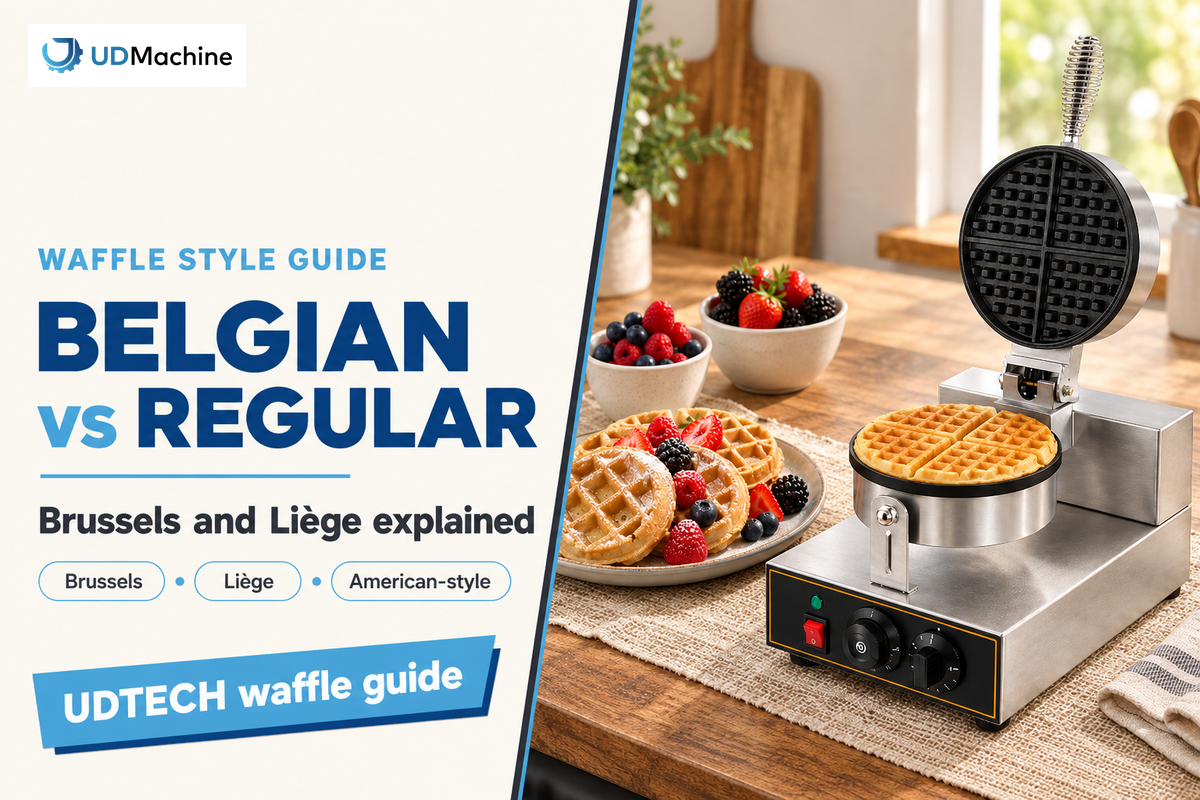
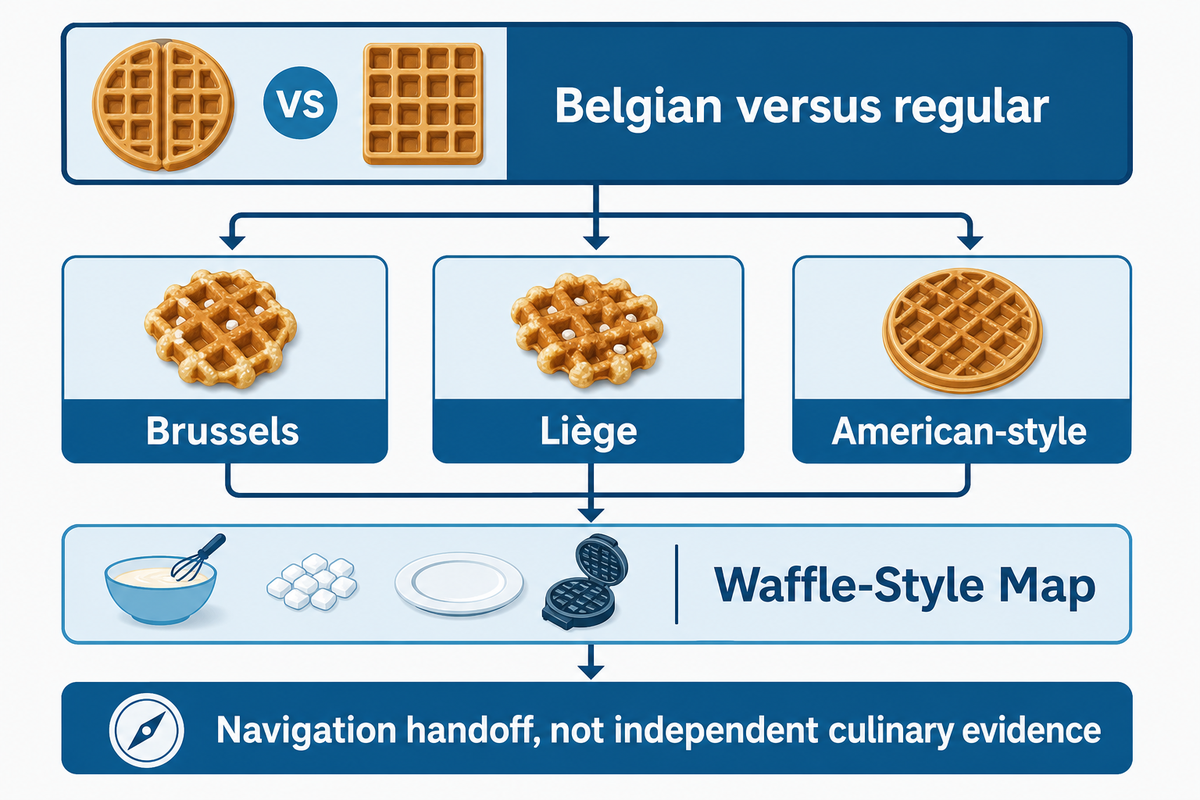
Belgian vs regular waffles is a comparison of named Brussels and Liège styles with a stated American-style baseline, not a choice between two fixed recipes. In this discussion, we are comparing three waffle styles: a Brussels-style waffle, a Liège-style waffle, and an American-style waffle that a recipe, café, or grocery aisle may call regular.
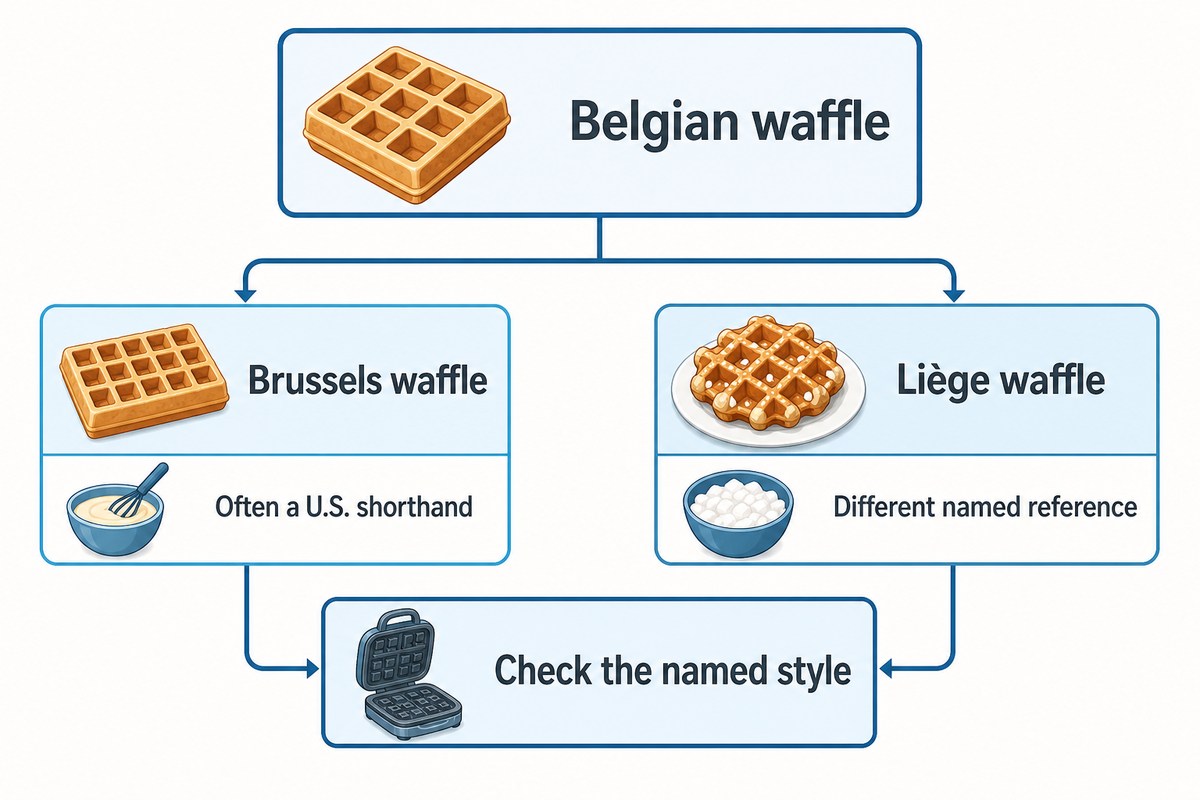
Quick answer: In U.S. usage, “Belgian waffle” often points to a Brussels-style, deep-pocket waffle. But Brussels and Liège are distinct Belgian preparations, while regular waffle is a convenience label rather than one fixed recipe. Compare the intended bite, sweetness, and cooking format before treating any of those names as a specification.
The useful distinction
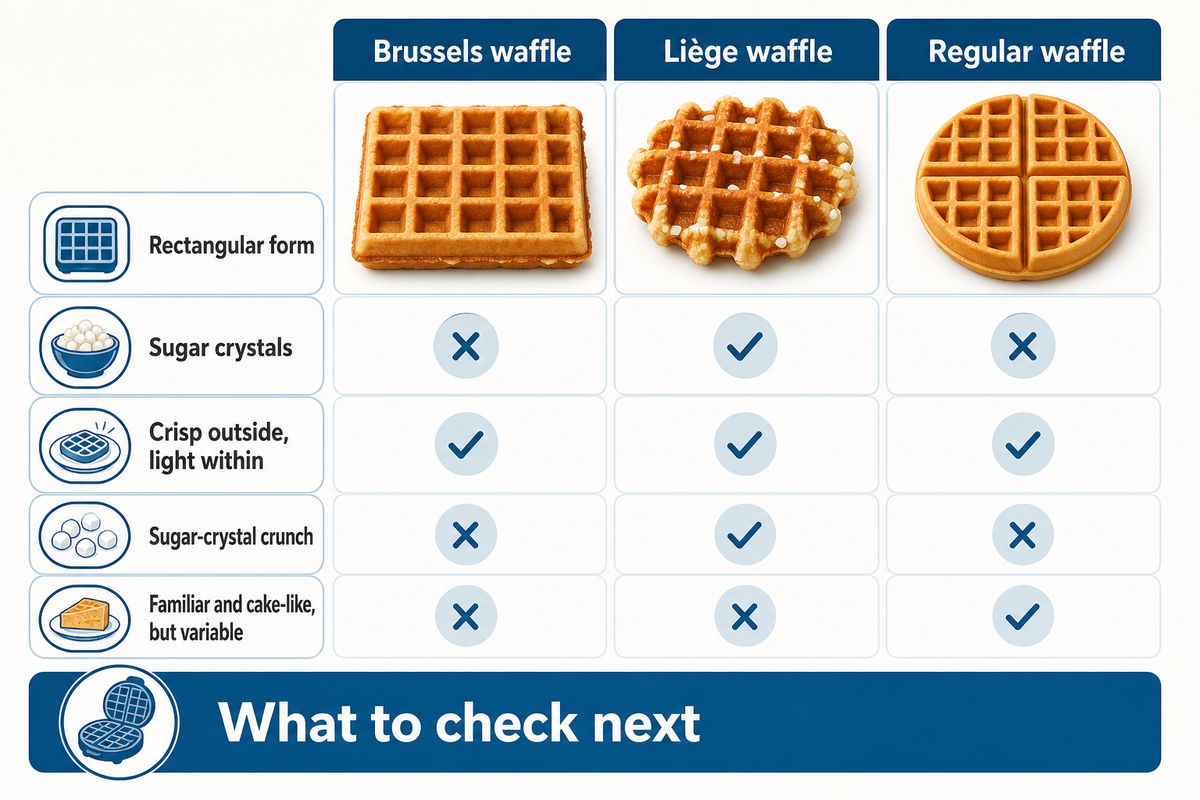
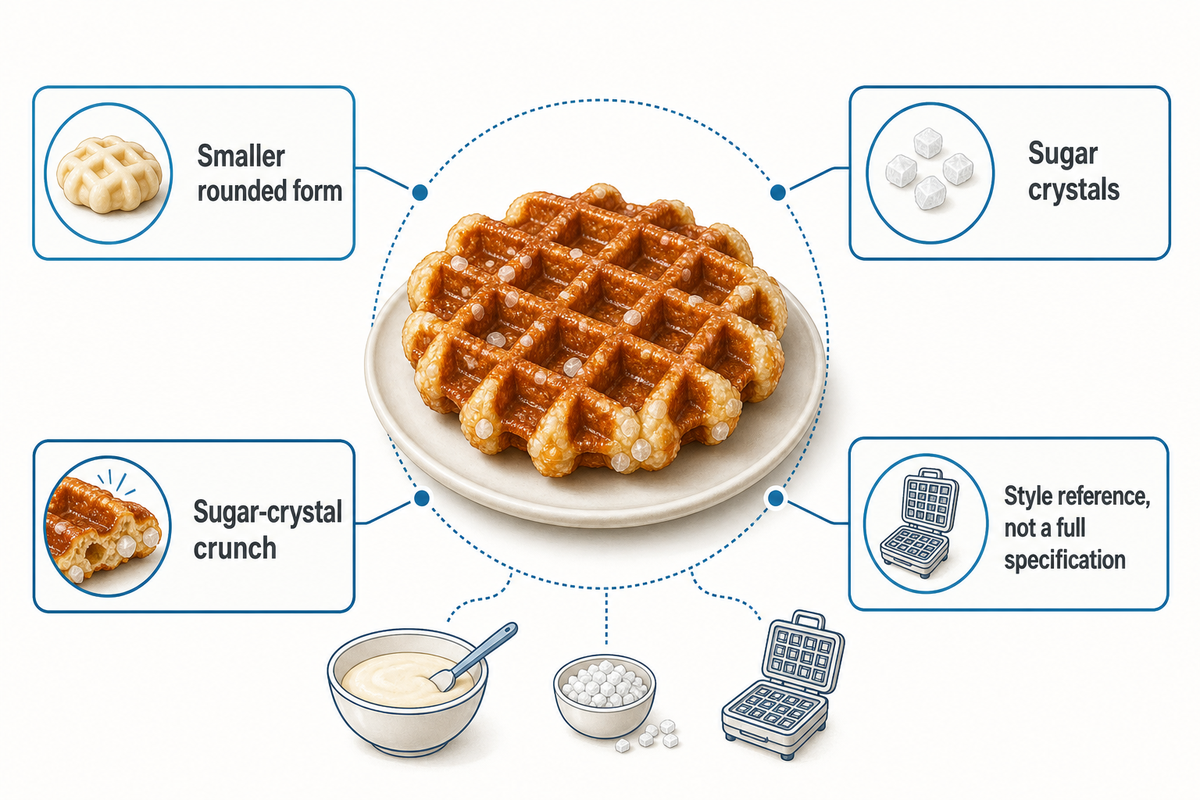
In common descriptions, a Brussels waffle is rectangular, light, and crisp outside. By contrast, a Liège waffle is commonly described as smaller, rounded, and marked by sugar crystals. Here, regular waffle means a familiar American-style batter waffle whose exact recipe can still vary.
What “Belgian Waffle” Usually Means, and What It Can Miss
The term Belgian waffle is useful only after the speaker’s reference point is clear. Musea Brugge’s municipal-museum account notes that the U.S. label usually refers to the Brussels waffle, while a Brussels destination guide presents Brussels and Liège as two different Belgian waffle types. Those notes can be useful without making the Belgian-waffle label a universal U.S. standard.
Musea Brugge describes the U.S. label as usually referring to the Brussels waffle and connects that naming story with the 1964 New York World’s Fair. The naming isn’t a rule that all menus and packages use the term, so we can’t assume that all recipes use the term in the same way. Its practical value is a reader check that can help. If someone says “Belgian,” ask whether they mean the airy Brussels style, the Liège style, or simply a deep-pocket iron.
“Belgian Waffle usually refers to the Brussels waffle.”
This is why a clean comparison shouldn’t treat Belgian as a single formula. The label can be a useful starting point, but the style name, the recipe format, and the desired eating experience are more informative. For a broader starting point, the site’s waffle and pancake guide hub places this comparison next to similar product and process topics.
Restaurant menus, recipe cards, and factory product briefs may invite the faulty assumption that Belgian names one finished formula. Because those documents serve different purposes, record the named style and intended texture before comparing products. The source material distinguishes types, but it does not standardize every use of the label.
Belgian vs Regular Waffles at a Glance
For the formula side of this comparison, controlled waffle research supports treating ingredients and process conditions as variables under its tested conditions; it does not define Brussels, Liège, or every American-style recipe.
The most reliable comparison isn’t Belgian against regular as if each were one recipe. It’s Brussels-style, Liège-style, and an American-style reference point. This table shows tendencies and labels to verify, not rules for every recipe or maker.
Waffle style categories: a label-to-style comparison matrix
Waffle style category
What it often signals
Texture expectation
What to check next
Brussels waffle
Rectangular form and a lighter preparation
Crisp outside, light within
Whether the recipe is yeast-risen or uses another method
Visit Brussels describes the rectangular Brussels waffle with a crisp exterior and light center, whereas the smaller, rounded Liège waffle gets its crunch from melting sugar crystals. Those style descriptions provide a useful start, but they do not provide a standard or universal ratio, nutrition information, or a claim about every waffle iron. Rather, take these descriptions as two different style versions.
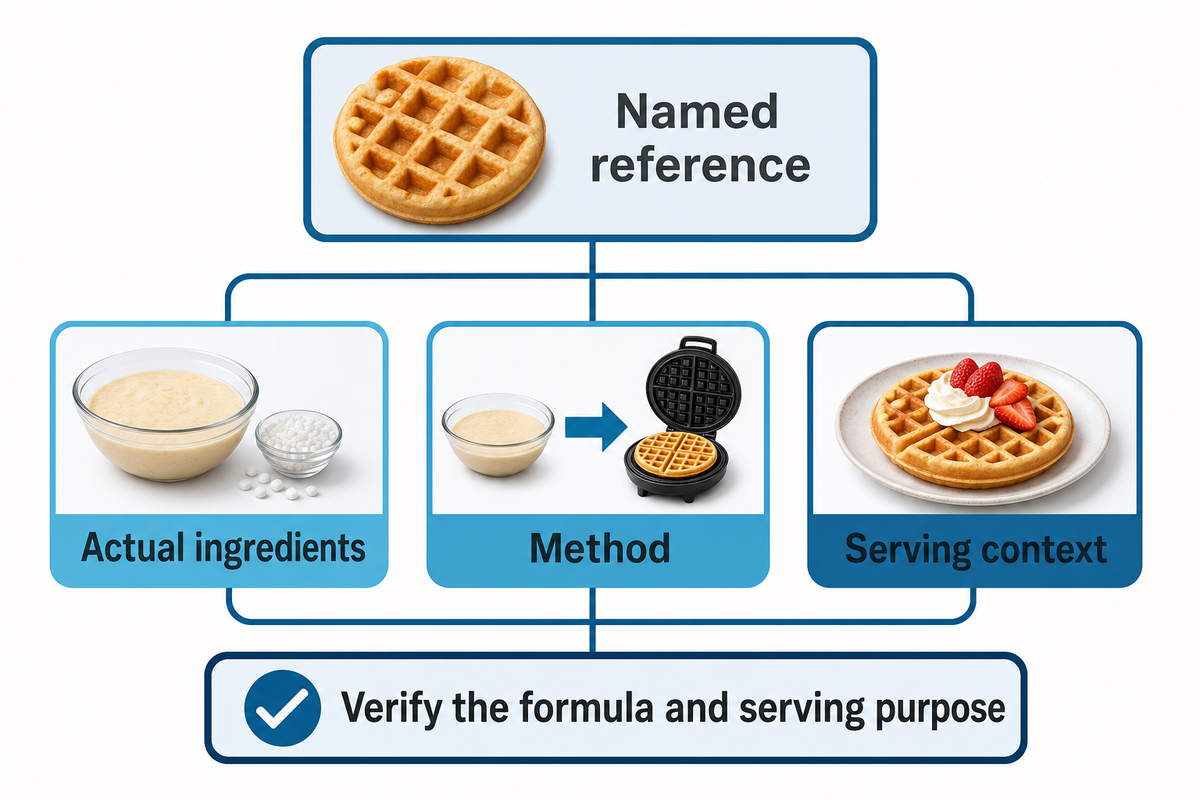
There’s a functional order to the matrix. Style names tell you the intended reference; the recipe or ingredient list tells you what was actually made; the plate pattern tells you only part of the presentation; and the serving plan tells you what the waffle must do on the plate or in the hand. Keeping those four jobs separate clarifies how menus, recipe cards, and packaged goods compare without putting a menu, recipe card, and packaged product in one category.
When a restaurant, foodservice operator, or factory team compares products, the risk is treating a label as the recipe. Because presentation, formula, and serving plan answer different questions, the matrix separates them before a buyer compares a menu item or packaged product.
Brussels Waffles: Light Interior, Deep Pockets, and a Crisp-Soft Contrast
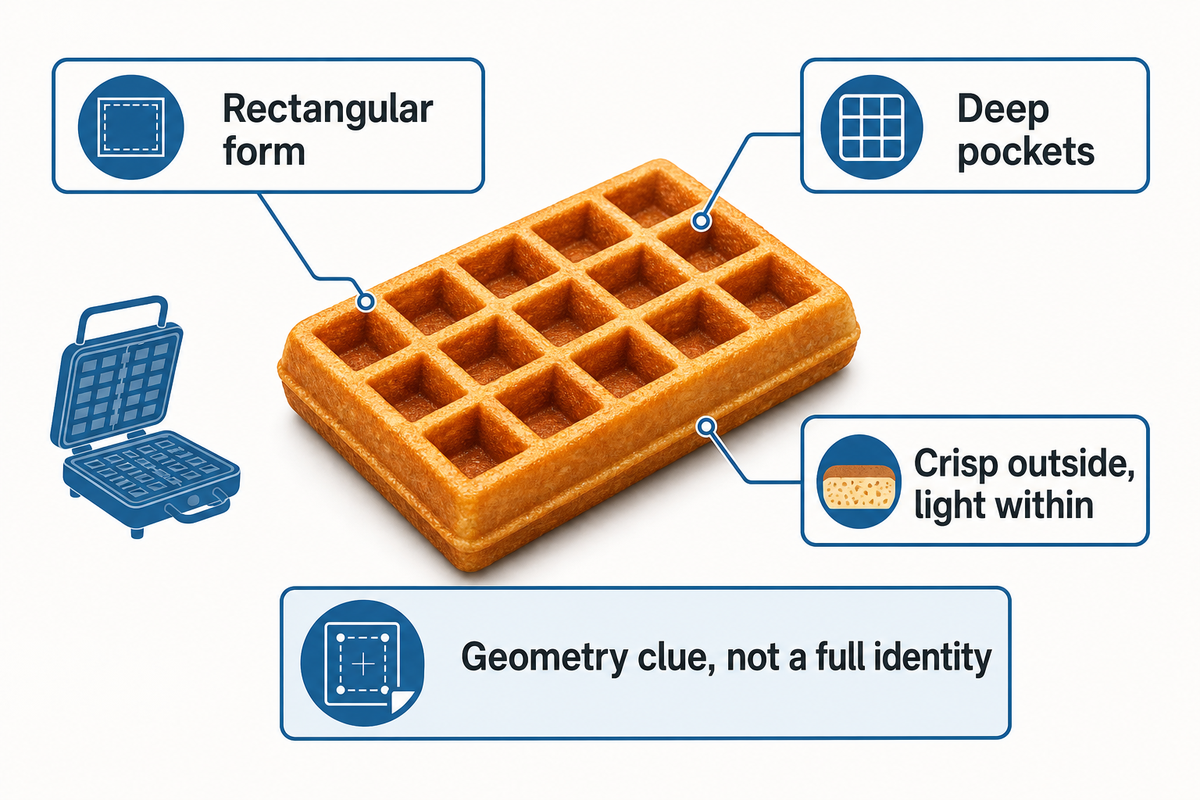
In common descriptions, a Brussels waffle is rectangular, light inside, and crisp outside. In an American comparison, it is often the specific style behind the phrase Belgian waffle, especially where deeper pockets are part of the serving format.
Here, the word that matters most is often. On a menu, a restaurant’s Belgian waffle can be a Brussels-style reference, a house variation, or a deep-pocket product designed around toppings. The shape can convey something visible, but it does not reveal every ingredient or fermentation choice. Therefore, treat “deep pockets” as a geometry clue rather than a full identity explanation.
For a topping-led plate, the terms fluffy, crispy, fruit, maple syrup, or whipped cream assist with the description of the intended eating experience more clearly than the umbrella label. They do not prove a formula, but they help explain why a Brussels-style reference often appears in a breakfast or dessert setting. The same plate format can be used with different formulas or house methods, so a reader should use the menu description as a cue to ask one more question rather than as a universal recipe.
Serving language can be loose. The phrase Belgian waffle maker can describe a deep-groove appliance, but it does not establish a named recipe. With a hot waffle iron, a reader may try an iron to make a thicker waffle, but the resulting geometry is still only one clue. Such a deeper grid pattern can change the serving presentation without answering what makes Belgian waffles different. Menu copy may promise “best waffles,” “the ultimate breakfast,” or “high quality ingredients,” but those are offer descriptions rather than recipe evidence. Readers may eat waffles with strawberry, another berry, fresh fruit, butter and syrup. Descriptors such as crunchy, fluffier, buttery, and richer describe an expected bite or topping plan, not a fixed formula. Some waffles come with toppings while others are served plain. The unaccented phrase Liege waffle may describe a product that is already sweet before other toppings are added, but a particular recipe still controls the result. The style name is a prompt to inspect the recipe rather than an instruction to infer every ingredient.
One food-science study on waffle production examined how formulation and baking conditions influence measured outcomes under its test conditions. Its modest but valuable lesson is that a waffle result comes from more than the shape of the plates. With regard to this comparison, a waffle result isn’t just about the shape of the plates. Formula, processing, release system, temperature, time, and plate conditions belong in the explanation. For a practical companion on this interaction, see the site’s guide on waffle batter texture.
In restaurant or foodservice work, the risk is promising a Brussels-style result from pocket depth alone. Because the cited formulation study evaluates multiple baking variables, a factory or development team should confirm the recipe and plate conditions together before assigning a product label. At a food factory, an in-house trial should follow those conditions; a production line category alone does not settle the result.
Liège Waffles: Form, Sugar Crystals, and a Distinct Style
Liège waffles most clearly break the simple Belgian-versus-regular shortcut. Common descriptions present them as smaller and rounder than Brussels waffles, with sugar crystals that can provide crunch during cooking.
Visit Brussels contrasts the smaller, rounded Liège form with the rectangular Brussels form and points to the sugar crystals as a defining sensory feature. This makes Liège a poor choice for any explanation that defines Belgian as airy squares and syrup-ready pockets. It also means that calling a waffle Belgian does not automatically reveal the specific formula or preparation.
Sugar crystals are a useful style clue, but they do not make one mandatory formula. When a product brief needs more detail, document the actual formula, sugar treatment, portion size, baking settings, and target result rather than assuming interchangeability. The baking-ingredients guide is a suitable option for readers looking for an ingredient-function breakdown rather than style naming.
Whether a bakery, restaurant, or factory team is writing a product brief, the risk is treating sugar crystals as proof of one Liège formula. Because the guide’s description is a style reference rather than a full specification, a development team should document the formula, sugar treatment, and intended bite instead of assuming interchangeability.
What “Regular Waffle” Means in This Comparison
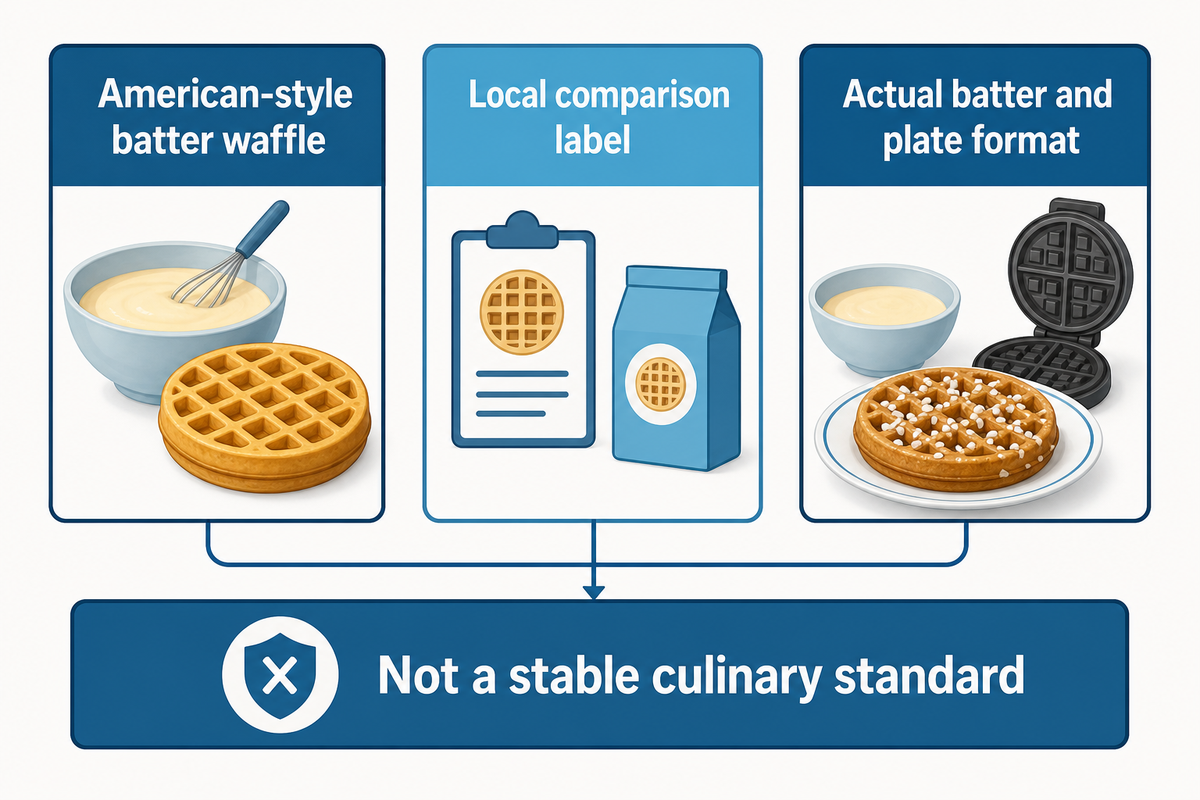
Regular waffle is not a stable culinary standard. In this article, it means the familiar American-style batter waffle used as the comparison baseline: less likely to be sold as a named Brussels or Liège preparation. There can be a great deal of difference between individual recipes and products.
That boundary is necessary because regular can mean “the waffle I make at home,” “the one on a diner menu,” “a thin frozen toaster waffle,” or simply “not the Belgian option” on a menu. Each can use a different batter, grid depth, leavening approach, sweetness level, and serving context. Good comparisons state which sense is in use rather than pretending there is one regular-waffle formula.
As an example, one University of Illinois Extension recipe uses a flour-and-baking-powder batter and also folds in whipped egg whites. Those are recipe choices, not a definition of American waffles or a promise that every home version behaves the same way. For this comparison, the Brussels-versus-Liège distinction is more precise than the word regular; in a U.S. home kitchen, regular may simply be the clearest shorthand for the familiar recipe already in use.
Recipe language often describes a method rather than a stable style. To make Belgian waffles, a cook may start with a light and airy yeast batter. Some recipes use a denser, brioche-like dough with pearl sugar. Belgian waffles are made in more than one way, so waffles made with dough cannot define every Belgian product. Package language can say Belgian waffles use yeast, but that wording still does not establish one universal leavening or sugar rule. Regular waffles use a lighter batter in some kitchens, while others start from pancake batter. Some recipes use baking powder or buttermilk. Others whip the egg whites separately. In those recipes, the whites are folded into the batter. Sugar in the batter, folded-in egg whites, and a dough-based method describe recipe choices rather than a blanket label. The Illinois Extension example is useful because it shows method choices without defining every American-style waffle formula.
For most readers, the useful contrast is simple: choose the regular reference point when you want a familiar, adaptable batter waffle and your recipe or product already defines the result. Choose a named Belgian style when you want the label to carry more information about a particular texture and format. Neither choice is automatically better; they answer different breakfast, dessert, and snack expectations.
For a diner, grocery buyer, or factory product brief, the risk is using regular as if it settled the formula. Because the term describes a local reference point rather than a controlled recipe, compare the ingredient list and serving use before making a product or menu claim.
Why Formula and Iron Conditions Change the Result
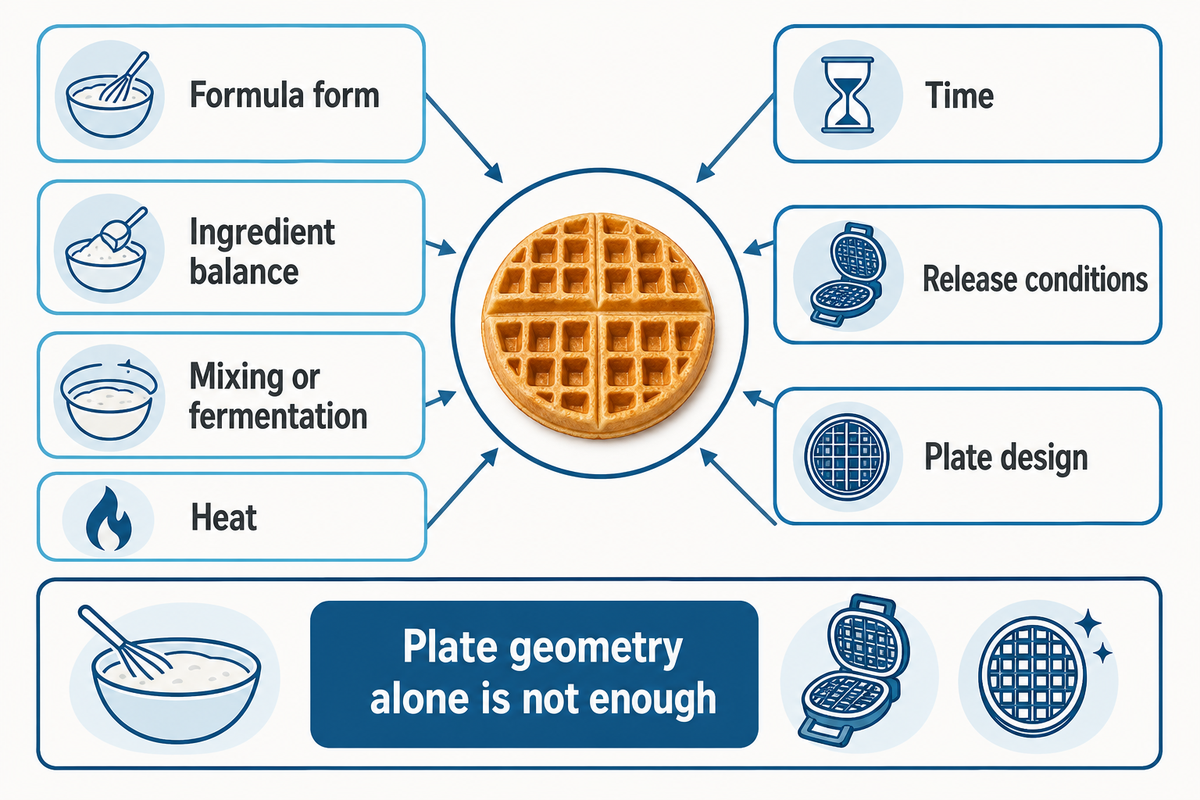
For the article’s reader-oriented taxonomy, a named waffle style can’t be identified by plate geometry alone. Formula form, ingredient balance, fermentation or mixing method, heat, time, release conditions, and plate design can all matter. Deep-pocket irons may support a desired presentation without proving a Brussels or Liège result by themselves.
In a 2017 peer-reviewed study of waffle formulation and baking variables, the researchers measured outcomes under controlled production conditions. It can’t be said to have tested Brussels, Liège, or domestic-waffle-maker performance. Its narrow value here is to show why a formula-and-process explanation is more responsible than treating plate depth as the full answer. It does not justify claims that one domestic device can make every named style, and this guide makes no such claim.
That distinction also keeps the question proportionate. When someone asks about the difference between Belgian waffles and regular waffles, the useful answer is usually about texture target and formula form, not a search for the one correct plate. A finished grid shows only the surface of the larger process. Use the intended outcome to check the formula form, target texture, plate format, and cooking procedure for that recipe.
For a reliable sequence, check the formula form and target texture, examine the plate format, and then adjust the cooking procedure for that recipe. That orders the steps so that most people don’t buy or select a plate before deciding what it should contain. For process teams documenting each controlled change, the separate controlled change trial record provides a structured handoff rather than a consumer cooking claim.
At a food factory, the risk is changing one visible variable and assuming the waffle result will follow. An in-house trial can test the actual recipe; a production line category alone is not a complete process answer.
The 3-Question Waffle Fit Check
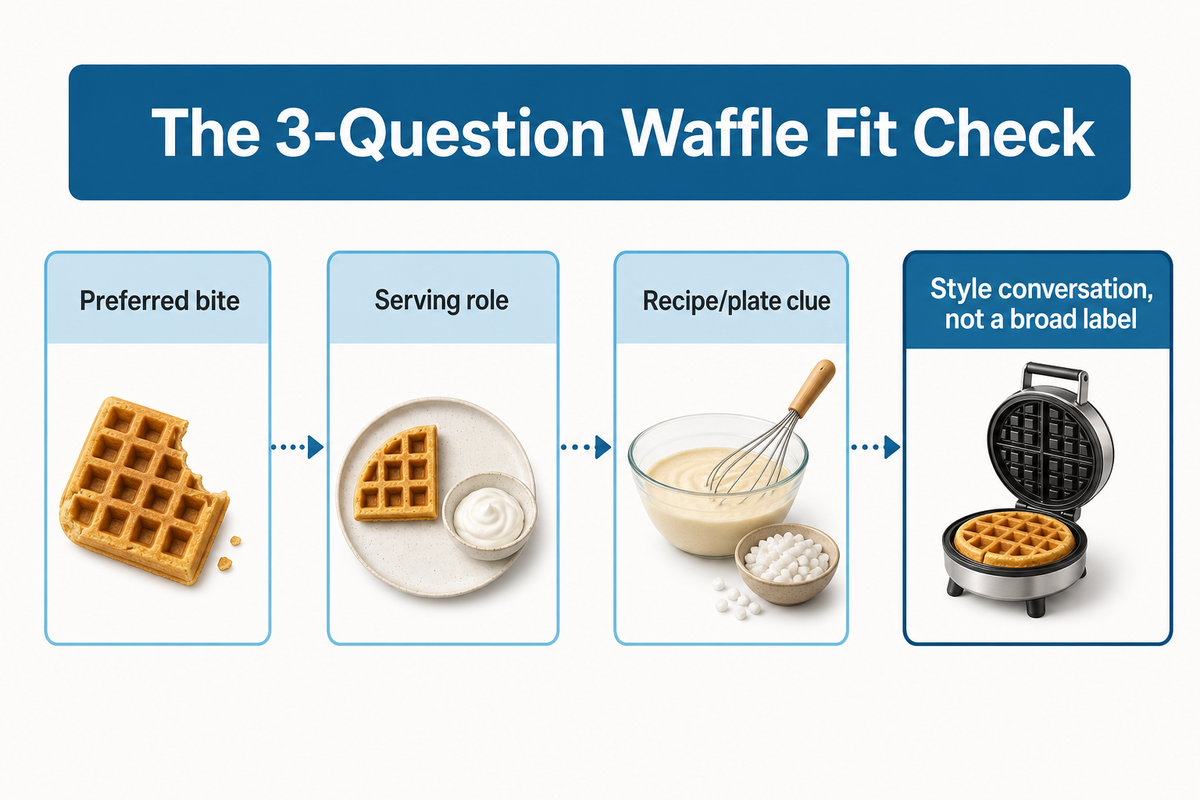
The 3-Question Waffle Fit Check is an editorial shortcut, not a culinary test or product score. Ask what bite you want, what role the waffle must serve, and what recipe-plus-iron format you actually have. The answer gets you to a style conversation rather than a broad label.
Nine decision paths from the 3-Question Waffle Fit Check
Preferred bite
Serving role
Recipe/plate clue
Useful next question
Light center
Breakfast with toppings
Rectangular, deeper grid
Is Brussels-style the intended reference?
Crisp shell
Fruit or cream service
Light interior
Which method creates the planned texture?
Sugar-crystal crunch
Handheld snack
Smaller, rounded form with sugar crystals
Is Liège-style the useful comparison?
Sugar-crystal crunch
Eat with or without toppings
Sugar crystals are visible
How will sugar behave in this formula?
Familiar soft-crisp balance
Everyday breakfast
Known home recipe
Is regular simply the clearest label here?
Thin, quick bite
Toaster or convenience use
Packaged product format
What does the package, not the label, specify?
Unknown
Restaurant order
Menu says Belgian
Does the menu mean Brussels or a house style?
Unknown
Recipe selection
Only iron depth is known
What formula is planned?
Repeatable target
Product-development trial
Several variables may change
What one change will be recorded first?
This framework does not rank styles on health, authenticity, price, or appliance compatibility. It is a way to name the decision before making claims about it. If a commercial team needs to specify texture, presentation, or process constraints for a new project, use the site’s production brief input table rather than treating this reader guide as an equipment brief.
For a restaurant, foodservice operator, or factory team, the risk is turning this editorial fit check into a product score. Because it is a naming aid rather than a test, use it to frame a product-development question, then record the recipe, plate, and intended serving role before an application decision.
Why a Style Check Beats a Blanket Label
As the University of Illinois Extension recipe guidance illustrates, one published waffle recipe can show a preparation choice without defining a universal American-style waffle formula, which is why a style check separates a named reference from the actual ingredients, method, and serving context.
Belgian labeling helps narrow a decision rather than eliminate one. Belgian may represent a Brussels-style context for a U.S. reader. Brussels and Liège are still distinct, named references. Regular can identify a familiar baseline, but only after the recipe or product format is stated.
It’s a better solution than forcing an artificial winner. Brussels may suit a topping-led breakfast. Liège may suit a smaller, rounded waffle with sugar-crystal crunch. A regular American-style waffle may suit the recipe, grid, and morning routine already in place. The actual, meaningful comparison is fit, not a claim that one name is better than the other.
Search phrasing creates one more reader question. The query “Belgian waffle vs regular waffles” compresses a comparison that needs three style references. Questions such as “what makes Belgian waffles different” and “how Belgian waffles differ from regular waffles” can be answered without turning the labels into rigid formulas. “Kinds of waffles” is a taxonomy question, not a product guarantee. In Belgium, Brussels and Liège are distinct named references, and an unaccented Liege waffle label still needs its actual recipe context. Historical language may use popularize or nationwide when describing a food’s reach, but those words need their own source. Tips and tricks can help a cook follow a recipe and make Belgian waffles, yet they do not supply a culinary standard. Every comparison should separate style, formula, iron, and serving plan. Readers get a clearer answer when they ask what a label means in the specific menu, package, or recipe at hand. The result stays useful without pretending that one broad label resolves every question.
Recipe wording can make the comparison sound more fixed than it is. A deep grid, a light interior, or visible sugar crystals can be useful clues, but no single clue names every recipe. When precision matters, name the intended Brussels- or Liège-style reference and verify the formula and serving context.
A useful communication advantage exists. A writer could specify ‘in the Brussels style’ when a light, rectangular waffle is desired, and a vendor could specify ‘in the Liège style’ when a smaller, rounded waffle with sugar crystals is desired. A menu specifying ‘our house waffle’ is signaling its offering. In each case, a concrete reference gives the reader something to verify. On the other hand, an unadorned ‘Belgian’ label could cause the consumer to consider formula, pocket depth, toppings, or sweetness. The style check list provides one more question to address and alleviates many situational misunderstandings.
For a restaurant menu, a foodservice buyer, or a factory brief, the risk is that a blanket label obscures the actual recipe choice. Because Brussels and Liège name different references, the next step is to verify the formula and serving purpose, not to infer a universal result.
Continue with the Waffle-Style Map
Use this article when the question is specifically Belgian versus regular. If the question then becomes “Which style am I actually looking at?”, then please see our complete waffle-style map. That page is the site’s broader taxonomy handoff; it complements this comparison rather than serving as independent evidence for a culinary claim.
For a restaurant, foodservice buyer, or factory team, the risk is using a taxonomy link as if it were proof of a formula. Because the internal map is a navigation handoff rather than independent culinary evidence, use it to identify the next style question and return to the relevant recipe or product documentation.
Frequently Asked Questions
What is the main difference between Belgian and regular waffles?
Read the answer
The main difference is that Belgian is often a broad U.S. label, while regular is an informal comparison label. A clearer comparison separates Brussels-style waffles, usually associated with a lighter rectangular format, from Liège-style waffles, usually associated with a smaller, rounded format with sugar crystals. In this guide, regular means a familiar American-style batter waffle, but recipes and products vary. Check the named style, formula form, and desired texture before assuming that either label names one exact product. That approach works better than trying to rank the types of waffles from a name alone, because the menu wording, plate pattern, ingredients, and serving role can each answer a different question.
Are Belgian waffles always Brussels waffles?
Read the answer
No. A historical museum account says the U.S. term usually refers to the Brussels waffle, which helps explain a common shorthand. It doesn’t make the label universal. Belgian-local references distinguish Brussels and Liège as different styles, and menus or recipes may use Belgian more loosely. If the difference matters, ask which named style, formula, and presentation the speaker intends rather than relying on the umbrella label alone.
Can a deep waffle iron make a Liège waffle?
Read the answer
Iron geometry is only one part of the result. A deep grid can change the visible pocket pattern, but it doesn’t independently establish a Liège-style or Brussels-style waffle. Formula form, mixing or fermentation, sugar treatment, heat, time, and release conditions matter too. Use the actual recipe and maker instructions, and avoid treating this comparison as a compatibility guarantee for any particular household appliance.
Are Liège waffles sweeter than regular waffles?
Read the answer
Liège waffles can include sugar crystals, but a style label alone does not establish how sweet a particular product will taste. Recipe size, sugar quantity, toppings, and serving context can change the experience. Use the style description to understand the expected direction, then read the actual recipe or product label for the specific item. A sweeter impression isn’t a nutrition ranking, and it shouldn’t be used to infer calories, portion size, or suitability for a particular dietary need without the specific product information. Compare the product in front of you rather than applying a style description as if it were a label panel.
A comparison works when its labels do real work
Name Brussels, Liège, or the specific American-style baseline before you compare. That one step prevents an iron shape, a restaurant label, or a sugar cue from pretending to be a complete recipe definition.
References & Sources
Additional technical process source: companion peer-reviewed waffle-production study. It is included for process context, not as a consumer-style definition or an equipment-performance claim.
UDTECH has been manufacturing food machinery since 2003. This is where we write down what we learn from product samples, trial runs and commissioning—the batter, the bake and the texture, rather than the sales sheet.
These guides help production managers, buyers and food entrepreneurs work through batter faults, sample runs, output targets and factory acceptance. When a question turns into an equipment question, the same enquiry form reaches our engineers.
OUR EXPERIENCE
Food machinery manufacturing since 2003, with practical experience from product samples, trial runs and commissioning across egg roll, wafer, waffle, biscuit and snack production.
OUR EXPERTISE
We work from real recipe and output conditions, covering process, product and machine specification questions. Technical enquiries are passed to the engineer responsible for that equipment.