Technical Review by the UD Machine Solution Technology Co., Ltd. technical team | Updated September 2026
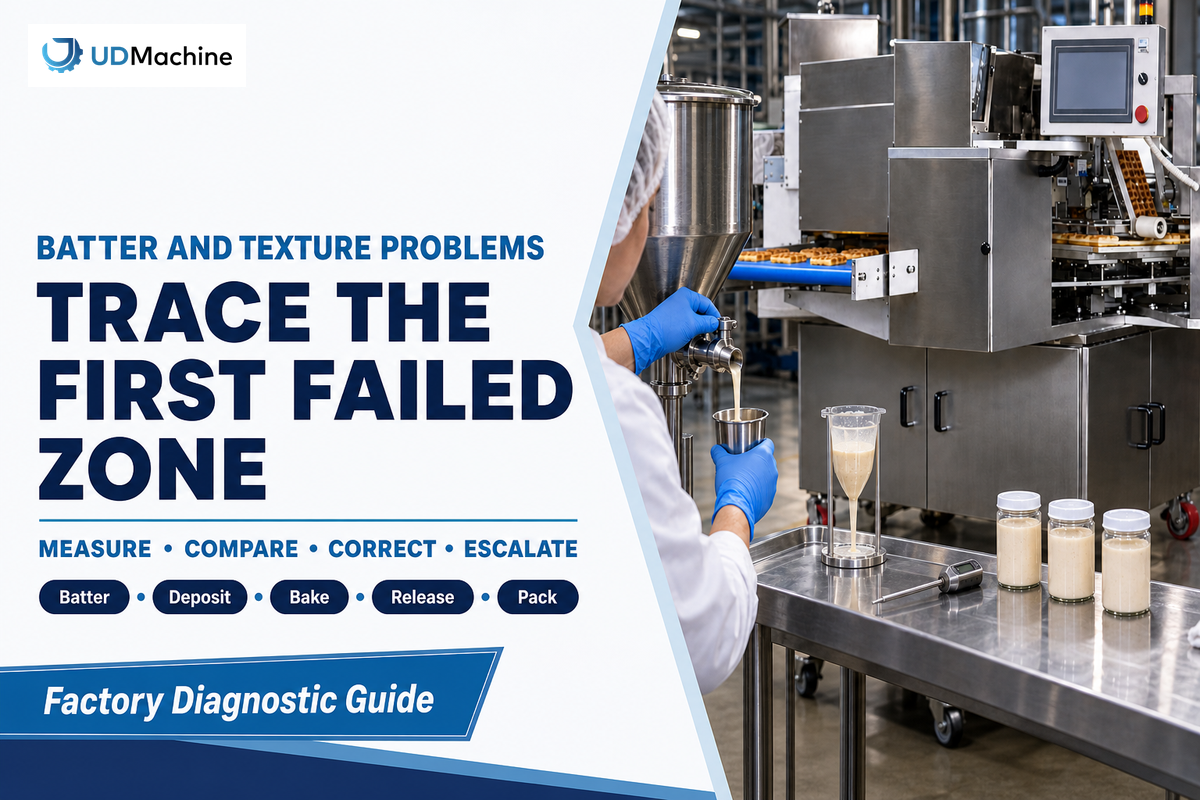
Batter and Texture Problems are production symptoms rather than root-cause labels. A dense center, incomplete grid, torn surface, or soft packed waffle may begin with ingredient condition, mixing, holding, dosing, heat transfer, release, cooling, or the package. The useful question is not “Which setting should we turn?” It is “Where did this run first stop matching an accepted run?”
No fixed rule of thumb defines a universal viscosity, baking temperature, or water-activity limit for every line. Each of these will be specific to the product, the formulation, the equipment, the method, the food safety plan and the criterion accepted on the line.
Short answer
Define the defect, compare the failed run with the last stable run, and move through the 6-Zone Batter-to-Texture Interaction Map in order: ingredients, mixing and hold, batter measurement, deposit, bake and release, then cooling and packing. Freeze unrelated settings. Escalate to hardware only when the same fault repeats under controlled conditions.
Waffle Texture Defects: Start at the First Failed Zone
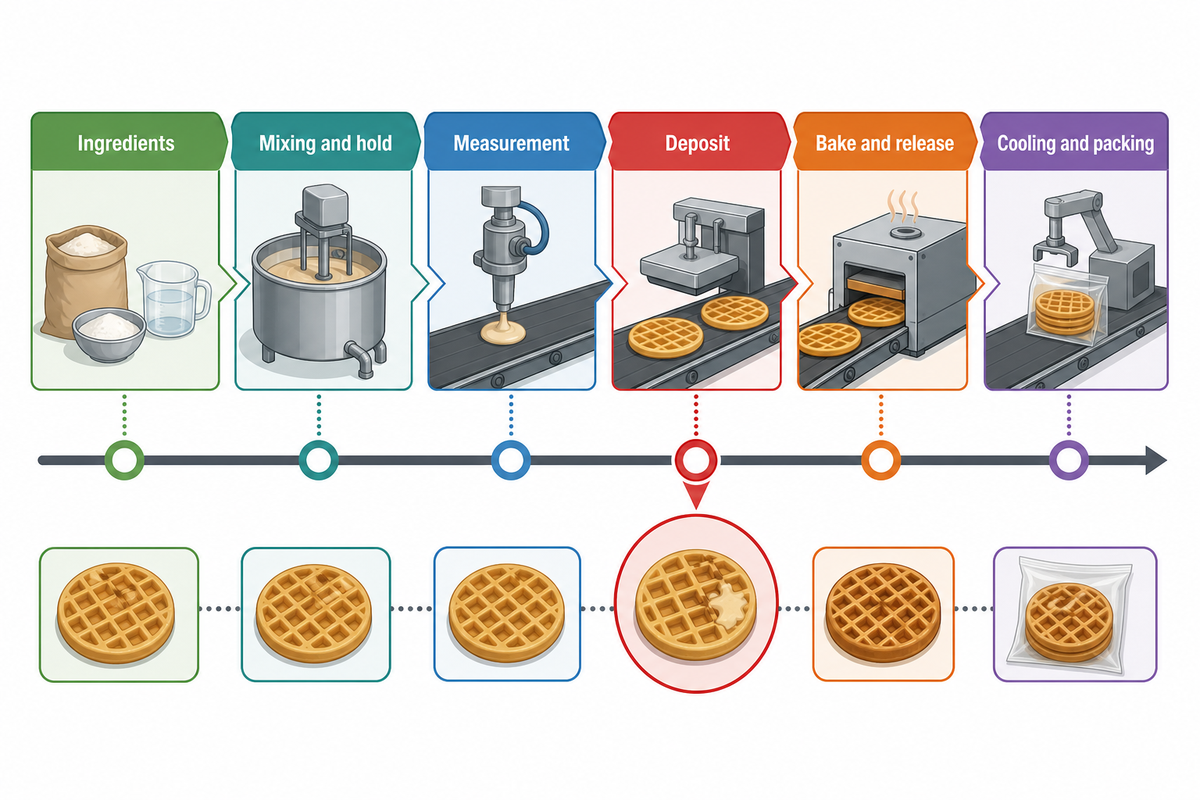
One finished symptom can be the result of many different upstream events. The First-Failure-to-Last-Stable Trace finds the earliest zone with changed evidence, then holds later settings still while the team tests one plausible cause.
- Define the defect – name its location, frequency, severity, and first observed time.
- Find the last stable batch – retain its recipe, lots, records, and a product sample where possible.
- Compare six zones – ingredients; mixing and hold; measurement; deposit; bake and release; cooling and packing.
- Stop at the first change – mark the earliest value or observation outside the plant’s accepted window.
- Freeze later variables – keep unrelated downstream settings fixed for the next trial.
- Run one controlled check – repeat enough cycles to show whether the effect is stable by time and position.
Use the defect triage router when ownership is unclear. “dense” still requires a cut section, line position, sample count, and a comparison batch; the word can’t segregate aeration, deposit mass, or bake completion.
Evidence capsule: In one controlled waffle study, 30 waffles per recipe were produced under a fixed 15 mL deposit and 110 s bake protocol. Formula-related removal failures still differed. The same method used 800 rpm, 1 min and 3-4 min mixing stages, and fat prewarmed to 40 °C for 1-2 min; these values describe that study, not a production target. This provides rationale for controlled comparison, not the use of these settings for another product. Please review the study method.
What Consistency Should Waffle Batter Be?
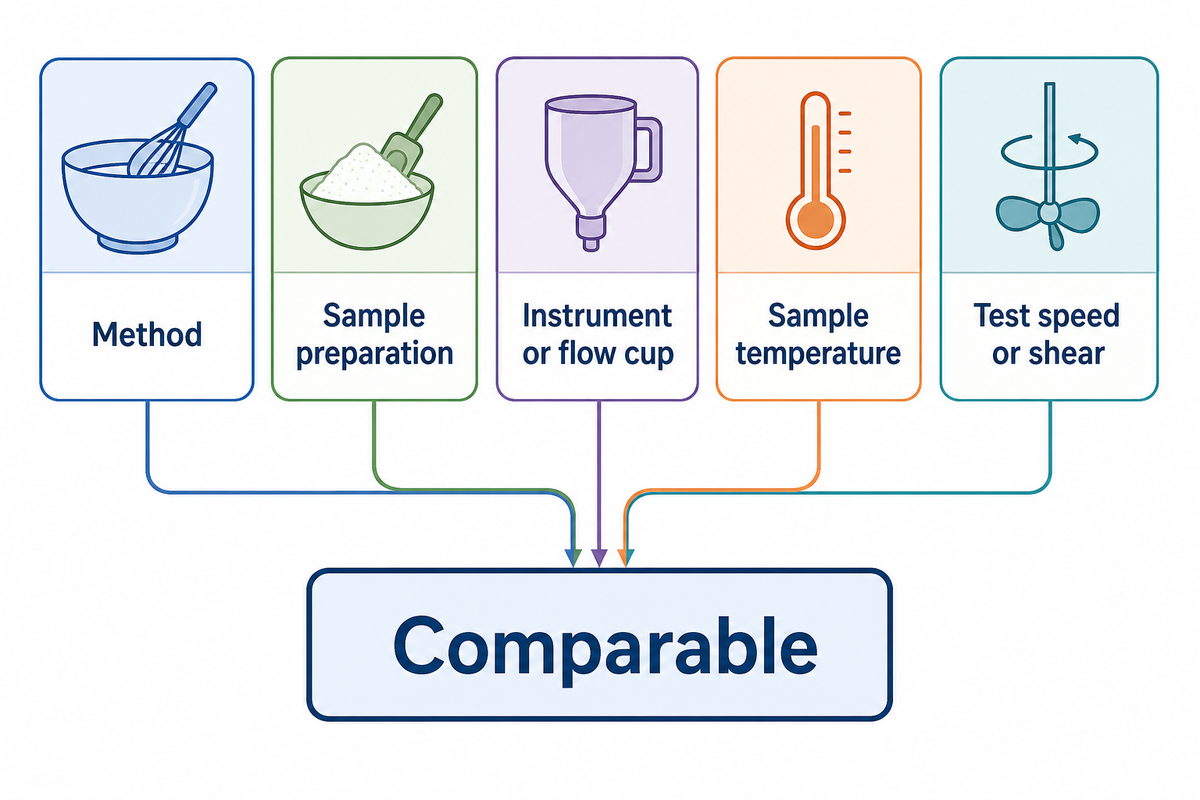
A universally consistent “thick” or “thin” target must have a product and a test. A consistency number becomes useful only when the method, sample preparation, instrument or flow cup, sample temperature, and test speed or shear condition are the same. Unless these factors are held constant, two readings could describe different tests. Keep those conditions together in the batter measurement record.
“The test in the laboratory should use a shear rate which is as close as possible.” University of Massachusetts, Food Rheology
Prior to the deposit of batter, adjacent wafer research supports recording minutes after mixing because holding can affect the flow behavior. Record revised formula, lots, sample °C, method, geometry, test duration, density, deposit g collected and the final result. The batter measurement record maintains all of the above mentioned conditions.
Do
- Condition samples to one stated temperature.
- Test at one stated elapsed time.
- Record density and deposit mass with viscosity.
- Compare against an accepted product run.
Don’t
- Copy a supplier number without its method.
- Compare different instruments as equivalent.
- Adjust water from visual flow alone.
- Treat one reading as the finished texture.
Evidence capsule: University rheology guidelines clearly state that apparent viscosity is shear rate dependent and requires a defined preparation, device, speed, time, and temperature. An unlabeled result isn’t a transferable specification, even with three decimal places.
Mixing, Lumps, Aeration, and Holding Drift
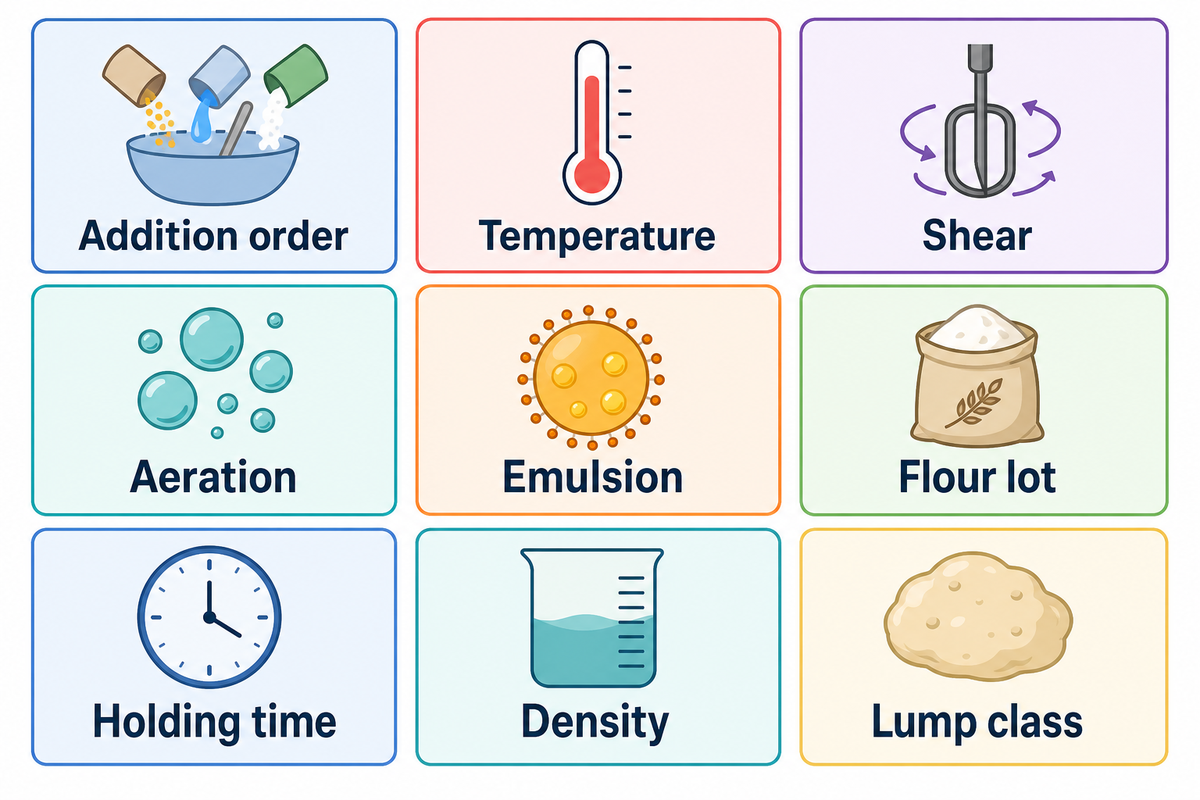
Smoothness doesn’t prove stability. Addition order, temperature, shear, aeration, emulsion, lot, and functionality of flour, as well as holding time, can affect the feed and the set. Density, lump class, separation, foam, and time drift reveal what apparent viscosity misses.
Log mixer, rpm, mixing min, time to first deposit, batter °C, density in g/mL, and flour lot. Photograph a fixed-volume sample consistently. The batter observation record keeps visual notes apart from measurements.
| Defect type | First comparison | Do not conclude yet |
|---|---|---|
| Dry flour pockets | Addition order and wetting time, min | Mixer power is insufficient |
| Fine persistent lumps | Sieve class and ingredient temperature, °C | More mixing is always corrective |
| Foamy top layer | Density, g/mL, at 0 and 15 min | The batter is simply too thin |
| Separation during hold | Hold time and sample-depth comparison | The depositor is at fault |
| Elastic or stringy flow | Mixer speed, rpm, and duration, min | One viscosity number explains it |
| Dense finished center | Density plus deposit mass, g | Overmixing is proven |
| Run-to-run drift | Flour lot, liquid lot, and room conditions | The recipe revision changed |
| Flow changes after pause | Reading at 0, 15, and 30 min | A higher pump command is sufficient |
| Curdled appearance | Fat and liquid temperatures, °C | The batch is safe or unsafe from appearance |
Adjacent wafer and cake-batter research links holding, flour properties, and air volume with rheology. These aren’t waffle limits; they illustrate how viscosity can miss aeration or lot changes. Please see ingredient function in industrial baking.
The 9-Cell Deposit Map: Mass, Spread, and Fill Geometry
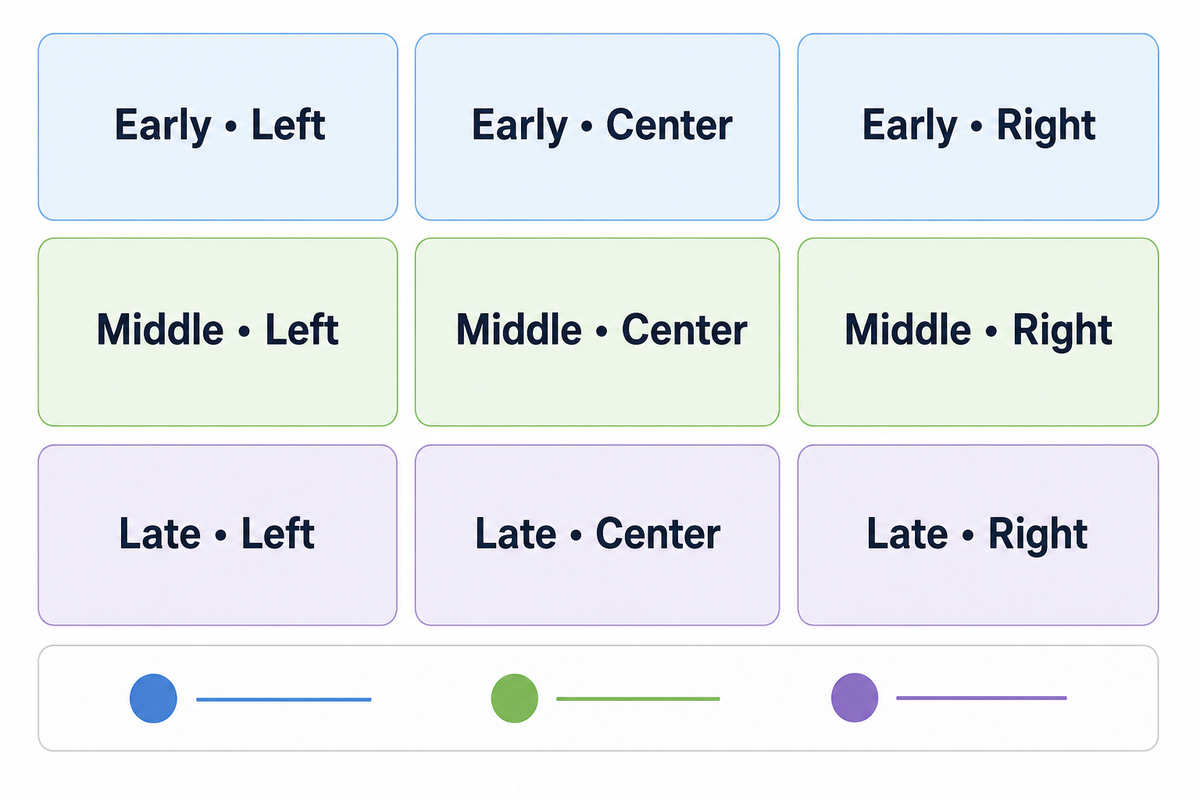
Against that mixing-and-holding evidence, incomplete grids may appear to be a consistency fault when mass, timing, plate level, or cavity geometry changes. That separates mixing and holding evidence from position-dependent delivery evidence. Separate command from outcome: collect deposits by position when safe, then compare mass, spread, and finished weight without changing formula.
Sample left, center, and right positions during early, middle, and late cycles. Record command, collected g, spread mm, pieces/min, and finished weight. The 9-Cell Deposit Map exposes patterns hidden by a run average. A hypothetical row such as 25.0 °C, 1.030 g/mL, 52.0 g, 118 mm, 110 s, and 50 pieces/min identifies one trial only; none of those values is a transferable target.
Position-following differences point toward delivery, alignment, or geometry; time-growing differences point toward batter condition. Uniform mass with poor spread shifts attention to rheology, surface condition, or closing behavior. Patent ranges remain formulation- and method-specific.
Evidence capsule: Waffle patent WO2009149947A1 describes 35-50 wt% flour, 40-65 wt% water, a 25 °C flow-cup condition, and 140-180 °C baking for its claimed system. Those numbers suggest method labeling. They don’t define another factory’s deposit, recipe, or plate window. Read the patent scope.
Flat, Undercooked, or Uneven Waffles: Check the Bake Record
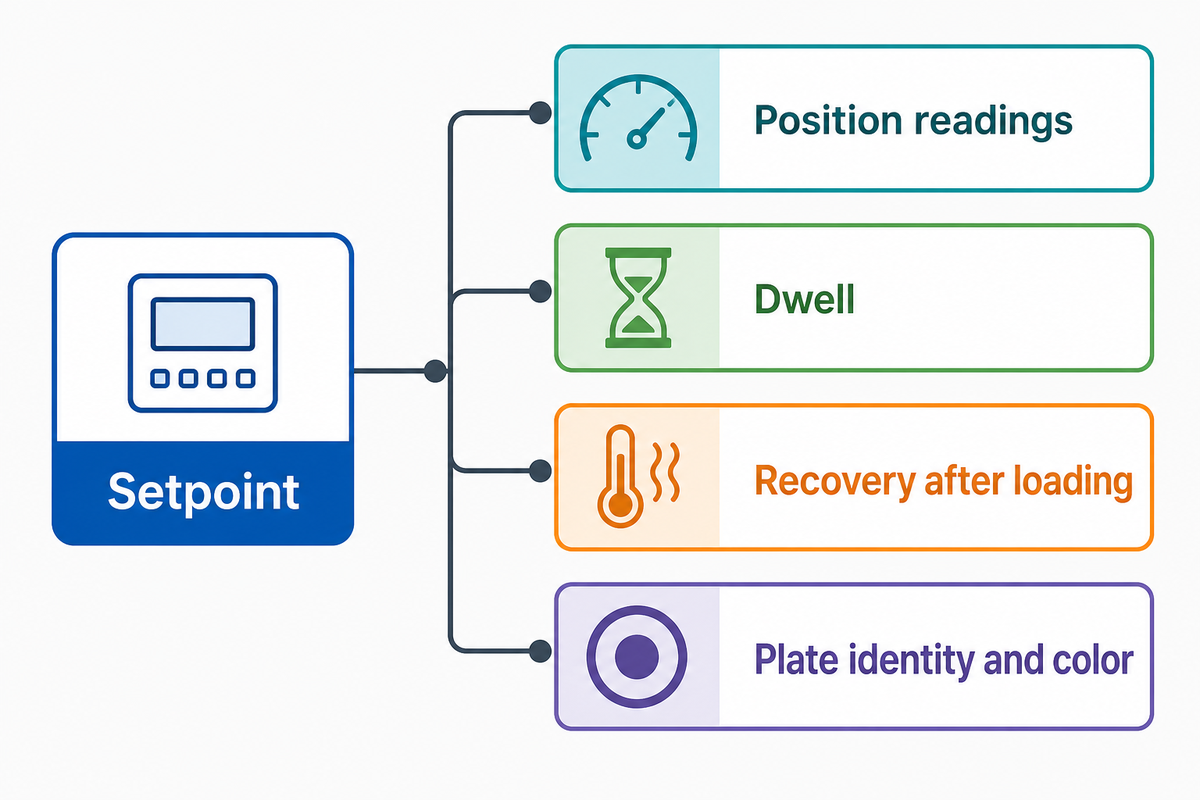
The controller display is a command, not proof of product heat exposure. Pair setpoint with independent position readings, dwell, recovery after loading, line rate, plate identity, color, and the validated product endpoint. Match the deposit-map positions.
Compare plate °C at startup and steady production, dwell s, recovery s, and pieces/min. A cold-position defect with stable deposits points toward sensor, heater, contact, contamination, or plate checks. A whole-line shift after a rate change would indicate a thermal-load test is required.
Keep texture work within the plant’s food safety control system. An FDA bakery warning letter shows why a claimed kill step needs written product-specific controls, monitoring, corrective actions, and verification. This article supplies no lethality settings.
More browning should not be seen as a free correction. FDA guidance notes acrylamide can form during some high-temperature cooking and sets no universal action level. Balance texture, color, moisture, safety, and process contaminants with baking texture, browning, and moisture control.
Why Waffles Lose Crispness After Baking
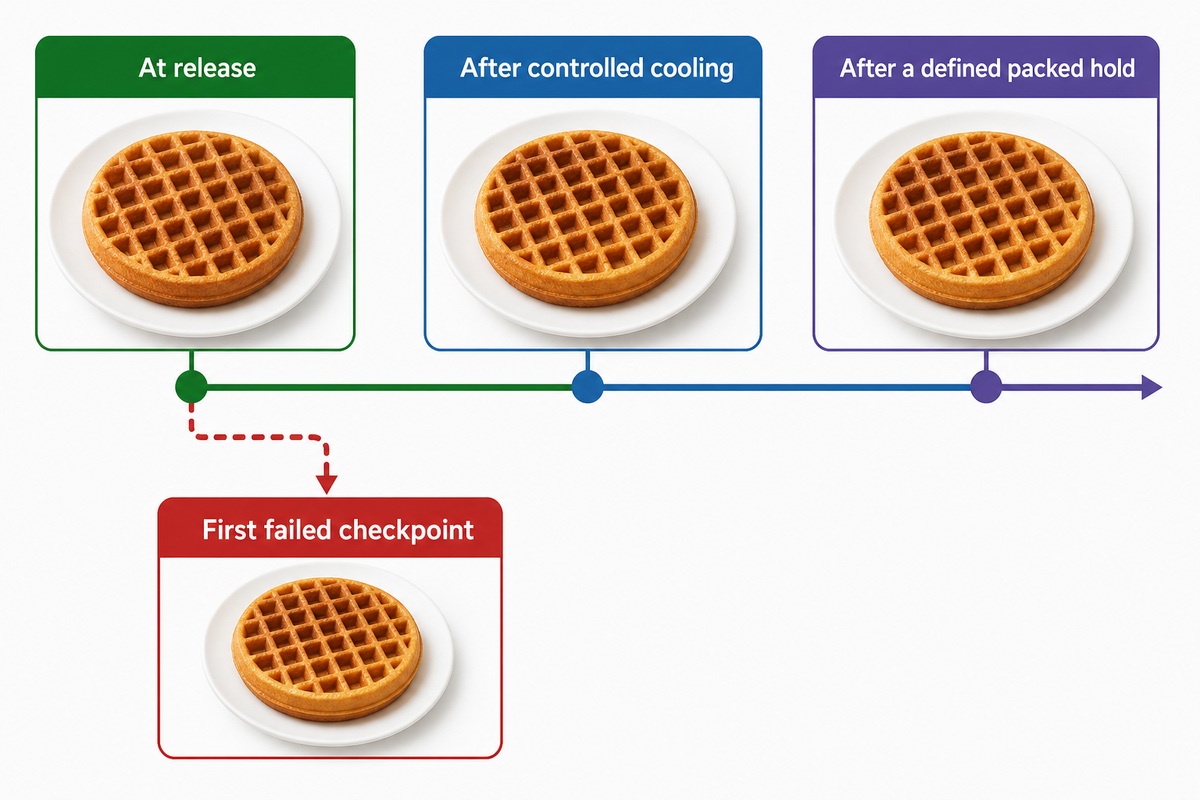
Crispness is a time-and-place phenomenon. With the plate and bake record established, the same lot can now be followed through cooling and packing. The Release-to-Pack Crispness Check samples one lot at release, after controlled cooling, and after a defined packed hold. The first failed checkpoint sends the next test to bake, cooling, or packaging.
3 stagesrelease, cooled, packed hold
25 °Cstorage condition in an adjacent snack study
20 daysstudy duration, not a waffle shelf-life claim
Record elapsed min, product °C, room conditions, relative humidity %, pack time, package, seal check, and one texture method. Release-to-cooling loss suggests exposure or redistribution; post-pack loss suggests product temperature, hold, seal, or barrier.
Average moisture or water activity may miss distribution and history. Excess drying may trade softness for fragility. Use the crispness risk checklist without referencing another product’s target.
Evidence capsule: In an adjacent low-moisture snack study at 25 °C and 50% relative humidity, moisture, water activity, and hardness changed during 20 days of storage. The direction supports staged observation, while the exact numbers remain product-, film-, and test-specific. They aren’t a waffle shelf-life specification.
Waffle Sticking and Tearing: Test Release Without Guesswork
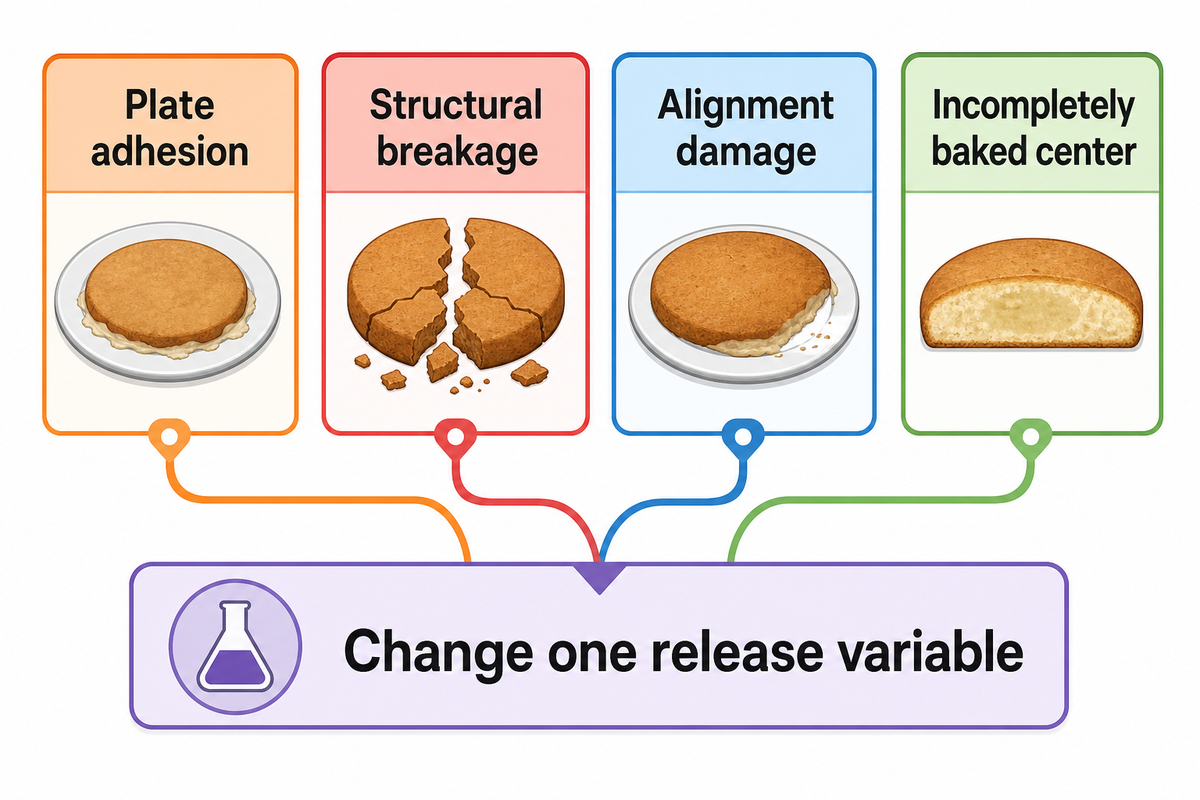
“Sticking” requires a failure description. After bake, cooling, and packaging are separated, release damage needs its own location record. Plate adhesion, structural breakage, alignment damage, and an incompletely baked center differ. Indicate the cavity, illustrate the tear, define residue, and compare removal to one definitive standard.
Freeze the formula, lots, deposit, measured heat, dwell, and rate. Verify the cleaning and surface condition, change one release variable, then repeat by cycle and position. Formula-related faults fall to the process; one-position faults support the case for maintenance.
One study reported 46.7% failed removals for a rice-flour formula and below 7% for potato-starch formulations. In that study, the failure of most of the rice was due to crumbly breakage. The companion study didn’t find a correlation between viscosity and sticking on the tested system.
Evidence capsule: The two 2016 waffle studies used 15 mL deposits, 110 s baking, a 140 °C bottom plate, a 145 °C top plate, plate stability within ±5 °C, and 30 waffles per recipe. Their counterintuitive result is diagnostic: thicker batter or longer bake times can’t be assumed to solve all release failures. See the companion study.
What to Record Before Changing Formula or Equipment
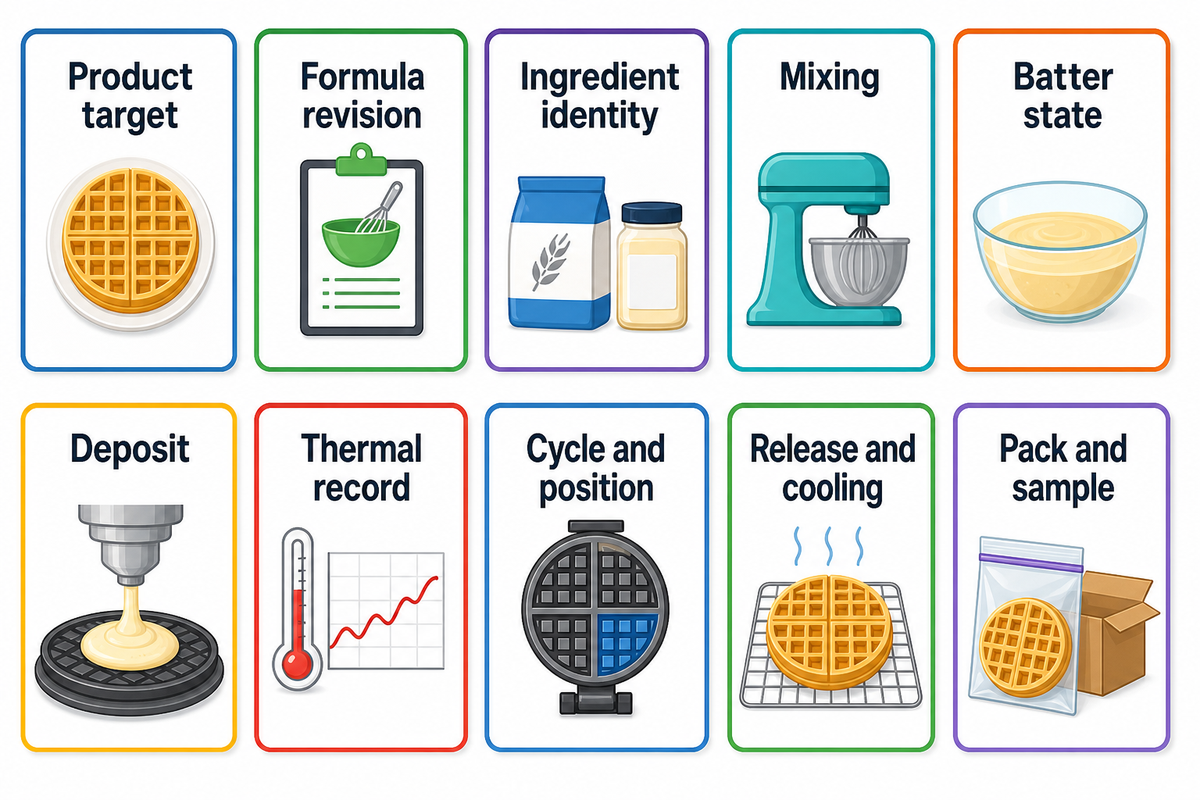
“The waffles became rubbery” along with two photos is hardly a run. A fault packet captures what changed and ranks the failed run against the last good run. It also keeps one photograph from standing in for measured process evidence.
| Control point | Minimum record | Comparison unit |
|---|---|---|
| 1. Product target | Style, dimensions, texture, approved sample | mm, g, named method |
| 2. Formula revision | Recipe version and batch | kg or wt% |
| 3. Ingredient identity | Flour, egg, liquid, fat, and minor lots | lot code, °C |
| 4. Mixing | Order, mixer, speed, duration | rpm, min |
| 5. Batter state | Method, reading, temperature, density, hold | method unit, °C, g/mL, min |
| 6. Deposit | Command, collected mass, spread by position | g, mm |
| 7. Thermal record | Setpoint, actual plate readings, recovery | °C, s |
| 8. Cycle and position | Dwell, rate, plate/cavity map | s, pieces/min |
| 9. Release and cooling | Tear class, release time, cooling exposure | s, min, % RH |
| 10. Pack and sample | Pack time, material, seal, sample count | min, n |
Attach a retained sample or controlled photos to define pass/fail. Confirm waffle styles and product targets. This UDTECH decision aid leaves every limit to the buyer’s accepted specification. For broader context, see the commercial waffle and pancake production guides.
Process Correction, Maintenance, or Machine Capability?
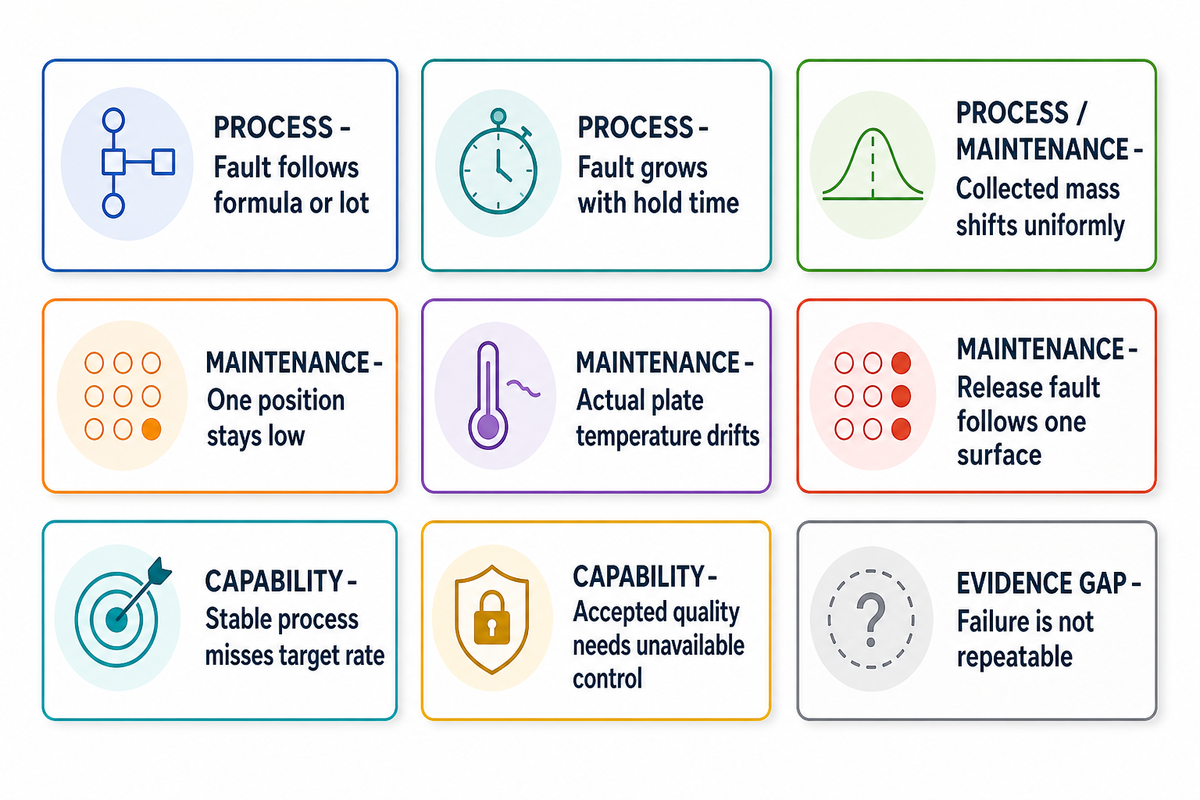
Evidence must lead to a defensible action. Once the fault packet is complete, its pattern determines which owner should act. The Process-or-Machine Escalation Matrix directs evidence to either process correction, restoration of intended machine state, or capability against product requirements and the desired rate.
| Evidence pattern | Primary path | Next proof | Stop condition |
|---|---|---|---|
| Fault follows formula or lot | Process | Controlled recipe/lot comparison | Do not replace hardware yet |
| Fault grows with hold time | Process | 0, 15, 30 min readings | Do not tune heat first |
| Collected mass shifts uniformly | Process/maintenance | Feed level, pressure, timing | Separate batter from dosing |
| One position stays low | Maintenance | Nozzle, alignment, valve check | Restore intended condition |
| Actual plate temperature drifts | Maintenance | Sensor/heater response by position | Recheck after repair |
| Release fault follows one surface | Maintenance | Cleaning and condition trial | Freeze formula and bake |
| Stable process misses target rate | Capability | Witnessed run at pieces/min | Use released-good output |
| Accepted quality needs unavailable control | Capability | Written control and acceptance test | Compare under identical product scope |
| Failure is not repeatable | Evidence gap | Increase sample and record coverage | No capital decision |
Prior to asking a supplier to perform a trial, use the trial escalation checker. State the product style, formula revision, measurement method, deposit mass, thermal record, cycle rate, defect position, required sample count, and acceptance result. This serves as one test control for the equipment buyer, quality manager, and plant manager.
Key takeaway
Escalate batter and texture problems to machine capability only after repeatable trials hold formula and process variables stable, maintenance confirms intended condition, and the buyer supplies a measurable acceptance criterion.
Bring UDTECH a comparable fault packet
Share your product target, formula revision, batter method, deposit map, position-resolved thermal record, cycle rate, defect evidence, and proposed acceptance test. UDTECH can then discuss a controlled production trial without guessing from the symptom alone.
What Rising Texture Queries Mean for Factory Troubleshooting
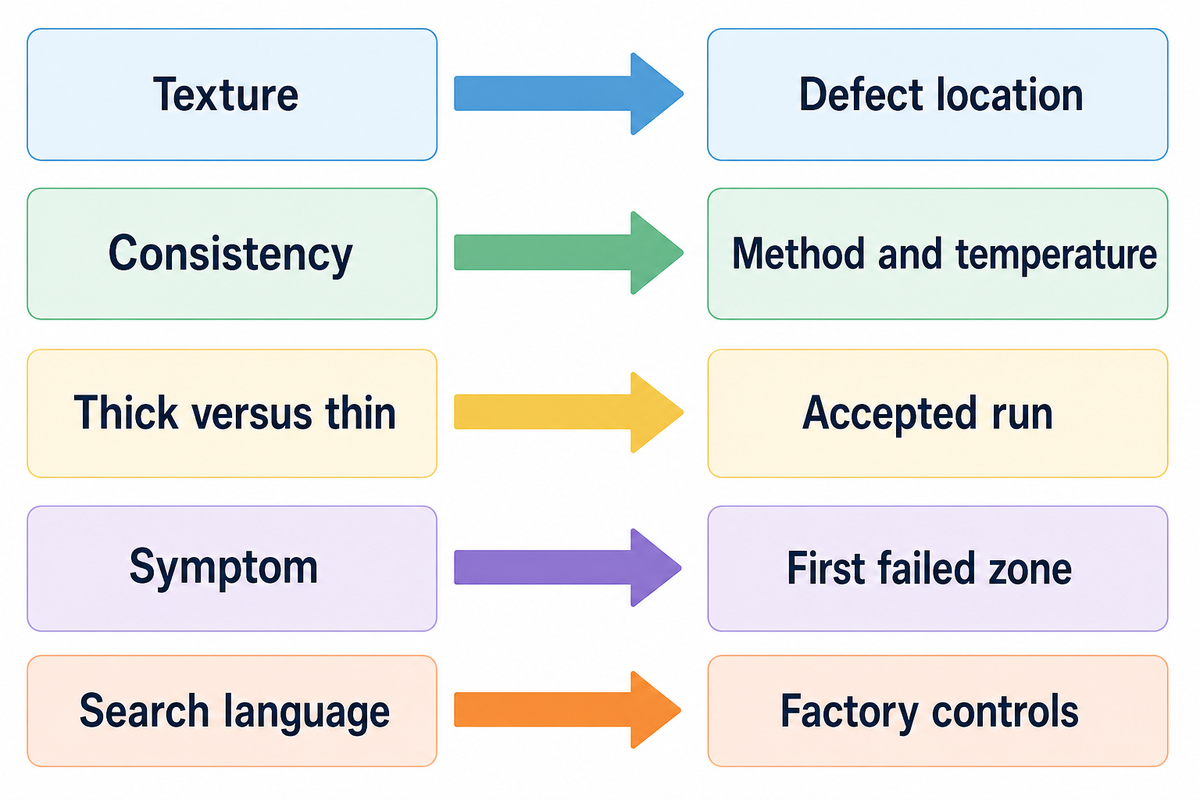
Search language refers to outward symptoms as texture, consistency, and thick-versus-thin. That same test boundary helps translate broad search language into measurable factory checks. This suggests no market cause, but it does describe terminology that industrial content should transform into quantifiable factory controls.
Consumer results may tell a home baker to cream butter and sugar, add cold eggs or milk, check oven temp with a toothpick, or judge cake batter by taste. That advice concerns baking a cake or cookies in a pan, not an industrial batter circuit. Don’t implement these changes on the waffle line until the formula and controlled trials offer evidence in support of a change.
Related consumer concerns include the reason for “cake batter curdled,” the solution to “prevent your cake batter from breaking,” and whether a lumpy or chunky mixture will come back together. They discuss room temperature or room-temperature ingredients, cold milk, how to properly combine or incorporate flour, or if flour should be added a tablespoon at a time. These are used in a search context and not in relation to a production line.
Others ask about the texture of the cake, a moist crumb, a bubble or chunk, how much flour to use, an accurate oven degree reading, or a tip to reduce crumble. Such questions would aid the factory in recognizing the symptom a buyer is referring to. It wouldn’t identify the broken process or supply a remedy that’s transferable.
| Query group | Saved change | Factory content response |
|---|---|---|
| Waffle texture | +29.8% | Define defect location and first failed zone |
| Pancake batter texture | +60.8% | Separate formula, mixing, hold, and deposit evidence |
| Batter consistency | +67.9% | Require method, temperature, elapsed time, and density |
| Thick/thin language | +51.4% | Reject universal targets and compare an accepted run |
The stored search comparison provides these numbers. They aren’t sales forecasts or causal data. Answer the visible question, then replace the recipe shortcut with a measurement path.
Frequently Asked Questions
These answers convert the typical queries of batter and texture to the next required factory inspection. None of the answers provides a universal recipe adjustment or machine setting. If a fault affects food safety, release status, or a contractual specification, use the plant’s approved procedure and qualified authority before resuming production.
What consistency should a batter be?
There is no universal thick-or-thin target without a named product, method, sample temperature, and elapsed time after mixing. Record those, and then compare the result with the density, deposit mass, spread, and finished texture from an accepted batch. If the method, instrument, or sample condition is changed, consider the readings different tests rather than equivalent.
What does overmixed batter look like?
Observable signs of overmixing can include excess aeration, altered density, smoother but less stable flow, unusual elasticity, or a dense and rubbery finished texture. None of these prove overmixing by itself. Compare all parameters with an accepted batch before changing the formula or replacing the mixer. This batch should include mixing speed, mixing time, hold time, ingredient temperature, flour lot, density, and deposit result.
Why are my waffles not crispy?
First, determine when crispness is lost. Test the same lot at release, after a controlled cooling interval, and after a defined packed hold. The presence of softness at release focuses attention on batter, deposit, bake completion, or plate conditions. Loss of crispness in cooled and packed lots directs attention to cooling exposure, product temperature at packing, hold time, seal integrity, and the package barrier.
Is pancake mix the same as waffle mix for a waffle maker?
Not necessarily. Test the candidate mix against the line’s accepted product record. While the formulation and the desired texture may differ, a given factory should validate flow, deposit, bake, release, and packed texture, versus assuming equivalence as a result of a product name.
Why do waffles stick to the plate?
Sticking can reflect plate adhesion, structural breakage, incomplete baking, cleaning condition, formula, deposit, alignment, or surface wear. Identify the location and nature of the break to document the position and tear pattern. Freeze the conditions of the bake and the formula. Verify cleaning. Then change a single release variable. Purchasing a coating or plate should only be justified after demonstrating that periodic maintenance and process control were done. Compare results by cavity position, actual thermal reading, and controlled cycle time.
When should a factory ask the equipment supplier for a trial?
Ask when the defect repeats under controlled formula, measurement, deposit, bake, cooling, and maintenance conditions, and the team can state a measurable product and rate acceptance criterion. The fault packet identifies the first failed zone and the conditions held unchanged.
Turn a Texture Complaint Into Comparable Evidence
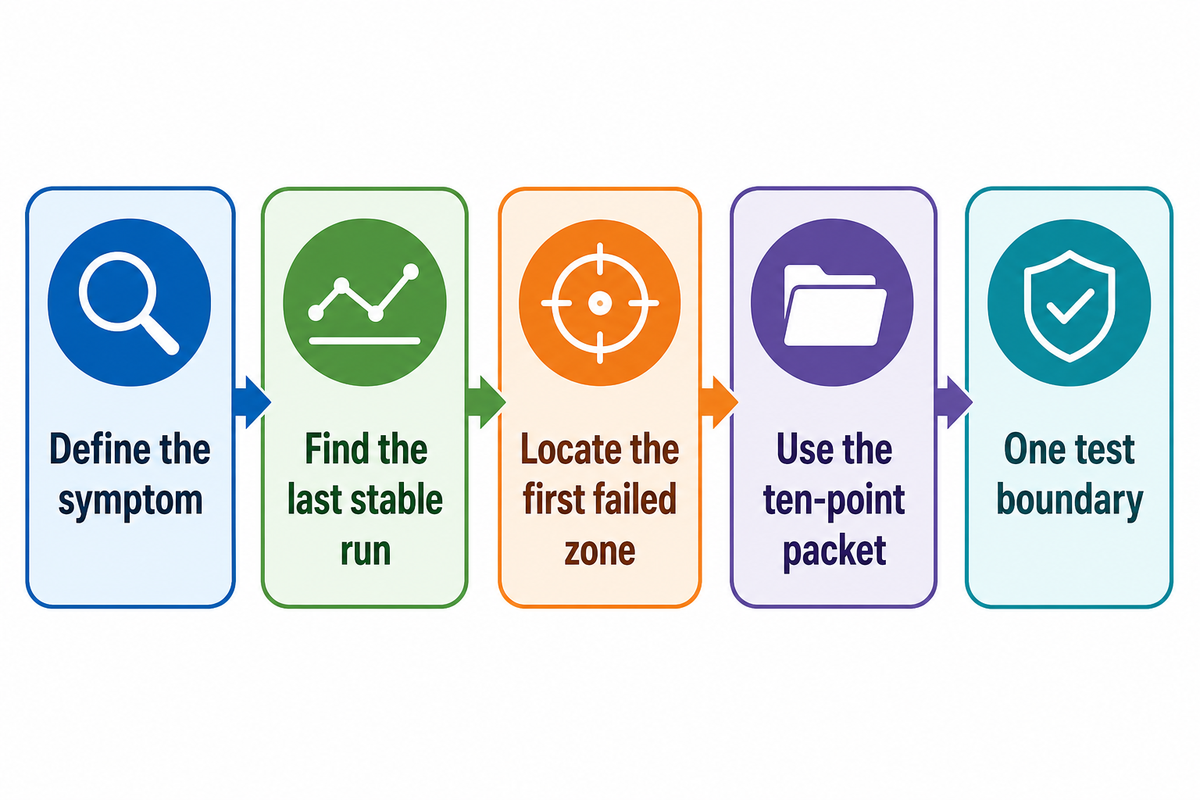
The credible route through Batter and Texture Problems starts by defining the symptom. Together, the answers above return each complaint to controlled formula and measurement evidence, followed by maintenance evidence. Next, find the last stable run and locate the first failed zone. Then use the ten-point packet. Production, maintenance, and suppliers, in this case, share one test boundary.
Established in 2003, UD Company has invested nearly RMB 200 million in two production bases covering 130 acres in Xinyu, Jiangxi. UDTECH develops patented food-production automation, including automatic egg roll and phoenix tail roll machine series. These statements don’t imply a reduction in defects.
References & Sources
- University of Massachusetts: Food Rheology
- Food Science & Nutrition: Industrial production of fresh egg waffles, Part I
- Food Science & Nutrition: Industrial production of fresh egg waffles, Part II
- International Journal of Food Science & Technology: Factors affecting wafer sheet quality
- Foods: Moisture-control packaging experiment for low-moisture snacks
- Foods: Packaging of cereals, snacks, and confectionery products
- Institute of Food Technologists: Packaging and moisture control
- WO2009149947A1: Waffle batter and method
- U.S. Food and Drug Administration: Guidance for Industry, Acrylamide in Foods
- U.S. Food and Drug Administration: Knickerbocker 365 warning letter