Batter & texture troubleshooting
A practical way to look at mixing, heat, and formula limits without pretending one rubbery batch can diagnose itself. Why are my pancakes rubbery is a texture question with several plausible causes: overmixing, heat, formula, cooking time, or intended style.
Why are my pancakes rubbery? Start with overmixing, as worked flour batter can develop more gluten, but rubbery pancakes can also result from the formula, the intended style, and the heat and time of cooking. Take one careful single change as a clue, not proof of a single cause.
The short answer
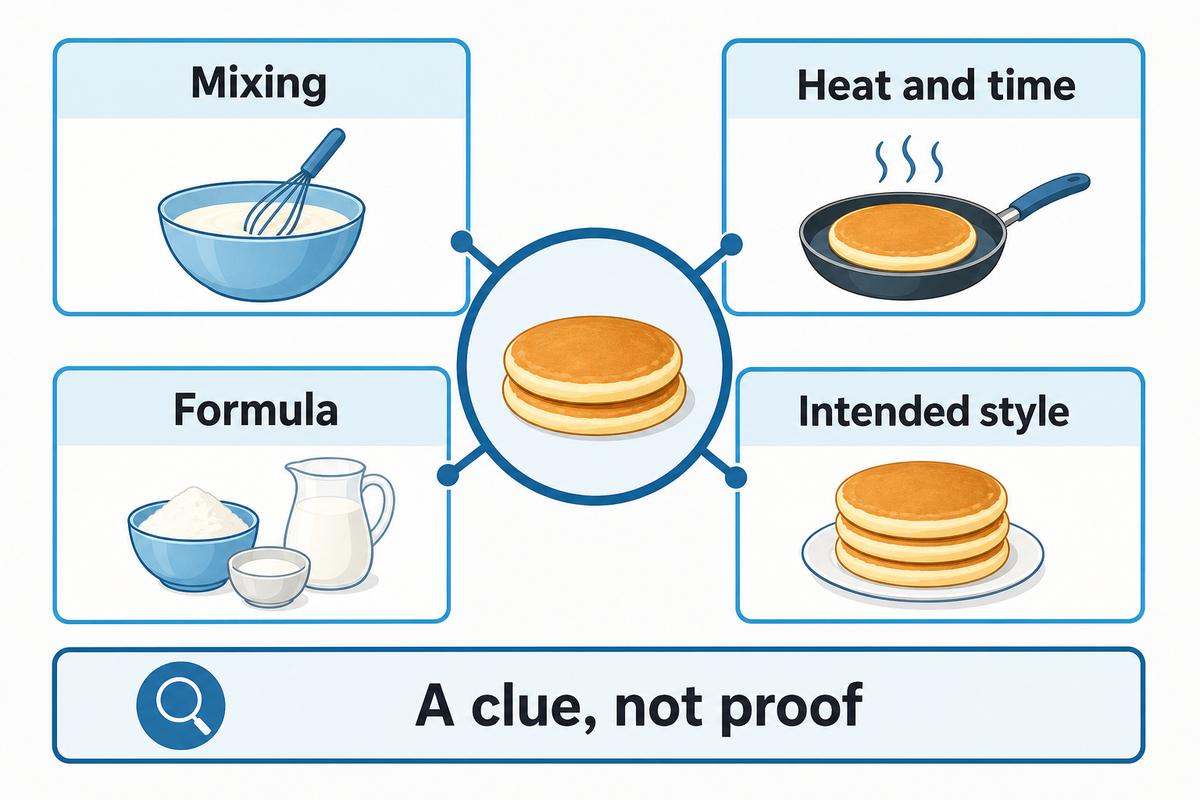
Rubbery pancakes can start with overmixing. Overmixing can make tender baked products less tender, but pan heat, cooking time, flour choice, eggs, liquid, and the intended pancake style can also affect what “rubbery” feels like. But it’s also important to consider the time and temperature of cooking, the formulation of the pancakes, the type of flour used, and the intended style of cooking. For the gluten mechanism behind that starting point, see Washington State University’s food-science explainer.
The easiest first method is to mix only until the dry flour disappears and leave a few lumps. Cook and test a single pancake and compare one choice in your formulation. Use your comparisons as a clue and don’t consider them proof of the single theory.
What mixing changes in pancake batter
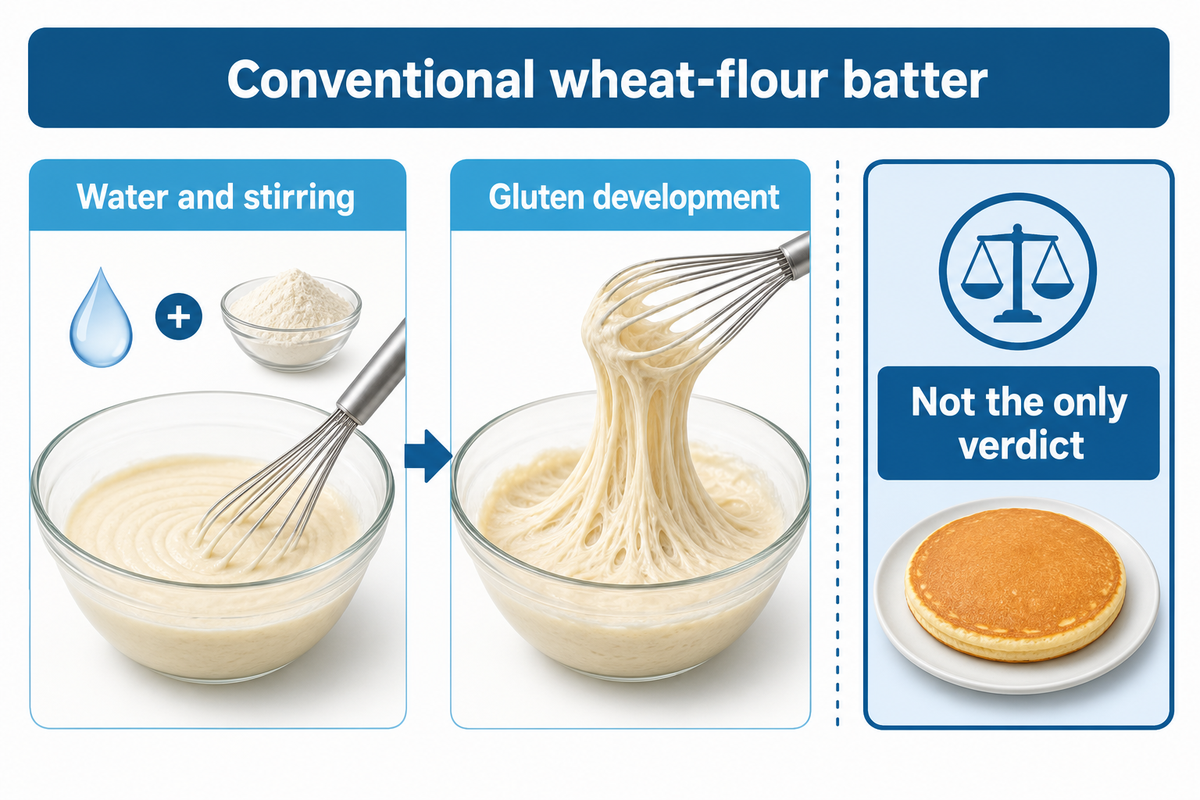
Gluten development is one factor in the final texture of a baked good, not the only verdict on a rubbery pancake; in a conventional wheat-flour batter, water and stirring build gluten, while heat, cooking time, flour choice, eggs, liquid, and intended style can matter too. Mixing a batter too much can lead to chewy pancakes.
Washington State University’s food-science explainer says that water and stirring help flour proteins form gluten. Hence, overworking a batter may result in rubbery and tough baked goods.
That explanation has a boundary. A peer-reviewed pancake study of 13 wheat cultivars connected different texture attributes to multiple flour properties, as opposed to a single mixing variable. In informal terms, “rubbery” is a description used by home cooks, not a standardized diagnosis. If you are using a gluten-free, protein-enriched, or unusually high-fiber mix, do not assume ordinary wheat-flour gluten advice explains the result. Start with the instructions for the formula (or recipe) and compare it to a basic recipe you’re familiar with and then adjust only one variable at a time.
In a conventional wheat-flour batter, stop mixing once the dry streaks vanish. Small lumps aren’t a failure; they’re the visible sign that you haven’t continued to mix the batter in an effort to achieve a smooth batter. King Arthur Baking’s more vigorously mixed batter led to flatter pancakes with a chewier texture; this is useful practical evidence, but it is still one recipe-specific test rather than a universal stroke count.
Use the Lumpy-Lift-Flip Check
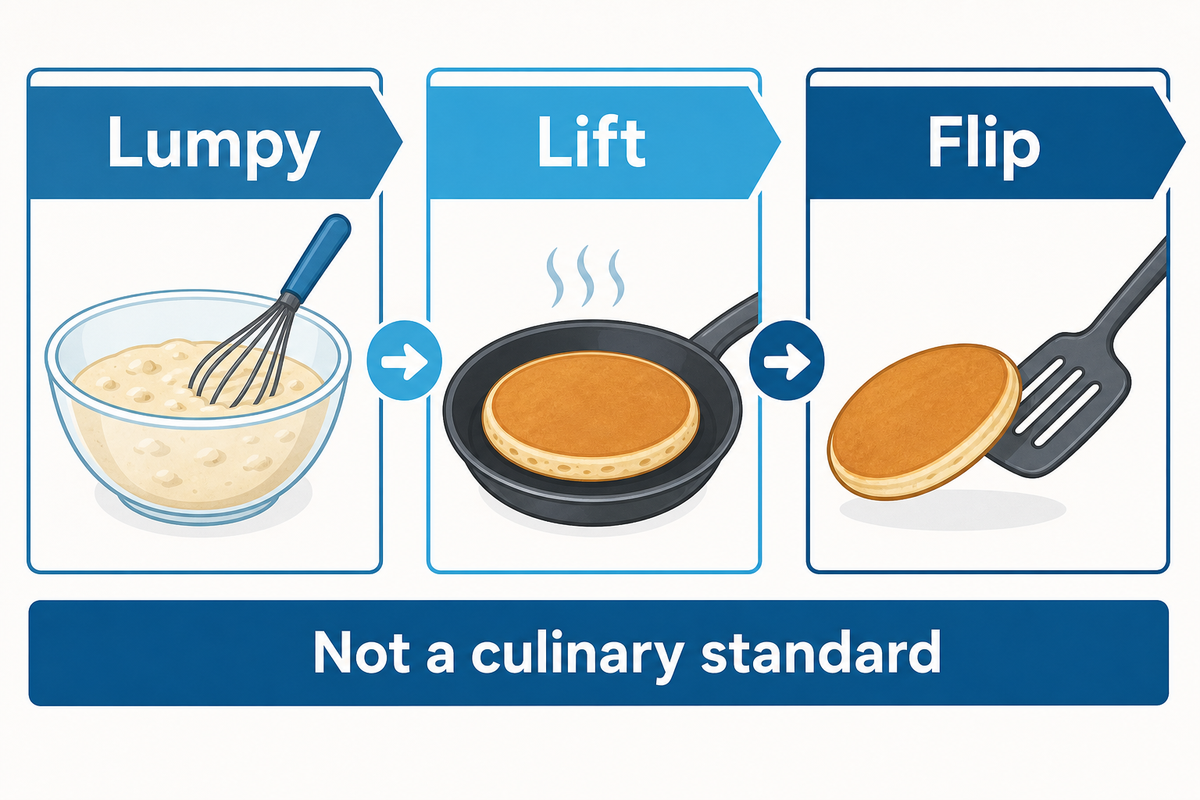
This is an editorial troubleshooting sequence for the next batch. For the gluten mechanism behind a mixing check, see Washington State University’s food-science explainer. It isn’t a culinary standard and it can’t determine the cause of a texture problem.
- Lumpy: Combine wet and dry ingredients only until the flour disappears, leaving a few small lumps.
- Lift: An edge is ready when a cooked surface has formed, not simply browned. Gently lift one edge to check the cooked surface.
- Flip: Turn once only, don’t flatten with the spatula. Pressing flattens and changes the physical result. This makes a later comparison harder to evaluate, not impossible.
If you continue to experience the same texture issue, you can continue reading this site by using the general purpose batter texture framework. That page is considered a contextual handoff and isn’t proof that it has determined what’s wrong with your recipe or recorded the result of a UD Company test.
Use the 9-Point Pancake Texture Comparison Card
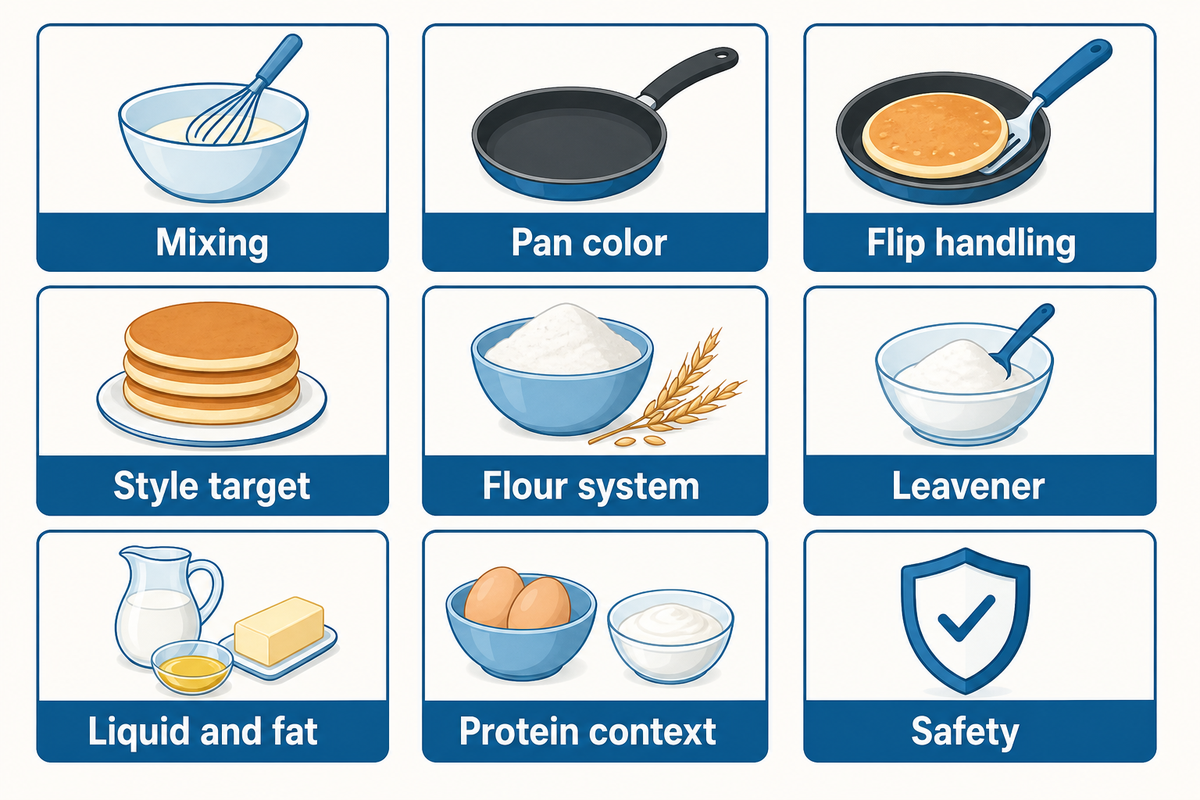
Mixing and batter interaction under heat cannot be cleanly separated in a single batch, so use a series of cautious comparisons. This is one less risky comparison to select, not proof from a single controlled experiment. For why one-factor comparisons can miss interactions, see NIST’s experimental-design guidance.
Keep in mind the context of the formula. Product-reformulation advice treats flour, fat, liquid, salt, sugar, and leavening (or lifting agents) as related formula choices. This is a good way to think of the home batter as a system. It doesn’t provide a recipe to prevent a rubbery pancake.
| Check category | What you notice | A cautious next comparison | What it does not prove |
|---|---|---|---|
| Mixing | The batter was beaten until completely smooth. | Mix the next small batch only until dry flour disappears. | This comparison does not show that gluten was the only reason the first pancakes felt rubbery. |
| Pan color | The surface darkens before the center seems ready. | Use gentler heat for one test pancake and observe the center and browning together. | This test does not show that heat, rather than formula or mixing, caused the texture. |
| Flip handling | The pancake was repeatedly moved or pressed after turning. | Leave the next test pancake alone after one gentle flip. | This observation does not show that handling alone explains the texture. |
| Style target | The pancake is thin and flexible but pleasant to eat. | Check whether you were aiming for a thin or crêpe-like style. | Thinness is not automatically a defect. |
| Flour system | The recipe uses gluten-free, high-protein, or high-fiber flour. | Compare with the written formula or a familiar base recipe. | That ordinary wheat-gluten advice transfers unchanged. |
| Leavener | A substitution changed baking powder or baking soda. | Restore the written leavener before adjusting technique. | That mixing was the only changed condition. |
| Liquid and fat | Buttermilk or melted butter was substituted or measured differently. | Return to the written liquid and fat choices once before making another judgment. | That the batter is equivalent to the original version. |
| Protein context | A technical source discusses flour protein in a product-reformulation context. | Use it only to recognize that flour choice matters. | That the source has supplied a home-batter target. |
| Safety | You want to taste raw batter to check the adjustment. | Do not taste it; clean up and judge only after cooking. | That a visual cue has verified food safety. |
Product-reformulation guidance is a scope marker, not a kitchen instruction. It reminds a reader to check whether the formula has been changed, but it doesn’t set a home-batter target or explain why a batch was rubbery.
Make a one-variable retest, without overreading it
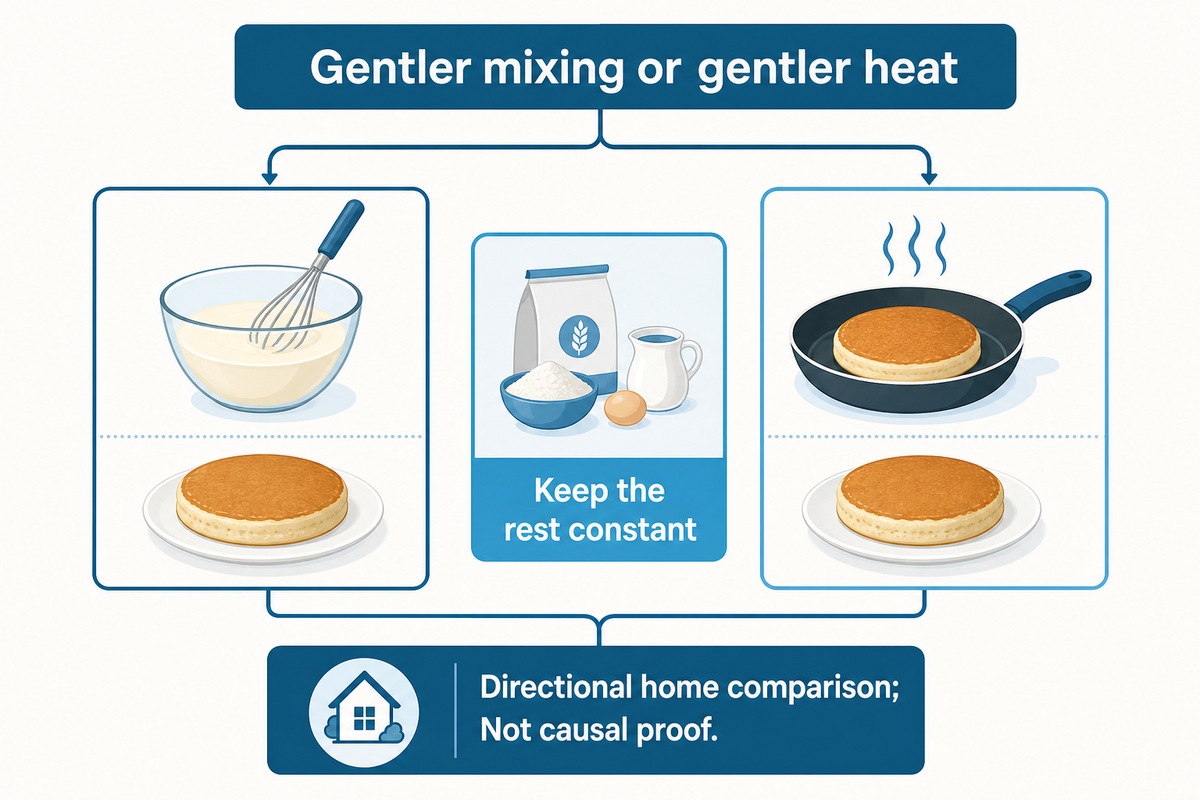
For the next small batch, choose one of the following changes: either gentler mixing or gentler heat. The rest of the recipe and your observations should remain constant, if possible. This will help to avoid the common frustration of changing flour, egg, liquid, leavener, and heat all at once, and not knowing which of the changes, if any, was important.
It’s still only a directional home comparison. NIST’s experimental-design guidance indicates that changing one factor at a time can’t determine the existence of factor interactions in a system comprised of factors that interact. So, while it’s nice to achieve a second batch that’s better, it doesn’t prove that one change alone improved the batch. So, continue to make the same change for another day to see if you can establish that as your personal rule.
When a different pancake style is the point
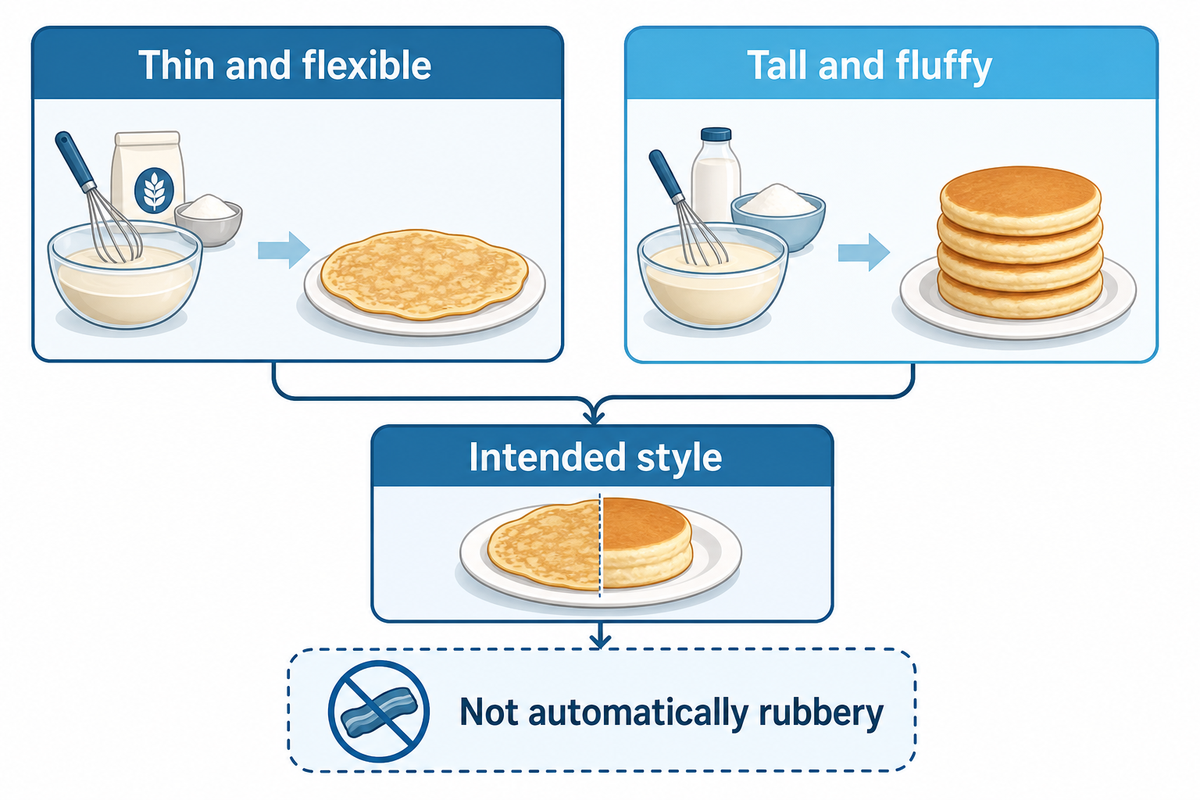
A thin, flexible pancake isn’t automatically rubbery. Some styles opt for a delicate, bendable result in place of the tall, fluffy crumb. King Arthur Baking’s thin pancake advice is a reminder to consider texture for your intended style. Focus your criticism on texture when the result is unpleasant for your target and not just different from a diner-style stack. A peer-reviewed pancake study also linked texture attributes with multiple flour properties, so a single texture target deserves a cautious reading.
Handle batter and flour safely
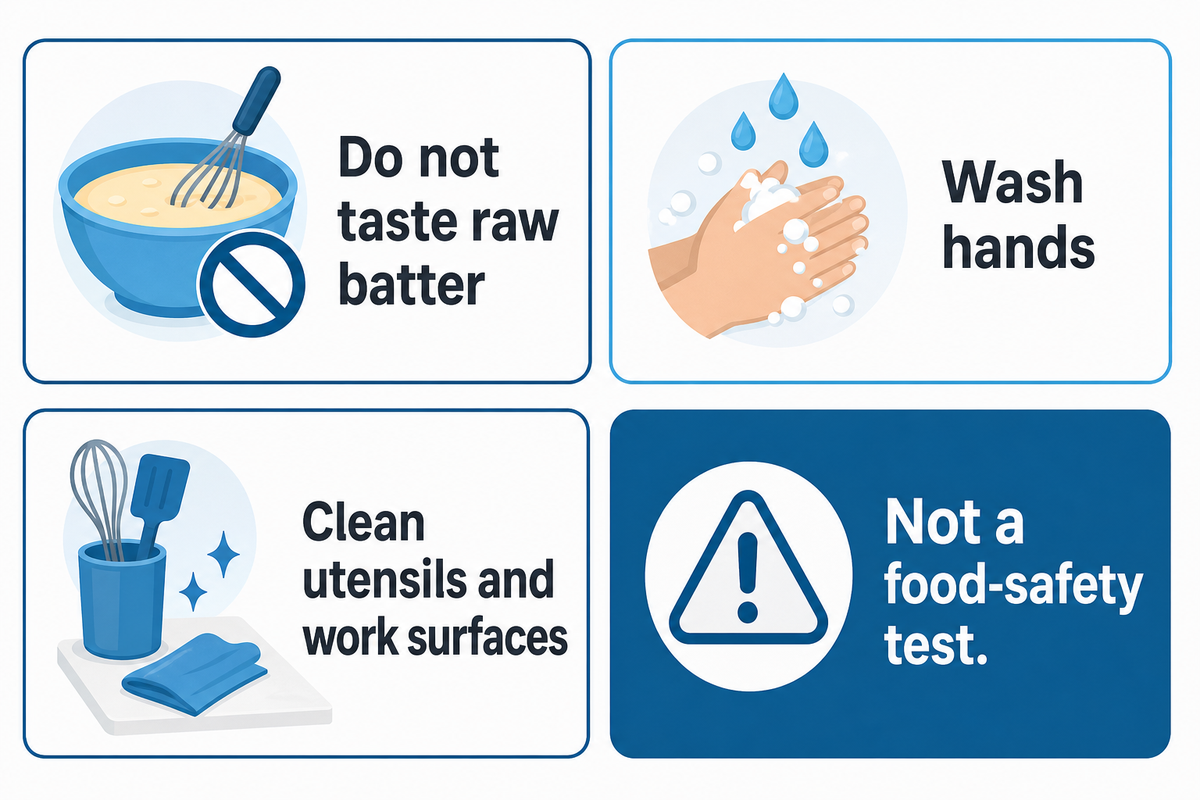
Do not taste raw pancake batter while you try to figure out what has gone wrong. FDA explains that flour is a raw food, and CDC warns that raw flour and raw eggs can carry germs that cooking is meant to kill. Wash hands, clean utensils and work surfaces after handling raw batter, and follow the recipe’s cooking directions. A browned surface or a familiar-looking bubble pattern is not a food-safety test.
Frequently asked questions
How much should I mix pancake batter?
Answer
For a traditional wheat flour pancake batter, mix just enough to get the dry flour to disappear. A few small lumps are usually better than overmixing to get a smooth batter. Trusting a universal number of strokes to get the batter the proper consistency is probably not wise. The size of the bowl, type of whisk, flour, liquid, and recipe will determine the result. Use the batter texture and the next cooked pancake as your gauge.
Can overmixing make pancakes rubbery?
Answer
This could be one cause. Water and stirring can develop gluten in wheat flour, and vigorous mixing has produced chewier pancakes in a recipe-specific baking comparison. However, you can’t say rubbery pancakes were caused by overmixing. There are many other factors like the flour system and the formula, the temperature and the duration of cooking, and the desired goal, which of course, can affect the result. Therefore, it makes sense to try treating mixing as one factor and see what happens, but this shouldn’t be construed as a complete explanation for all recipes.
Are lumpy pancakes better?
Answer
Large pieces of dry flour need more folding, not more mixing. At the other extreme, keep a few small lumps once the dry streaks are gone. Large dry streaks in the batter also tell you to stop mixing. The goal of mixing is to cook pancakes evenly: stop when there are no dry streaks, keep a few small lumps, and do not keep mixing for a perfectly smooth batter. The important thing to remember is whether the pancakes you cooked were of the texture you desired.
Why are my pancakes rubbery even when I barely mix them?
Answer
Think beyond combining ingredients. Evaluate the next pancake cooked at a gentler heat. Check whether the formula or flour choice changed from the written recipe. Also, see if you’re judging a particular style of a thin pancake against the standard of a fluffy pancake. If you use a gluten-free, high-protein or high-fiber mix, the advice you find about gluten likely isn’t going to apply to these types of mixes. Make one choice at a time and note what happened. Also, don’t assume one better batch is enough evidence. Make sure the plain facts and elementary details guide the next comparison, rather than prove one cause. These don’t prove anything, but they may help you decide what to compare next.
References & Sources
- Washington State University: Exploring Food Science gluten formation and texture context.
- Peer-reviewed pancake texture study multiple flour properties and distinct texture attributes.
- King Arthur Baking: Don’t Make This Pancake Mistake recipe-specific mixing comparison.
- NIST: One-Factor-at-a-Time Experiments limits of one-factor comparisons where interactions exist.
- FDA: Flour Is a Raw Food and CDC: Raw Dough Safety raw-batter safety guidance.
- King Arthur Baking: Delicate and Thin Pancakes style-expectation boundary.