Waffle Styles and Pancake Comparisons for Commercial Production
Waffle styles are useful product labels, but they are not machine specifications. This compares ten formats, explains the process variables for each format, and turns an idea into a brief that an engineering team can use to perform a test.
Primary Formats
Brussels
BATTER · DEEP GRIDLiège
DOUGH · PEARL SUGARAmerican
BATTER · REGULAR GRIDEgg / Bubble
BATTER · CELL MOULDStroopwafel
THIN · FILLED PAIR
Discuss Your Waffle or Pancake Line
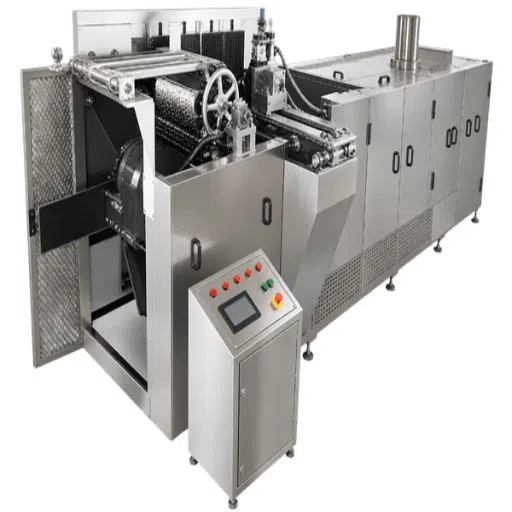
Starting with your product idea, think of the size, weight, and texture of the product, your targeted output, your targeted shelf life, and the format of the package. Once this information is clear, the line discussion can begin.
Heart
THIN · SEGMENTEDCrisp wafer
LOW MOISTUREStuffed
FILLING CONTROLMini
PORTION CONTROLPancake
OPEN SURFACE1 useful output
TESTABLE BRIEF
10 formats
Nine waffle formats and one pancake benchmark.
6 bottlenecks
From feed behavior to sanitation release.
3 evidence states
Published evidence, engineering review, or project test.
1 next step
Prepare the product brief before choosing hardware.
Industrial Insight
Waffle Styles at a Glance
Lists of types of waffles often mix regional names, shapes, recipes, and serving ideas. That creates a procurement risk: two products can share a name while behaving differently at the depositor, baking plate, release point, or cooling conveyor, a risk that the peer-reviewed formula-and-sticking study illustrates for formulation and release.
A practical classification
Use physical product structure first: batter or dough, open or closed contact, thin or thick section, filled or unfilled, and soft or low-moisture target. Cultural names still matter for the customer promise, but the process brief needs variables a product developer and plant engineer can measure.
Brussels Spec
Recognisable structure
Rectangular, deep grid, batter-based
Texture direction
Light interior with a crisp surface target
First variable to verify
Batter aeration and fill across deep cells
Liège Spec
Recognisable structure
Portioned dough with pearl sugar
Texture direction
Dense, chewy, caramelised surface
First variable to verify
Dough portioning and sugar residue
American-style Spec
Recognisable structure
Regular grid, round or square
Texture direction
Soft-to-crisp breakfast profile
First variable to verify
Recipe viscosity and dwell window
Hong Kong Egg Bubble
Recognisable structure
Connected spherical cells
Texture direction
Flexible shell with crisp cell walls
First variable to verify
Cell fill, venting, and release integrity
Stroopwafel Spec
Recognisable structure
Two thin patterned discs with filling
Texture direction
Crisp or chewy layered bite
First variable to verify
Sheet thickness, split or pair, and filling step
Thin Crisp Wafer Spec
Recognisable structure
Very thin sheet or formed shell
Texture direction
Low-moisture snap
First variable to verify
Conditioning, moisture, and post-form timing
Stuffed Waffle Spec
Recognisable structure
Closed product around a centre
Texture direction
Outer bake with a distinct filling
First variable to verify
Deposit sequence and seal integrity
Mini Portion-Controlled
Recognisable structure
Small repeated units
Texture direction
Defined by the chosen recipe
First variable to verify
Deposit repeatability at smaller mass
Belgian Waffle Styles: Brussels and Liège
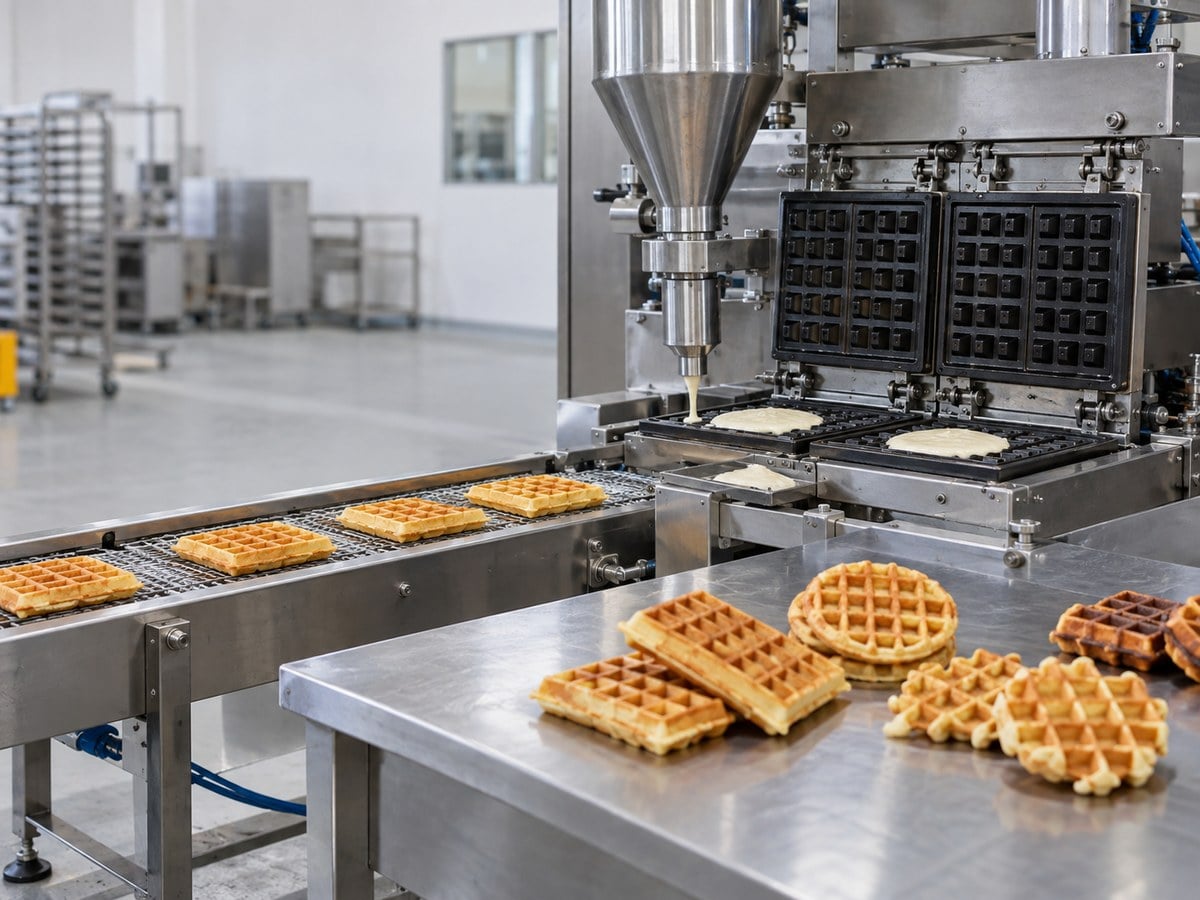
“Belgian waffle” is a product family, not one engineering solution. The official Brussels description identifies a rectangular waffle that is light and crisp outside and soft inside; Liège starts from a denser dough with pearl sugar. A buyer’s sample marketed as a classic Belgian format may still follow either route, so the name alone does not identify its feed state.
Batter route
Brussels waffles
Deep cells help the batter spread and aerate. If the submitted recipe is made with a yeast-leavened batter, the proofing and holding conditions belong in the test record. A weak fill can leave corners bare and cause excessive batter to flow and spread beyond the boundaries of the mold, resulting in a messy spill that requires cleaning.
Review the Brussels descriptionDough route
Liège waffles
Portioned, yeasted dough and pearl sugar change the feed and residue problem. The leaven, dough temperature, and sugar distribution need their own controls. Caramelized sugar gives the surface part of its identity, but hardened residue can increase release and cleaning demands.
Project proof
Brussels direction
Liège direction
Feed state
Flowing batter
Portioned dough
Recipe, temperature, rest time, and handling trial
Cell fill
Spread into a deep grid / Dough expansion under closed plates
Weight and coverage check across the mould
Sugar behavior
Recipe-dependent browning / Pearl-sugar distribution and caramelised residue
Surface color, release, and cleaning observation
Release risk
Breakage, adhesion, or underfill / Adhesion plus sugar build-up
Global Waffle Styles & Formats
Different types of waffles and broad waffle varieties become easier to plan when the visible shape is tied to a physical constraint. The cards below describe recognisable formats; they do not set ratio recipes, protected origins, or universal operating values. The risk is a mismatch between the market label and the supplied sample, because two products sold under the same name may demand different dosing and release behavior.
American-style grid
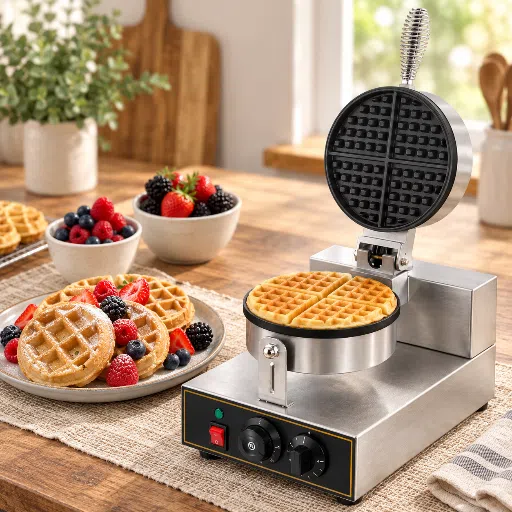
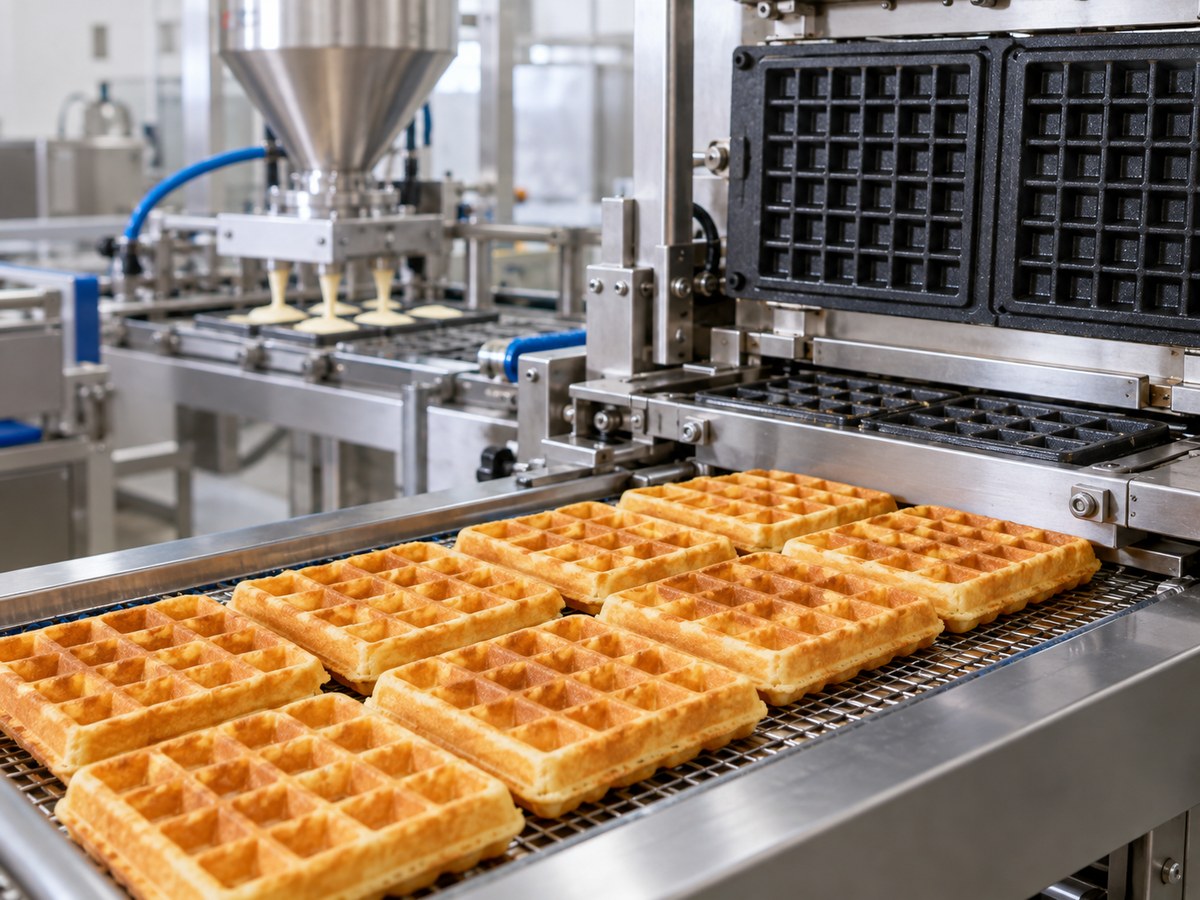
An American waffle may be a round waffle or a square product that a foodservice team simply calls regular waffles. For an automated line, “waffle maker” and “waffle iron” are only shorthand: the grid pattern, formula, and heat targets still need drawings and tests. Do not approve the first waffle; confirm viscosity, release, packed-product behavior, and a stable run.
View Specification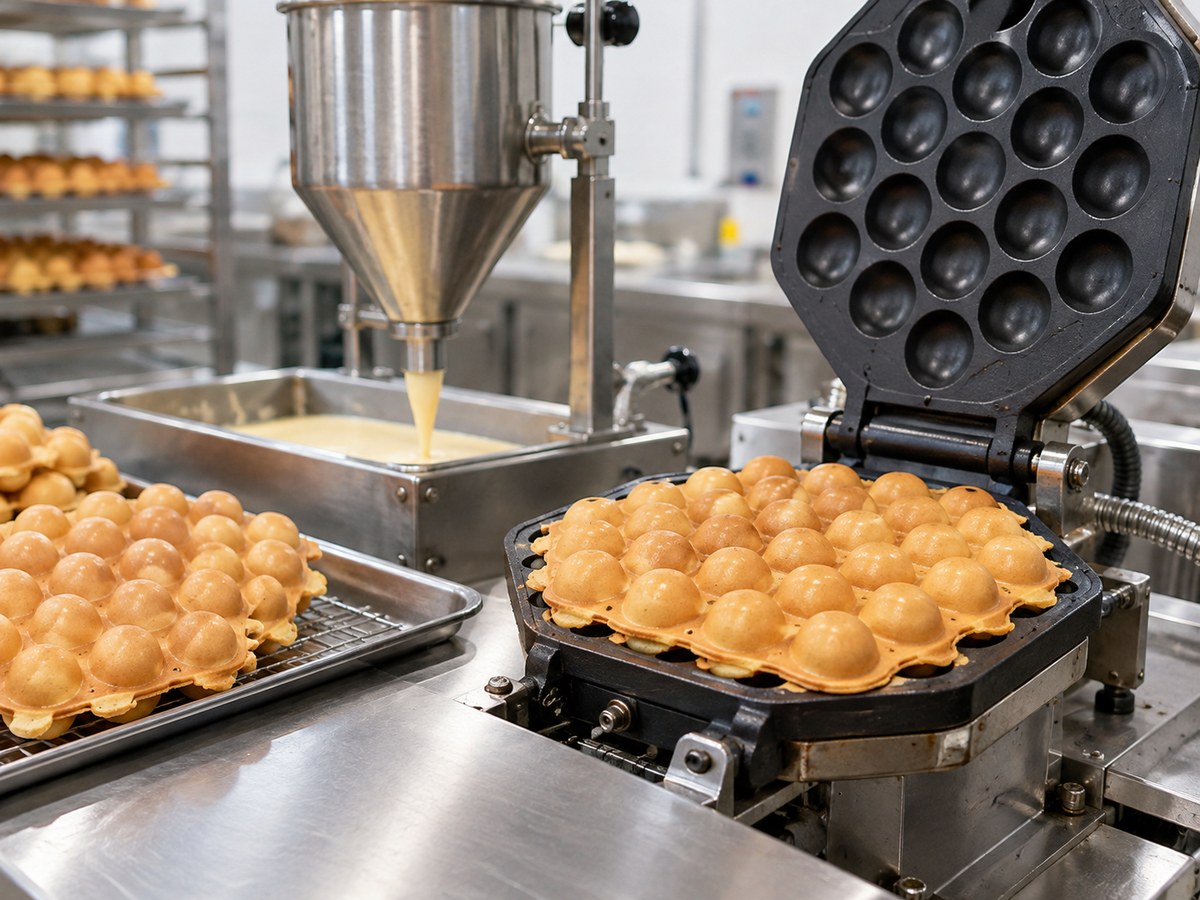
Hong Kong egg or bubble
The Hong Kong Tourism Board describes batter baked in an egg-shaped iron. Bubble waffles are a popular street food, but for a Hong Kong egg waffle project, cell fill, venting, turning, and release damage matter more than the informal “bubble” label.
See description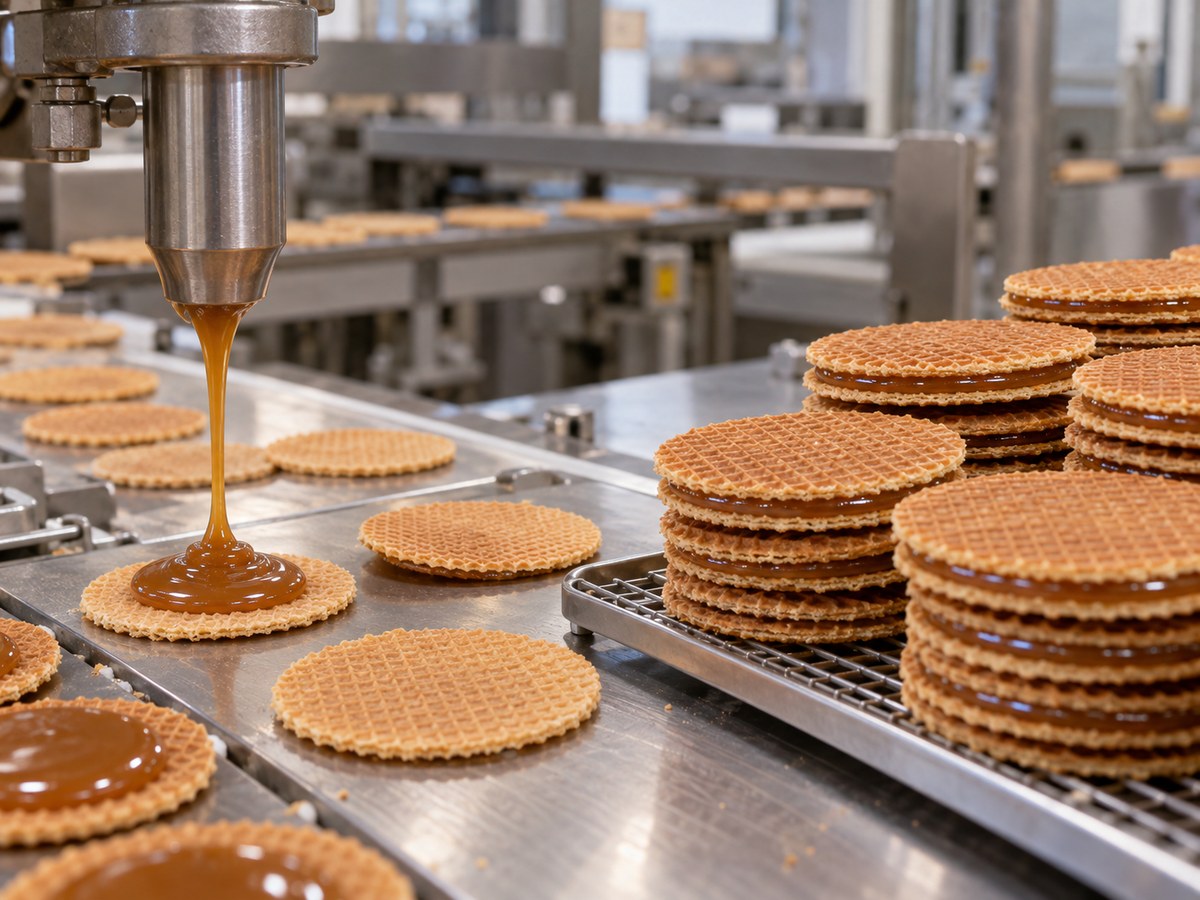
Stroopwafel
Filled stroopwafels use two thin patterned pieces and a filling step, creating a different line architecture from a thick breakfast waffle. Verify forming, baking, split or pairing method, filling temperature, alignment, cooling, and wrap barrier.
View Specification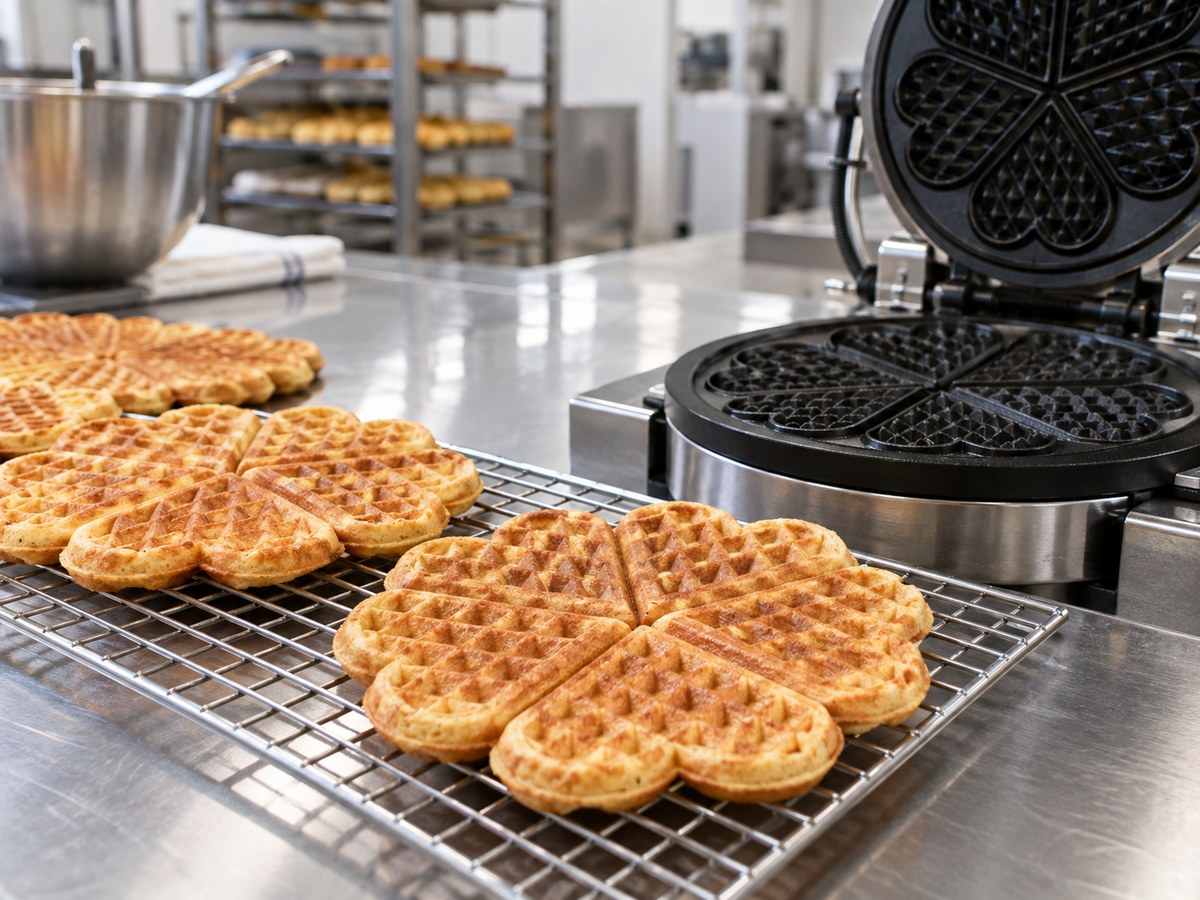
Scandinavian heart
Sweden’s official tourism source describes a flatter waffle made in a heart-pattern iron. Shallow segmented moulds change spread and edge definition, while a Waffle Day promotion changes the volume forecast rather than the product specification.
See description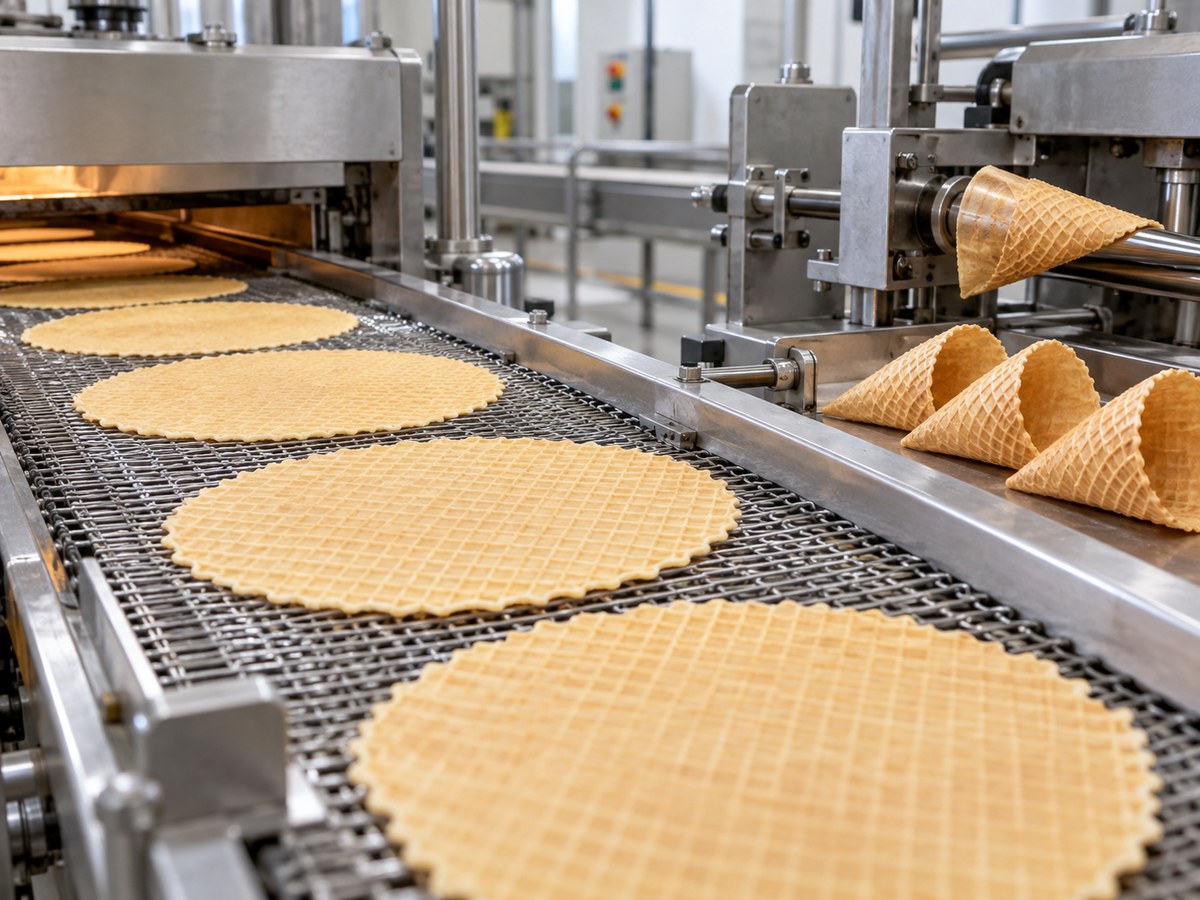
Thin crisp wafers
Thin waffles may leave the oven as a flat pizzelle, a rolled waffle cone, or an ice cream cone blank. These low-moisture sheets depend on rapid baking, conditioning, and tightly timed forming or filling; a thick soft-waffle route is not interchangeable.
View Specification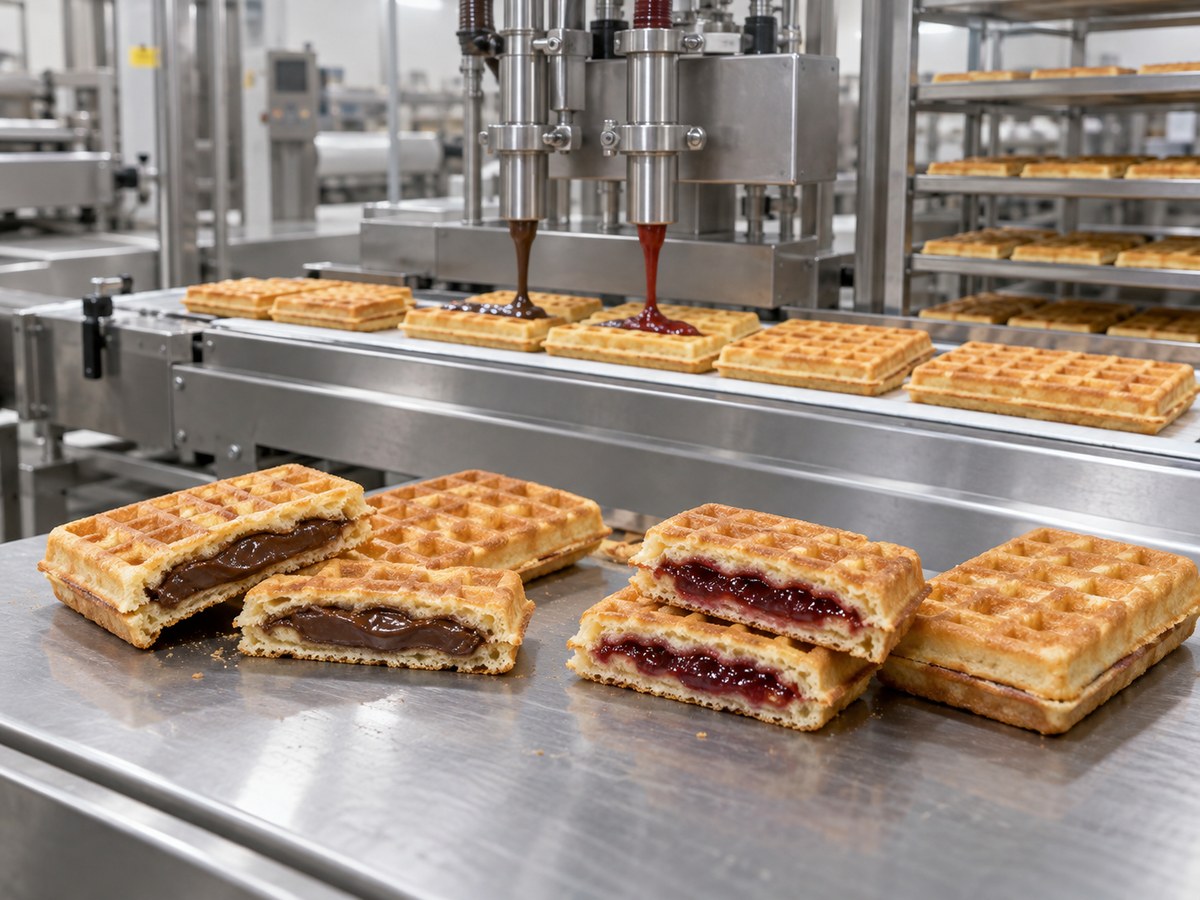
Stuffed & filled formats
A filling of fruit or cream, or inclusions such as chocolate chips, adds deposit sequence, leakage, food-safety, cooling, and pack-integrity checks. List all ingredients and toppings and state whether they enter before baking, after cooling, or only at service.
View Specification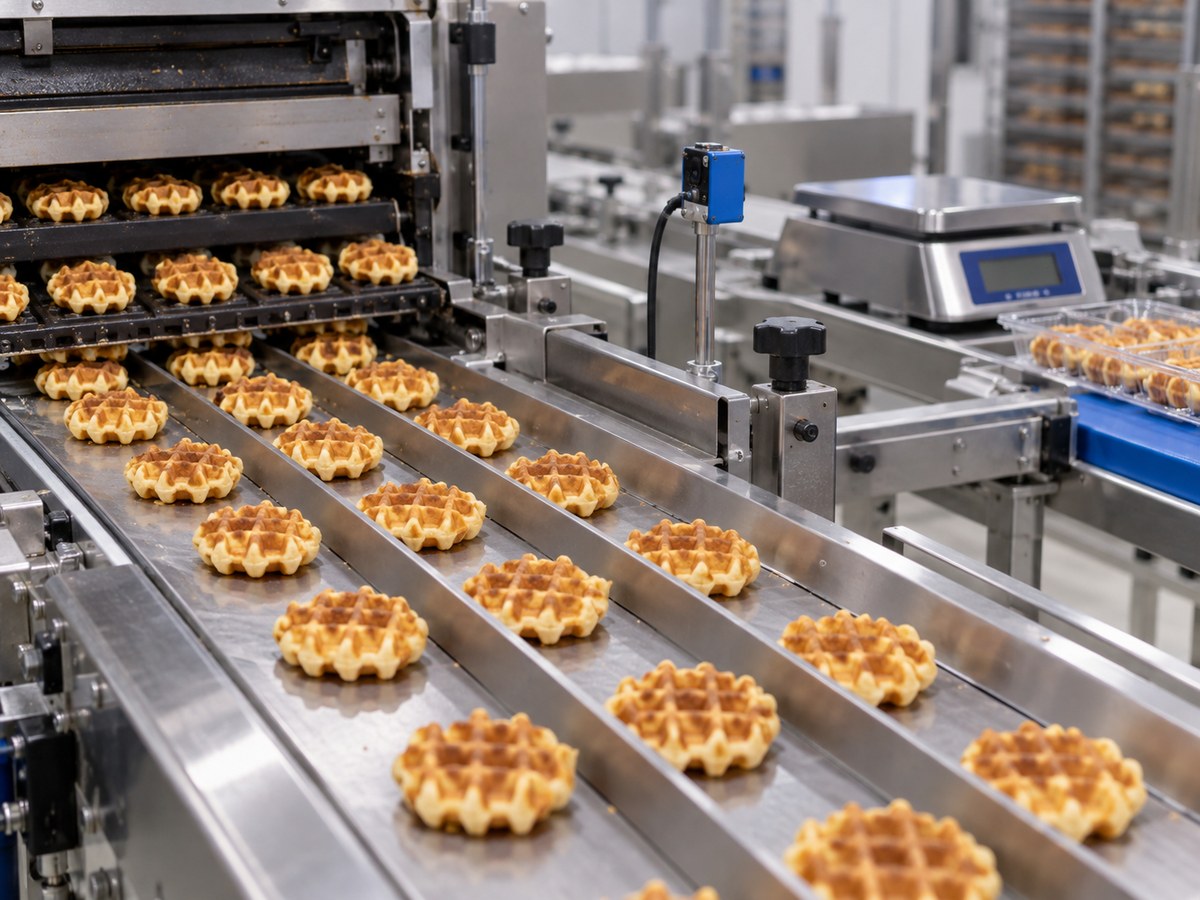
Mini & portion-control
Smaller products can raise the number of deposits and handling events for the same sellable mass. Confirm repeatability, transfer spacing, cooling stability, count accuracy, and pack orientation.
View Specification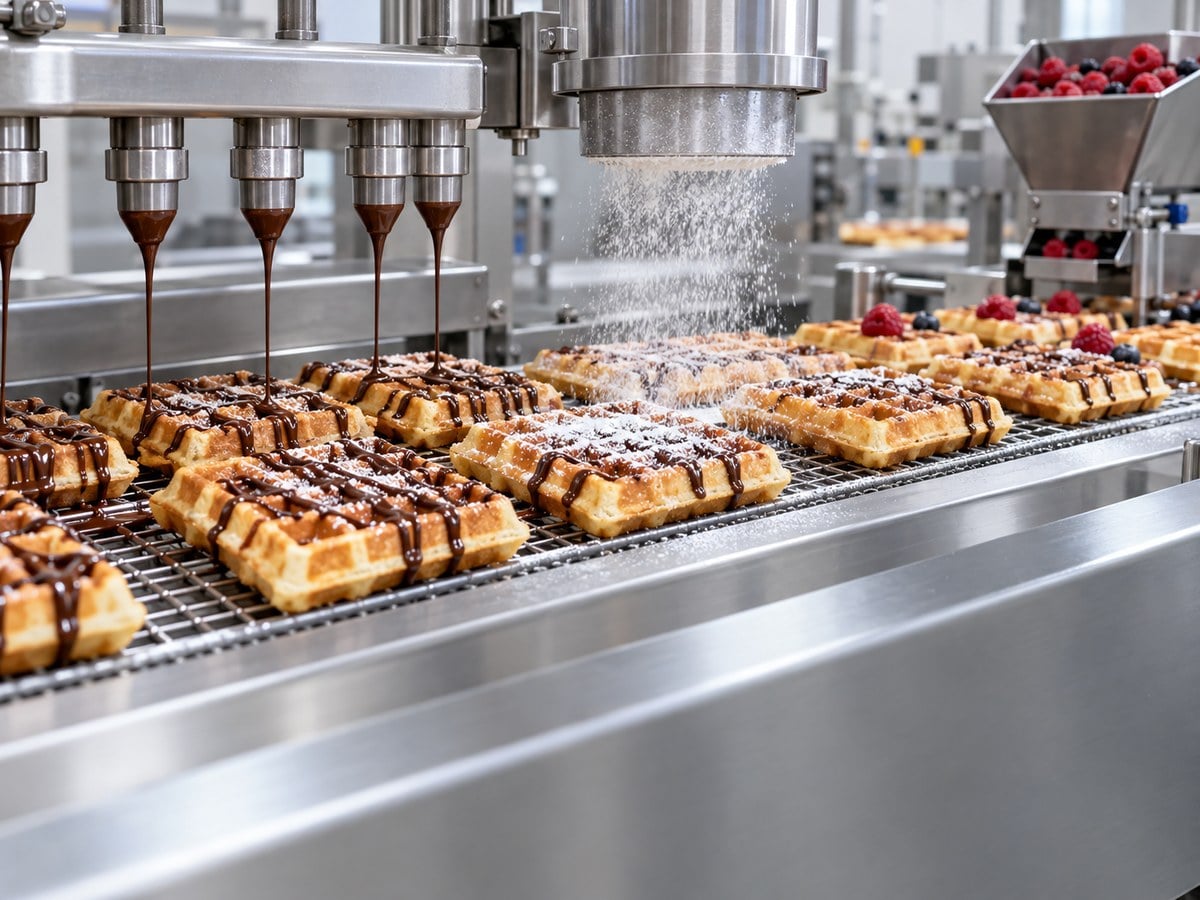
Finishing / topping
A product topped with whipped cream is not the same factory brief as one finished with a dusting of powdered sugar. Maple syrup or a berry may be a service-only topping, a packed component, or an in-line deposit; the intended route decides the equipment scope.
View Specification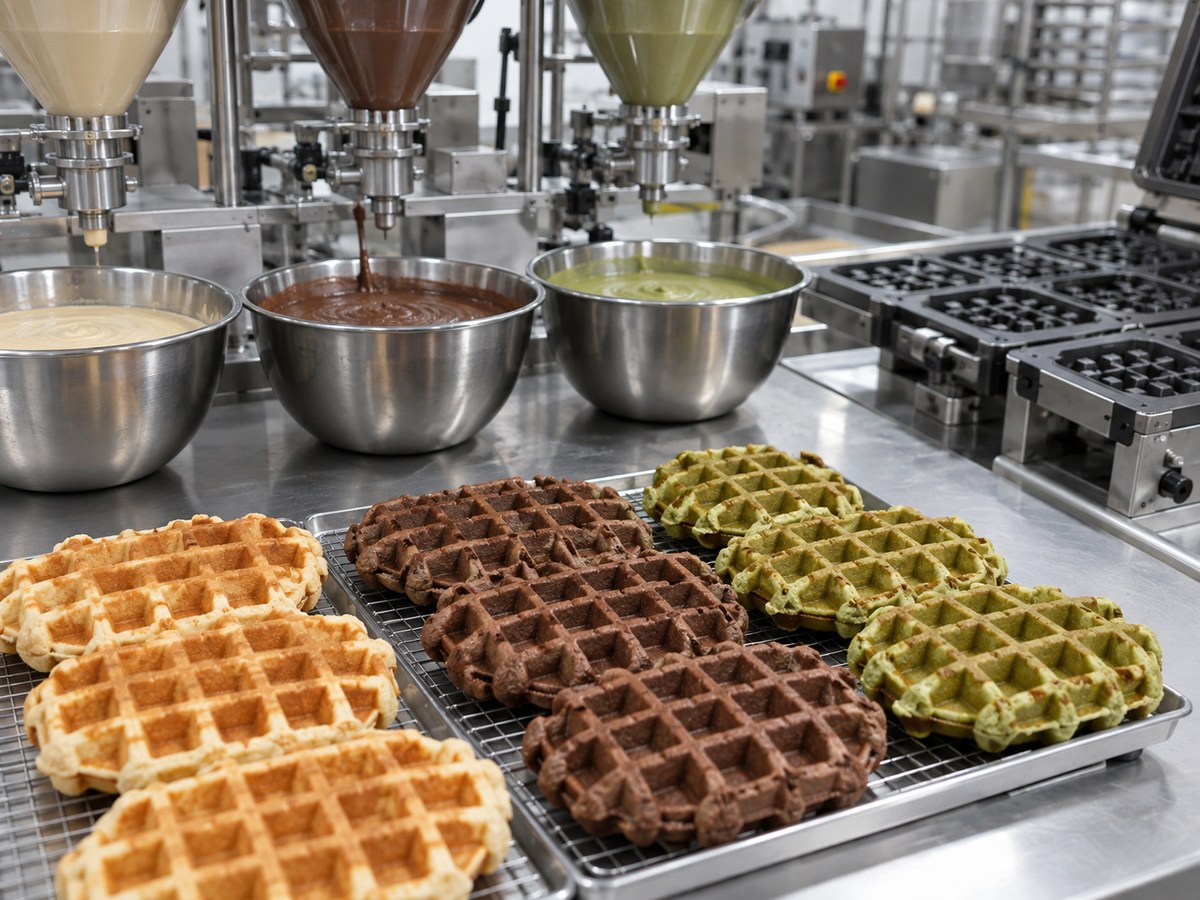
Flavor-defined formats
Pandan waffles and formulas using orange blossom water need a named flavor revision, ingredient control, and changeover plan. Shape alone does not tell the supplier how aroma carryover, allergens, color, or cleaning will be accepted.
View SpecificationWhere classification stops
Waffle types and waffle variations can help a brand team name a product family, even when a brief promises many variations. They do not reveal pumpability, dough strength, sugar residue, allergen profile, moisture target, or whether a hot product survives automated transfer. Treat each type of waffle as a separate sample and formula revision.
Waffles and Pancakes: A Production Comparison
The short production answer
Waffles and pancakes can share ingredients or front-end mixing logic, but they do not automatically share the same forming, contact heating, turning or release, texture, sanitation, cooling, and packaging path. A common assumption is that a similar batter or a template change proves a shared platform, but that is not necessarily the right call: the trade-off sits in downstream controls. A platform decision needs the actual recipes and samples; a template change alone does not establish compatibility.
One government pancake recipe provides useful counter-evidence to an absolute separation claim: one ingredient family can be adapted to either waffles or pancakes with changes in egg handling and cooking equipment. Waffles are usually made from batter or dough, but those labels still leave the factory brief incomplete.
State the leavening system
An industrial waffle recipe should state the leavening method and holding conditions. A waffle batter leavened with baking powder behaves differently from a formula that relies on yeast; if a buyer uses baking powder instead of yeast, that substitution belongs in the test brief. This supports “may share inputs,” not “will share an industrial line.”
Control point
Waffle route
Pancake route
Shared-line test
Base system
Batter or dough, depending on style
Flowing batter
Compare ingredients, hydration, aeration, rest, and allergen family
Flow behavior
Must fill a defined cavity or accept a dough portion
Spreads over an open heated surface
Measure portion delivery and final diameter or cell coverage
Shape definition
Closed mould geometry defines both faces
Deposit and spread define the plan shape
Check deposit placement, spread, edge, and thickness
Heat transfer
Two-sided contact through plates
Open-surface contact with a turn or second heating step
Map product temperature and color across the full cycle
Release or turn
Plate opening plus intact take-off
Release from the surface plus turning
Separate adhesion, structural break, fold, and handling damage
Texture target
Ranges from soft cake-like to low-moisture crisp
Tender, flexible, or browned to the product specification
Define measurable color, moisture, height, and texture checks
Residue pattern
Cell walls, vents, seams, sugar, fat, and release agent
Open surface, spreading edge, and turning contact
Inspect hard-to-clean points after the planned run length
Downstream
Release, cool, fill or sandwich, condition, freeze, or wrap
Turn, stack or cool, freeze, count, and pack
Compare transfer temperature, deformation, spacing, and pack interface
Food safety
Ingredient and allergen families, food-contact surfaces, cleaning access, process controls…
Document the hazard analysis and verification method
The 6-Stage Shared-Line Hidden Bottleneck Map
01
Formula feed
Weighing, mixing, rest, temperature, dough or batter state, and allergen family.
Production-Line Scope and Cost Drivers
An industrial waffle machine is not priced from the style name. Scope includes product, target output, molds, heat system, automation boundary, changeover controls, cooling, optional filling or freezing, packaging interface, utilities, and site constraints.
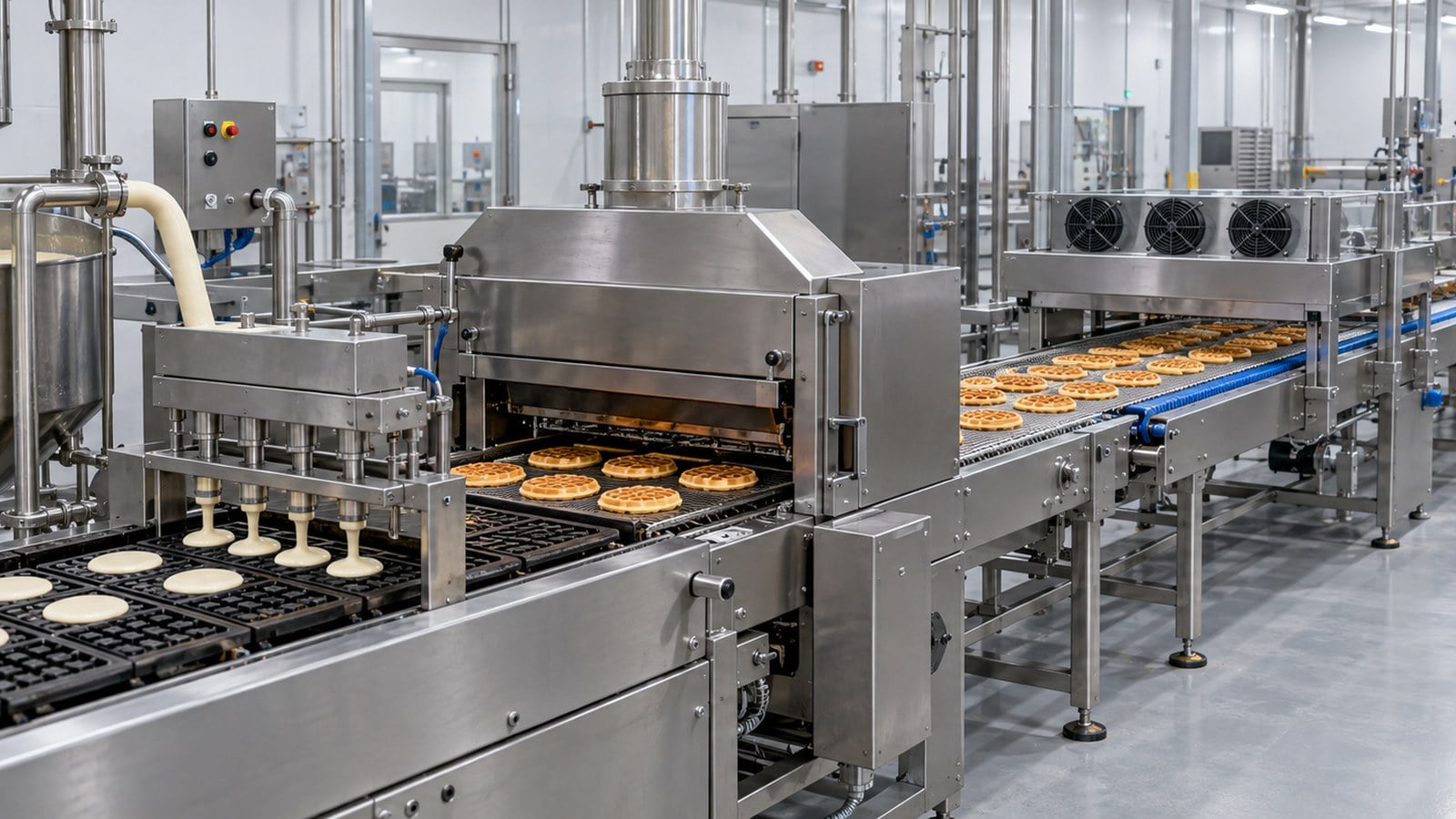
Product side
What defines the hot process- Formula, allergens, batter or dough state
- Product width, length, thickness, unit mass, and cell geometry
- Target color, texture, moisture, and intact-release criteria
- Output basis: pieces, mass, shift pattern, and acceptable reject definition
Plant side
What defines the installed scope- Fuel or electrical supply and available factory space
- Mixing, holding, dosing, mould, cooling, and downstream interfaces
- Cleaning access, sanitation release, and allergen changeover
- Inspection, controls, recipe management, guarding, and local acceptance needs
Project input specification
01 Product geometry
Input Value
Width × length × thickness in mm
Decision it changes
Mould layout, closing space, transfer, and pack format
02 Unit mass
Input Value
Target grams per piece
Decision it changes
Portioning, output basis, heat load, and count
03 Recipe state
Input Value
Full formula, mixing method, temperature, rest, viscosity or dough description
Decision it changes
Feed, deposit or divide, residue, and trial method
04 Sellable output
Input Value
Good pieces per hour or kilograms per shift
Decision it changes
Mould count, cycle, parallel lanes, cooling, and packaging interface
05 Quality target
Input Value
Color, moisture or water activity, height, texture, intact release, and reject categories
Decision it changes
Thermal profile, inspection, sample-run acceptance, and control plan
06 Changeover
Input Value
Product sequence, allergens, cleaning method, verification, and allowed minutes
Decision it changes
Access, removable parts, scheduling, sanitation, and line release
07 Downstream route
Input Value
Cooling, conditioning, filling, stacking, freezing, counting, wrapping, or cartoning
Decision it changes
Conveyor length, queue control, orientation, interfaces, and footprint
08 Site utilities
Input Value
Available fuel, voltage, frequency, compressed air, exhaust, water, and floor plan
Decision it changes
Heating architecture, services, installation boundary, and factory layout
Bronze cost model
Compare the investment on cost per 1,000 good pieces, not nameplate pieces alone. Enter sellable output, rejects, labor, energy, moulds, cleaning and changeover minutes, planned uptime, cooling and packaging scope, service, spares, and validation work; without those inputs, a payback number is decoration.
“Commercial waffle baker” can mean a foodservice appliance used in a hotel or restaurant. A waffle production line refers to a broader processing system, so the equipment scope, food-safety responsibilities, installation review, and acceptance documents need to be defined for the real case usage.
Company foundation: UD Company Food-Production Automation
We are UD Company. We were established in 2003. We have invested nearly RMB 200 million.
01
Xinyu City:
We operate in the High-tech Development Zone of Xinyu City, Jiangxi Province.
02
130 acres:
Our footprint covers 130 acres.
03
Two bases:
We have built two production bases.
04
Research:
We research automation technology for food production.
05
Development:
We develop automation technology for food production.
06
Adjacent automation development
We independently developed our fully automatic egg roll machine series.
07
Adjacent roll-forming development
We independently developed our fully automatic phoenix tail roll machine series.
Waffle Styles Configuration & Acceptance Protocol
01
Access Builder
Parameter Handoff
Waffle Style Brief Builder
Turn a product name into a testable handoff. This builder records product, formula, quality, output, storage, and pack inputs without pretending to select a machine.
02
Open Scorecard
Compatibility Engine
Shared-Line Fit Scorecard
Compare the shared portion of two products. Score what is already demonstrated, not what a replaceable mould appears to imply.
03
Configure Planner
Acceptance Protocol
Sample-Run Acceptance Planner
Set an observation rhythm, keep failure modes separate, and prepare a run record. Pass limits must come from the project owner and quality team.
Turn a Product Format into a Production Brief
Discuss Your Waffle or Pancake LineBring the product sample or image, complete formula, measured dimensions, unit mass, target sellable output, quality limits, shelf-life target, downstream steps, packaging interface, site layout, and utilities. All of those items are sufficient to initiate the development of a focused waffle or pancake line.
What are the main waffle styles?
Useful working groups include Brussels, Liège, American-style, Hong Kong egg or bubble, stroopwafel, Scandinavian heart, thin crisp wafer, stuffed, and mini formats. It is not an official taxonomy; each label still needs a formula, geometry, texture, storage, and pack definition.
How is a Brussels waffle different from a Liège waffle?
Brussels is a batter route associated with a light structure and deep rectangular grid. Liège is a portioned dough route associated with pearl sugar and a denser bite, so feed, sugar residue, mould fill, release, and cleaning require a different review.
What is a bubble waffle?
Bubble or egg waffle is a Hong Kong format baked in a mould of connected rounded cells. Commercial planning should define cell geometry, batter spread, venting, release, flexibility, serving method, and whether the product is folded, filled, topped, held, or packed.
What is the difference between waffle batter and pancake batter?
There is no single universal waffles vs pancakes ingredients rule. Formulas can overlap, but target viscosity, aeration, fat and sugar level, spreading, two-sided mould contact, turning, release, texture, and downstream use can change how the product must be prepared and what the equipment path must control.
How does waffles vs pancakes texture affect production?
Texture changes the measurable targets: height, surface color, centre set, crispness, flexibility, moisture or water activity, release integrity, cooling deformation, and reheating behavior. Those measurable targets determine what a controlled sample run must record and which operating settings still need development.
Do waffles and pancakes require the same cooking process?
No automatic conclusion is safe. Waffles use defined mould contact, while pancakes spread on an open heated surface and require a turn or second-side heating step; one platform can be considered only after formula, mechanics, sanitation, cooling, and pack handling are tested.
Can one commercial line produce multiple waffle styles?
Producing multiple waffle styles on one commercial line can be a valid project goal, but the shared portion must be demonstrated. Compare feed state, deposit or division, mould and heat, release, cooling and finishing, cleaning, allergens, and packaging; a changeable mould does not settle the other stages.
Which product specifications affect waffle equipment selection?
For equipment selection, provide the full formula, allergens, preparation method, dimensions in mm, unit mass in g, target good pieces per hour, color and texture, moisture target, intact-release criteria, shelf life, cooling or filling steps, pack interface, factory layout, and utilities.
What information is needed before requesting a line proposal?
Start with product images or samples, formula revision, dimensions, unit mass, target output, quality limits, storage and shelf life, packaging route, site layout, utilities, sanitation, and acceptance requirements. The brief builder on this page turns those fields into a copyable handoff.
How should a new waffle format be tested before scale-up?
A new waffle format should be tested by freezing the sample and recipe revision, defining project-specific pass limits, and recording start-up through stable running. Separate fill, adhesion, breakage, color, moisture, texture, cooling, cleaning, and packaging failures so the corrective action points to the right stage.