Guide at a glance
For: food R&D, quality and production teams.
Output: reference-based texture target, controlled comparison, batch-to-bag record.
Boundary: product quality research; food safety and full shelf-life validation require separate programs.
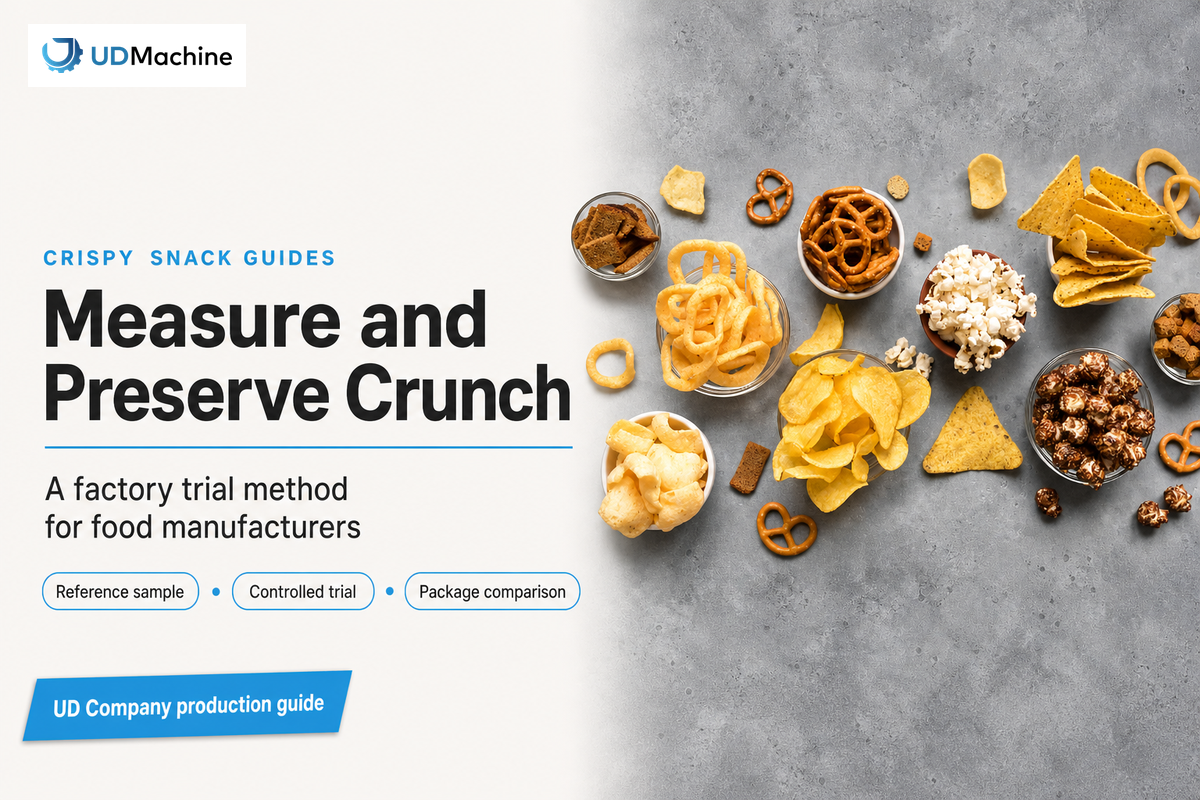
Crispy snack guides are product and process guides for production teams. For production teams, a guide needs to capture “crisp” for the product, indicate the spot where the bite transitions, and disentangle process effects from package effects. This article outlines a method to assist this task: one useful tip is to compare a candidate with an unchanged control. This article doesn’t establish a water-activity target, machinery setting, or a shelf-life period for an untested snack.
Crispy snack guides for manufacturers begin with an approved reference sample, then compare matched products at process exit, after cooling and after packed storage. A measured change tells the team which handoff to investigate before altering the line or film.
Key points
- The same water-activity reading doesn’t guarantee the same crisp bite across different snack structures.
- Fracture or acoustic measurements are given meaning by a sensory reference. Once calibrated, a model can aid routine assessments of a specified product in the future.
- Test package candidates against a control with comparable snack, seal and storage conditions.
- The three sampling points below are an editorial diagnostic method, not a published universal standard.
What Does a Crispness Target Need to Specify?
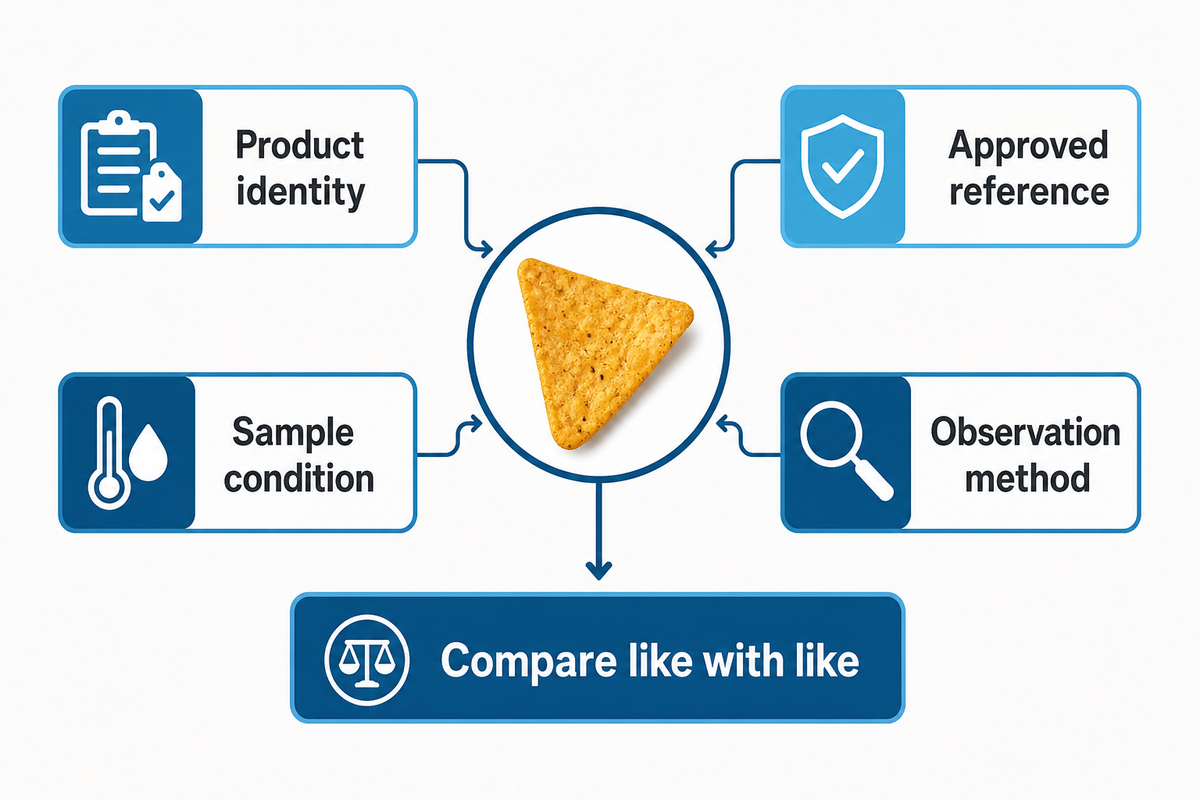
Useful crispness targets provide product identification, the approved reference sample, the condition and age of the sample, and the important sensory attribute. “Hard” alone is an incomplete target. Even a strong bite can lack the crisp fractures and sound people perceive as crisp. Record how the reference was judged and the format of sample presentation prior to selecting an instrumental response.
Maintain one approved lot and save a sufficient number of sealed reference samples for the comparison schedule. Use the crispness risk checklist to record open exposure and filling questions before comparing lots. Include a brief description of the proposed first bite, break pattern, and sound. Keep product geometry, temperature, and time since manufacture with the reference record. Please include a description of the bite that includes its fracture and sound. This description will assist a trained panel in discrimination, but the acceptance by the intended consumers is a different challenge.
A puffed-snack classification study at Bern University of Applied Sciences trained a force-and-sound model against sensory rankings and reported up to 92% accuracy within its studied products and humidity conditions.
That result supports validated, product-bounded routine classification; it isn’t a ready-made pass score for another snack because a production team risks copying its reported 92% accuracy without UD Company product-specific validation.
Record the sensory anchor first, then test whether a chosen instrument remains reliable across your own lots.
Build a Controlled Trial Before Changing the Line
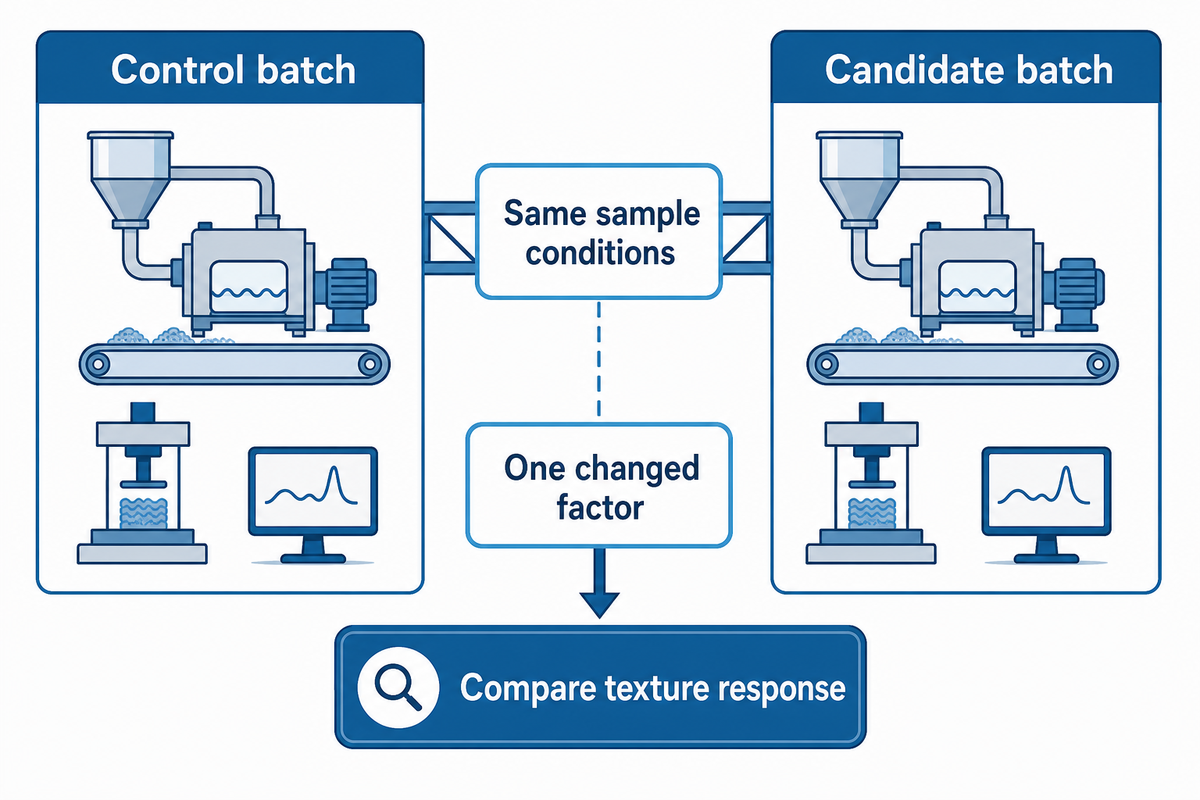
A controlled screening trial compares a candidate to a defined control while keeping the product and observation method the same. If the objective is to identify the most probable cause, first locate the texture change, then change a single factor while keeping all other factors constant. If it isn’t feasible to maintain constant conditions, then replicate the samples and change the order in which the experiments are done. If the formulation and settings may be interacting, be sure to use a design that accounts for interactions prior to making a strong causal or scale-up claim.
The easiest starting comparison likely involves a change in an exposure time used in the cooling step while holding the recipe and process step schedule the same. Use the same sampling method and sensory reference in both conditions. If the perceived difference disappears on the next run, look at the lot or the method of measurement before spending money on new equipment. NIST’s experimental-design advice tells us about why replication and randomized assignment help to strengthen a one-factor comparison. A study of pearl millet extruded-snack used a more complex design to analyze the effect of interaction of composition, feed moisture, and barrel temperature; the values used in that study shouldn’t be taken as recommendations for another product.
| Record | Control | Candidate |
|---|---|---|
| Product and ingredient lot | Same identified lot | Same identified lot |
| Changed factor | Current condition | One documented alternative |
| Sample timing and method | Predeclared schedule | Matching schedule |
| Outcome | Sensory, break observation, water activity | Same observations |
This screening table can’t account for all potential interactions, and an apparently superior preliminary result will still have to be validated at the scale of intended full-scale production. A controlled-change trial record can capture the one changed variable and held conditions before the run.
Published protocols show why a trial sheet must name its own conditions. None of these studies are UD Company specifications or are intended to be reproduced in new recipes.
| Study | What the researchers recorded | Transfer limit |
|---|---|---|
| NIST design example | 1 factor, 4 levels and 3 replications per level, yielding 12 runs | Illustrates design logic, not snack performance |
| Pearl-millet extrusion | 17 runs; 10%, 15% and 20% feed-moisture levels; 60 °C, 70 °C and 80 °C barrel-temperature levels | Only the studied ingredients and lab machine |
| Fish-cracker sorption | 25 °C and 35 °C; approximately 1–2 g per sample; 100 ml/min flow in the sorption instrument | A measurement method, not a production setting |
| Cereal-snack storage | 20 days at 25 °C and 50% RH; the experimental film showed 21% lower reported water-vapor capability | Only the compared snacks, bags and conditions |
Measure Fracture and Water Activity Together
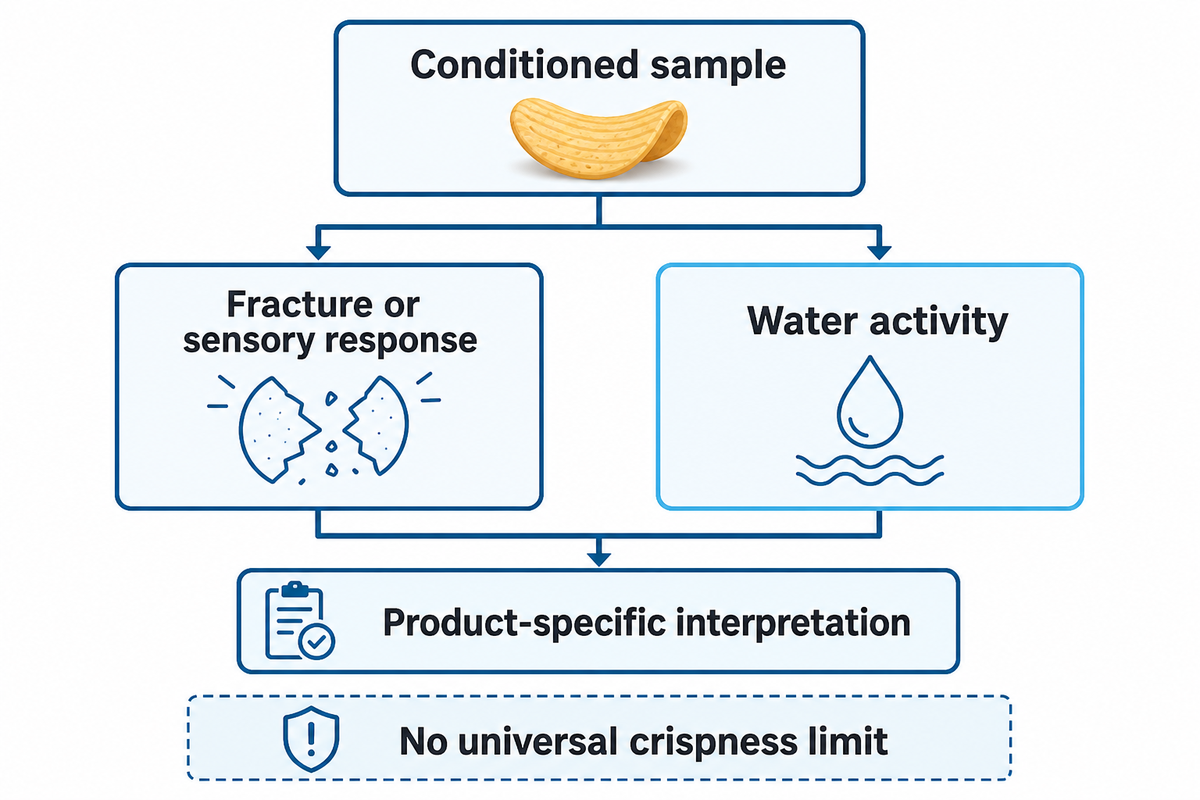
Water activity refers to how much water is available under the given conditions, which isn’t equivalent to the total moisture content. Break or sound observations concern what happens when a sample breaks. There should be a sensory reference for matched samples to enable the connection to the eating experience. Keep sample preparation and measurement temperature consistent before comparing lots.
The fish-cracker sorption study changed sample particle size and tested at 25 and 35 °C. Preparation influenced the estimated transition, which is a reason to standardize the test method before interpreting a difference in production, because inconsistent preparation risks a false failure signal. An USDA-hosted extrudate study compared trained sensory evaluation with force and acoustic responses and warned against treating instrument readings as an unconditional replacement for a panel. The Bern study shows the other side: a product-specific classifier can assist routine work after sensory calibration and validation.
For a defined product, a texture analyzer is useful if a repeatable sample break is possible and if a feature is captured which indicates the approved bite. In the absence of a texture analyzer, a sample break done manually and a descriptive panel which is used with great consistency still yields observable information. Don’t be taken in by an aw cutoff, peak force limit or test geometry from a different snack. Replicate the test and note if a high force resulted in a pleasantly crisp snap or an unwelcome hard bite.
Although a crunchy sound may be an interesting observation, prior to comparison identify the break method and the listener.
Use the 3-Point Crunch Drift Trace
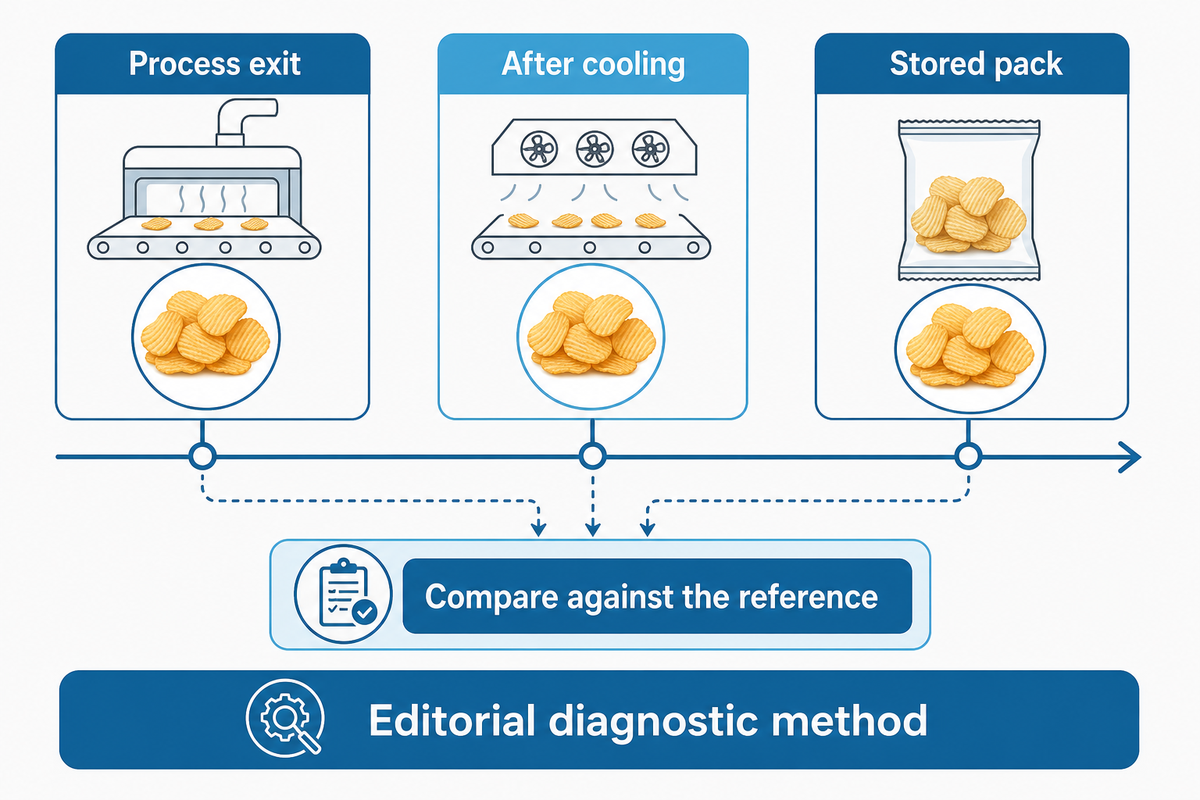
The 3-Point Crunch Drift Trace shows a proposed sampling record at a process exit, after cooling and following a defined period in a sealed package. It’s an editorial trouble-shooting method and not a validated industry standard. This method is used to identify the first observed texture change prior to the team selecting the process, exposure, or package condition for which a controlled trial is warranted.
- Sample process exit — record the product state and a matched break observation as soon as the defined cooking or drying step ends.
- Sample after cooling — record elapsed time, product temperature and ambient exposure using the same observation method.
- Sample after sealed storage – identify pack identity, examine the seal, record the storage condition and the predefined period prior to repeating the observation.
Retain a control sample that isn’t exposed to the test condition. If the sample is already weak in process exit, then investigate the input and the process condition prior to attributing the finished bag result to the film. If the failure occurs during cooling, then that should be measured. Otherwise, do not increase the temperature of the oven or fryer without a controlled comparison. When a change is observed only after storage, it points toward package, seal, humidity exposure, or another time-dependent pathway; it does not establish the cause. These are diagnostic leads and not evidence of a failure mode.
Diagnose a Failed Sample Without Guessing at the Fix
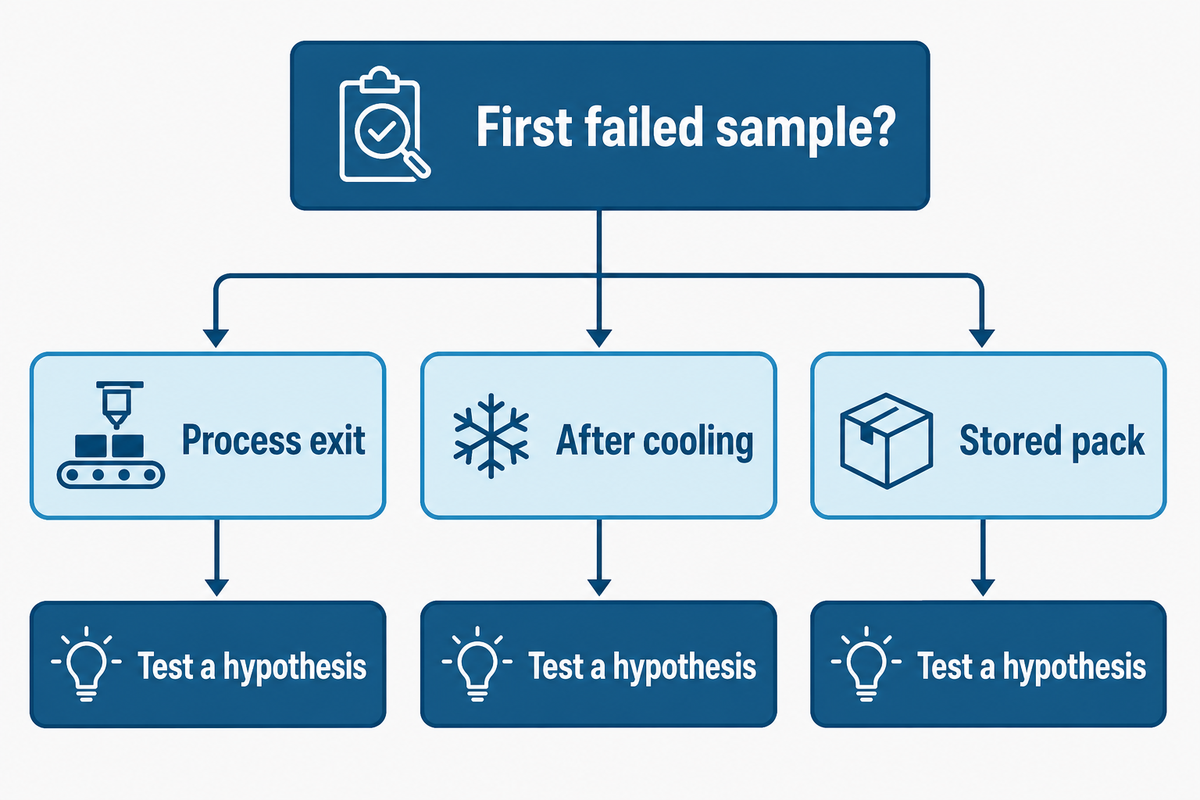
Identify the earliest reproducible failure, then challenge the predominant explanation by conducting a matched-control comparison. Soft samples could be affected by formulation, processing and cooling, or storage. The finished bag by itself can’t discriminate among these possible causes. Consider the measured texture, along with the lot of the ingredients and the pack geometry, as well as processing and handling conditions. Repeating a controlled comparison is more informative than changing heat, speed, and package material in the same run.
Do
- Compare samples from the same identified batch.
- Keep sample temperature and test method consistent.
- Check the first time point that fails.
- Inspect seal condition before blaming film barrier.
Do not
- Transfer another product’s aw limit.
- Change several process factors in one screen.
- Assume a stored-pack failure started in storage.
- Call a texture pass a complete shelf-life pass.
For early failures, compare the failed lot with its approved reference and with a repeat lot of the same recipe. For cooling stage failures, compare exposed and sealed samples over the same period of time. For a storage-stage failure, compare control and candidate packages with consistent fill, closure, and handling. Report what would disprove your hypothesis before conducting the next run.
Use the matrix as a test-selection aid. Each observation is a lead, not a diagnosis.
| Observed pattern | Controlled check | Next decision |
|---|---|---|
| Weak at process exit | Compare the failed lot with an approved reference and a repeat lot using the same recipe. | Test the input or process hypothesis before blaming packaging. |
| Hard at process exit, little snap | Compare a matched sensory break with the instrument response. | Check whether force is measuring the bite people actually reject. |
| Change first seen after cooling | Compare exposed and protected samples from the same lot on the same schedule. | Test the cooling or exposure pathway; keep the process hypothesis open. |
| Cooling result does not repeat | Repeat sample preparation, observation method and run order. | Treat the result as uncertain before changing equipment. |
| Change first seen in storage | Compare matched product in control and candidate packages at predeclared times. | Investigate package, seal or exposure without assigning a cause yet. |
| Only some sealed units weaken | Inspect finished seals, wrinkles, damage and handling alongside texture. | Separate unit-level closure variation from the film specification. |
| Instrument shifts, panel does not | Repeat the break method and compare readings with the approved sensory sample. | Review method fit before resetting a texture limit. |
| Water activity shifts, bite holds | Observe matched sensory and water-activity results over the same interval. | Keep the acceptance rule product-specific; do not infer a universal cutoff. |
| Pilot result changes at production scale | Check residence time, energy input and sampling conditions at both scales. | Revalidate the target instead of copying a pilot setting. |
Compare Packages Against a Control
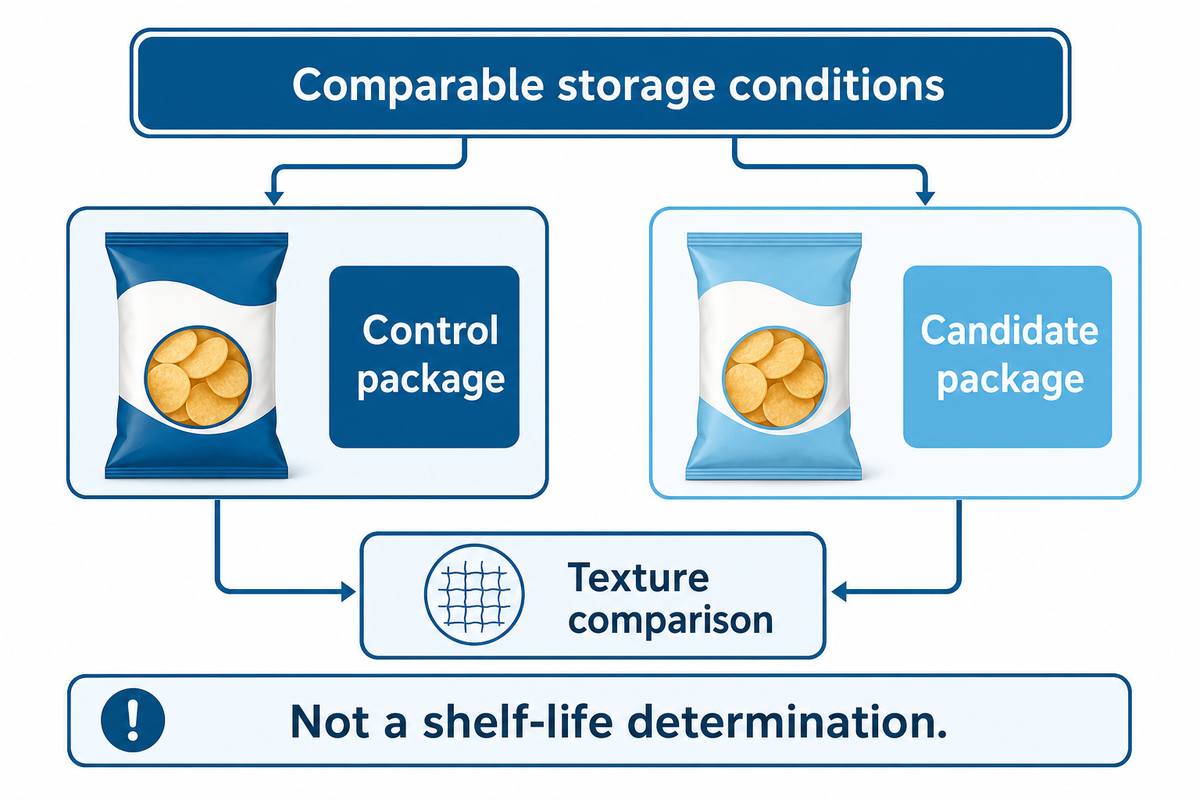
An ideal packaging test involves placing comparable snack samples in the control and candidate packs, and placing these samples under the same storage conditions for observation. Record the film structure and closure, then inspect finished seals and physical damage separately. Barrier data describe a material; the comparison of package and product sample assesses the texture. Despite numerous observations, conduct the measurements at the predetermined time interval as opposed to selecting only the best looking end sample.
According to ASTM E460-21, a sensory practice for evaluating the impact of different packaging systems on stored products is described. The public scope of the packaging comparison practice says it is not an assessment of shelf life. In a study on cereal and snacks stored for 20 days at 25 °C and 50% relative humidity, researchers compared an experimental bag to a conventional LDPE zipper bag as a control for biscuits, shortbread, and puffed snacks. They reported moisture and texture changes in the test products, which were observed under those packaging and test conditions; they do not ensure a shelf life.
Even a candidate that doesn’t get selected can provide guidance. If two packages have equal performance, but individual units fail, check the consistency of seal, filling contamination, wrinkles, and damage. If a control and a candidate diverge only after a change in exposure, repeat the comparison under the intended distribution conditions. An IFT package-seal testing discusses why seal integrity should be assessed independently of a film specification.
Set a Product-Specific Acceptance Rule
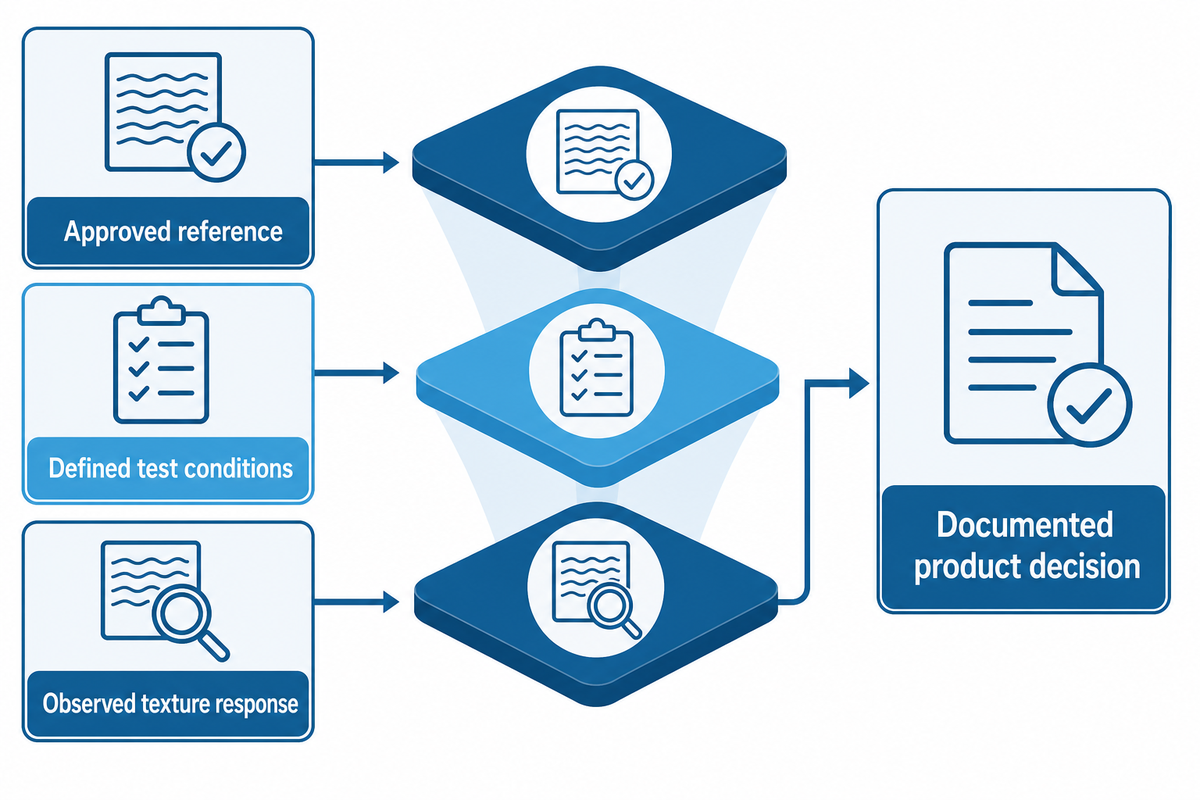
A rule for acceptance must be stated before candidate results are assessed. The description of the sensory comparison, the amount of sample, and the measuring method for the product must be stated; the variation shown by the reference lot must also be stated. For that product, a water-activity value can be included in the rule only after it has been related to the desired bite for its formulation and structure. Copying a universal number used for another cracker or puff would conceal differences in the product.
Texture is only one endpoint. Trained panels can describe whether samples differ; intended consumers may still prefer a different bite. Fat-containing snacks may develop an undesirable oxidized flavor, while the fracture may still be acceptable. Controls of food safety and full shelf life claims require their own evidence. The FDA water-activity technical guide discusses preservation and measurement conditions, while ASTM E460-21 explicitly limits its packaging practice to comparative sensory effects. Neither source provides a universal crispness pass level.
When a team is missing replicates or has a sensory result that’s ambiguous, consider a “repeat” decision instead of requiring a pass or a fail. Keep both of the reference samples (rejected and accepted) for the following review. With a documented rule in place, operators and quality personnel from the affected teams and suppliers can review the same trial after a challenge. A product trial acceptance matrix can keep the rule and open items visible before an engineering discussion.
Translate Trial Evidence into Line Requirements
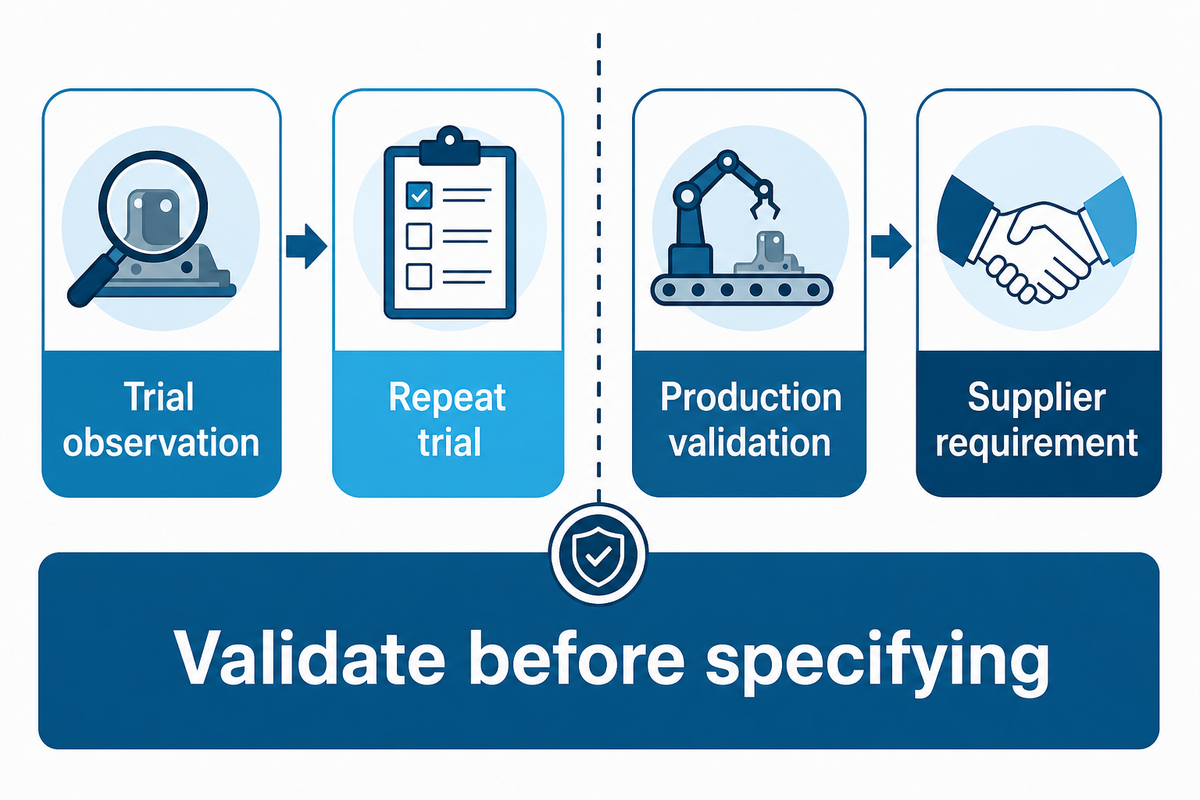
Bring a defined product sample, the first texture-change time point, the controlled comparisons, and the measurement conditions to the equipment discussion. Describe the behavior of the process to be observed or controlled (e.g., uniformity of heating, degree of exposure during transfer, access for sampling) before requesting a change in a machine setting. The supplier can’t determine formulation, cooling and packaging from one finished-bag reading because that reading cannot locate the production failure.
Record target throughput, product geometry, recipe range, cleaning requirements, utility constraints, and the downstream package interface. The finished-product brief builder can collect product format, output basis, and packaging questions for that discussion. Indicate which values were measured at a pilot scale and which are still pending measurement at full scale. A Purdue extrusion scale-up study identifies energy input and residence-time distribution as important scale-up relationships. A separate pilot-versus-industrial wheat-bran comparison found different material responses under nominally matched conditions. These sources warrant a scale-up checklist; they don’t provide any settings or performance for UD Company equipment.
UD Company is developing automation for the production of food, such as egg-roll machinery. The company hasn’t provided any product-specific trial results for crispness for this guide. For the production of various types of crispy snack and the various routes of production, refer to the existing solution page. This article is intended to assist the team in the preparation of evidence for the discussion. It isn’t intended to duplicate the catalog or to indicate that we’ll fix the machine.
A One-Page Batch-to-Bag Record
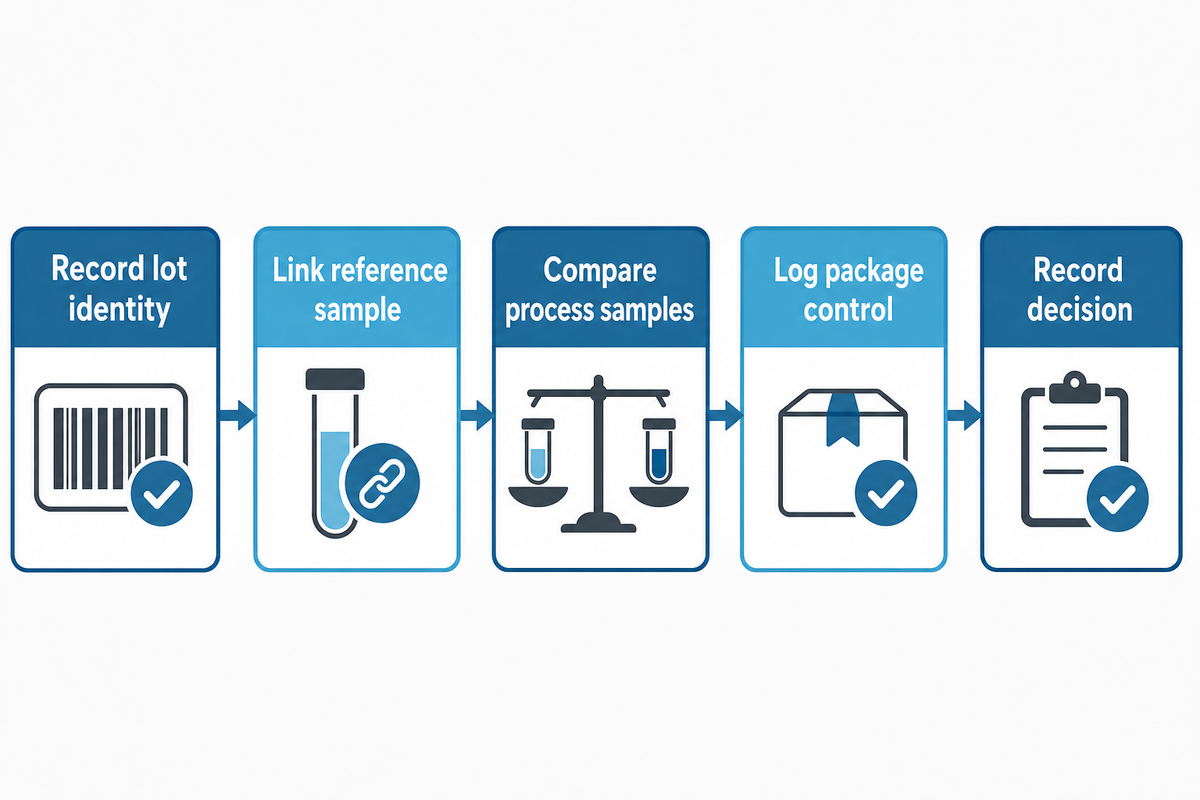
One record should be able to capture all the conditions for a texture decision. Using a blank worksheet avoids fabricating plant data and ensures that the experiment can be repeated. Assign sample collection to one person and sample review to another person if the result will lead to a purchase. Keep the decision along with observations rather than reducing to a pass/fail decision.
It would be useful to record the ID of the reference sample next to every observation so a later reviewer can reconstruct the comparison.
| Record category | Entry to capture |
|---|---|
| 1. Reference | Approved sample ID and sensory description |
| 2. Batch | Product, recipe version and ingredient lot |
| 3. Changed factor | One planned difference and held conditions |
| 4. Run context | Equipment, scale, rate and operator |
| 5. Exit sample | Time, temperature and texture observation |
| 6. Cooling sample | Elapsed time, ambient exposure and observation |
| 7. Package control | Control and candidate pack IDs |
| 8. Seal and handling | Inspection result and visible damage |
| 9. Storage sample | Interval, conditions and texture observation |
| 10. Water activity | Method, sample preparation, temperature and reading |
| 11. Break response | Sensory note or instrument trace and replicates |
| 12. Decision | Advance, repeat or investigate; reason and reviewer |
The label ‘Advance’ indicates a candidate has satisfied the predetermined criterion for texture in the specified conditions. ‘Repeat’ indicates the evidence is too variable or incomplete. ‘Investigate’ indicates a reproducible failure has been identified, but its cause requires more investigation. These terms can’t be used as a substitute for safety or full shelf life evaluation.
Key takeaway
For a specific snack, a reference sample and three timed observations can help locate the first texture change. Treat this as a potential starting point for a controlled study, rather than a definitive explanation of how one machine or film may have caused the problem.
Frequently Asked Questions
What is the difference between crispness and hardness in a snack test?
Read the answer
Hardness describes the force needed to deform or break a sample under a defined test. Crispness is defined as the sensory experience of the first rapid fracture. Even a hard sample can still feel tough. When interpreting results, reference an approved product, consistent sample geometry, and a documented sensory description. In most cases, instrumental measurement after calibration can support routine checks but should not replace the sensory reference.
Can water activity alone tell us whether a snack will remain crisp?
Read the answer
No single reading of water activity provides a clear indication of the bite of every snack. There are several other factors. In the fish cracker study, changing the preparation altered the measured sorption behavior. That study shouldn’t provide a pass criterion for another recipe. Compare water activity with sensory or fracture observations on matched samples at the same time points. Set an acceptance rule only after readings have been related to your own approved reference and repeated across relevant lots.
How should we compare two package films for crisp snacks?
Read the answer
Fill a control and candidate packs with similar product, then use the same closure method, storage conditions, and observation schedule. Inspect each finished seal, and record any evidence of handling. Do not credit film barrier alone for texture changes. Follow the sensory texture and water-related measures together. ASTM E460-21 offers a comparative sensory scope for packaging systems, but explicitly does not evaluate shelf life. A package that wins one controlled trial still needs assessment under the intended conditions of production and distribution.
What should we record when a snack softens after cooling?
Read the answer
Keep the batch ID with process-exit and post-cooling samples. Record elapsed time, product temperature, room exposure and a reference break description. Compare an exposed sample with a protected control from the same lot. Repeat an inconsistent result before changing a machine setting. The three-point trace organizes these observations; it’s an editorial method.
When should a texture problem be raised with the equipment supplier?
Read the answer
When the first failing handoff occurs, provide the supplier with an evidence package from a controlled comparison. An approved sample, recipe, and lot version with the intended scale and rate are required. Include samples from the process exit and cooling, pack control and seal, observations of seals, and the test method. Provide a description of the physical failure; i.e. a weak fracture or tough bite failure, etc., along with a description of the process parameters which were held constant. If the snack is sound prior to packing but deteriorates during storage, examine the package, and exposure and production conditions. Illustrate the basis for the target bite and assessment of whether the proposed line can be used for the sampling points. Request the supplier to differentiate measured user observations, instrumented measurements, rated capabilities, and conditions still to be confirmed. Measurement from a pilot sample implies a test hypothesis; it neither confirms the same result at production scale nor validates that the proposed line is the cause of the issue.
Planning a product trial?
Use the blank record above to define the sample, comparison, and acceptance question before discussing production equipment. UD Company can review documented process requirements for a relevant food-automation project.
Editorial transparency: This guide synthesizes published research and an explicitly proposed three-point screening method. UD Company did not provide first-party crispness measurements, customer trial outcomes, or product-specific equipment settings for this article. Study conditions are cited as examples of what researchers tested, and shouldn’t be considered factory recommendations. Updated September 2026.
References & Sources
- Classification of puffed-snack freshness Bern University of Applied Sciences repository
- Completely randomized designs National Institute of Standards and Technology
- Pearl-millet extruded-snack trial Discover Applied Sciences
- Fish-cracker moisture-sorption study Journal of Food Science and Technology, PubMed Central
- Mechanical, acoustic and sensory evaluation of extrudates U.S. Department of Agriculture hosted paper
- ASTM E460-21 public scope ASTM International
- Cereal-snack packaging comparison Foods, PubMed Central
- Testing the integrity of package seals Institute of Food Technologists
- Water Activity in Foods U.S. Food and Drug Administration
- Extruder scale-up parameters Purdue University
- Pilot and industrial extrusion comparison PubMed Central