Updated September 2026 · By GW
Guide scope
Reader: product development, plant, QA and procurement teams.
Task: move from a named sweet snack to a sample brief, trial record and supplier questions.
Boundary: product names alone do not establish a recipe, equipment route or safety release.
Reader: product development, plant, QA and procurement teams.
Task: move from a named sweet snack to a sample brief, trial record and supplier questions.
Boundary: product names alone do not establish a recipe, equipment route or safety release.
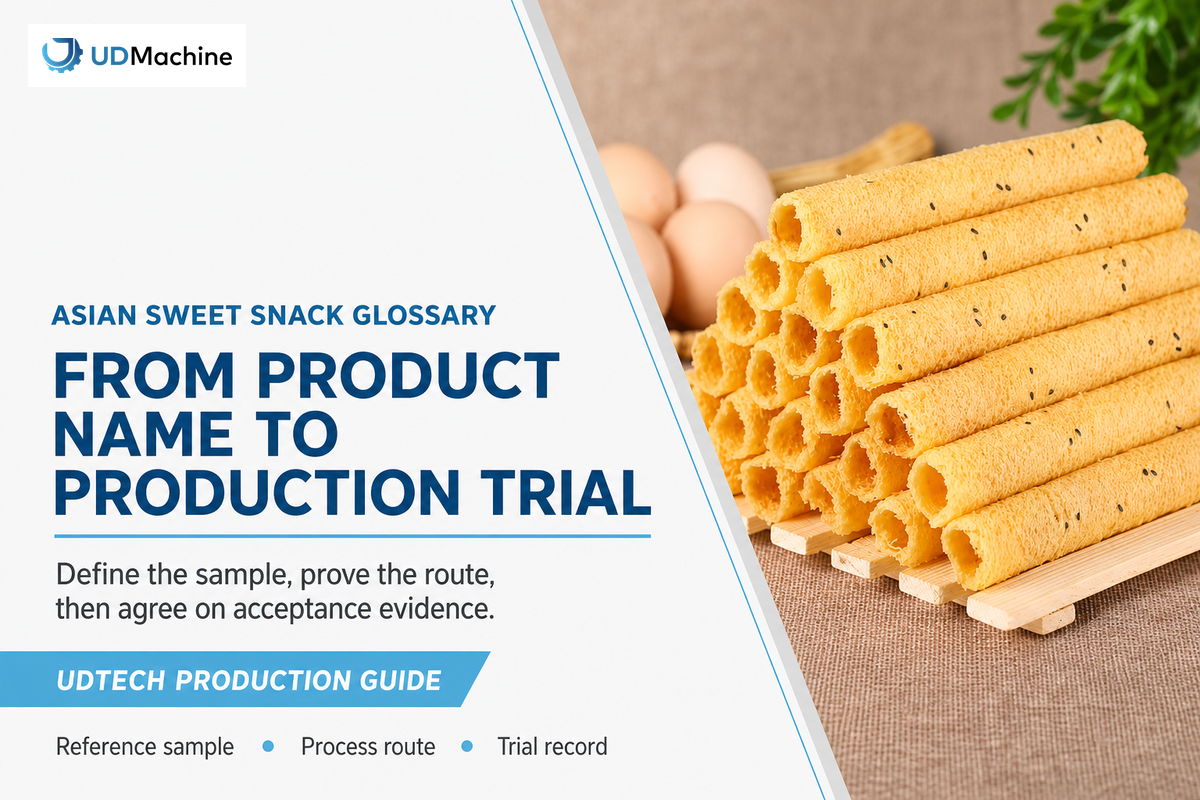
An Asian sweet snack glossary is a list of product names, forms and regional labels; for production teams, the name is only the first step in planning a manufacturing trial. Production teams need a reference sample, finished dimensions, ingredient and allergen information, target bite, handling conditions and a test plan. Please refer to UDTECH’s Asian sweet snack glossary for names, regions and A-Z entries. This guide starts after identification and asks what a trial must prove.
Production teams’ Asian sweet snack glossary: identify a reference product, identify measurable attributes, estimate likely process steps, then agree to a documented trial. One pleasing sample is product-quality evidence only; the buyer must evaluate food safety and line integration separately.
Key points
- A familiar trade name can describe several finished forms.
- Packed wafer bite may differ from its bite at the machine exit.
- One changed setting can’t reveal interactions among filling, cooling and storage.
- Before accepting a line quote, request model-specific cleaning, utility and interface documentation.
The name is not a production specification
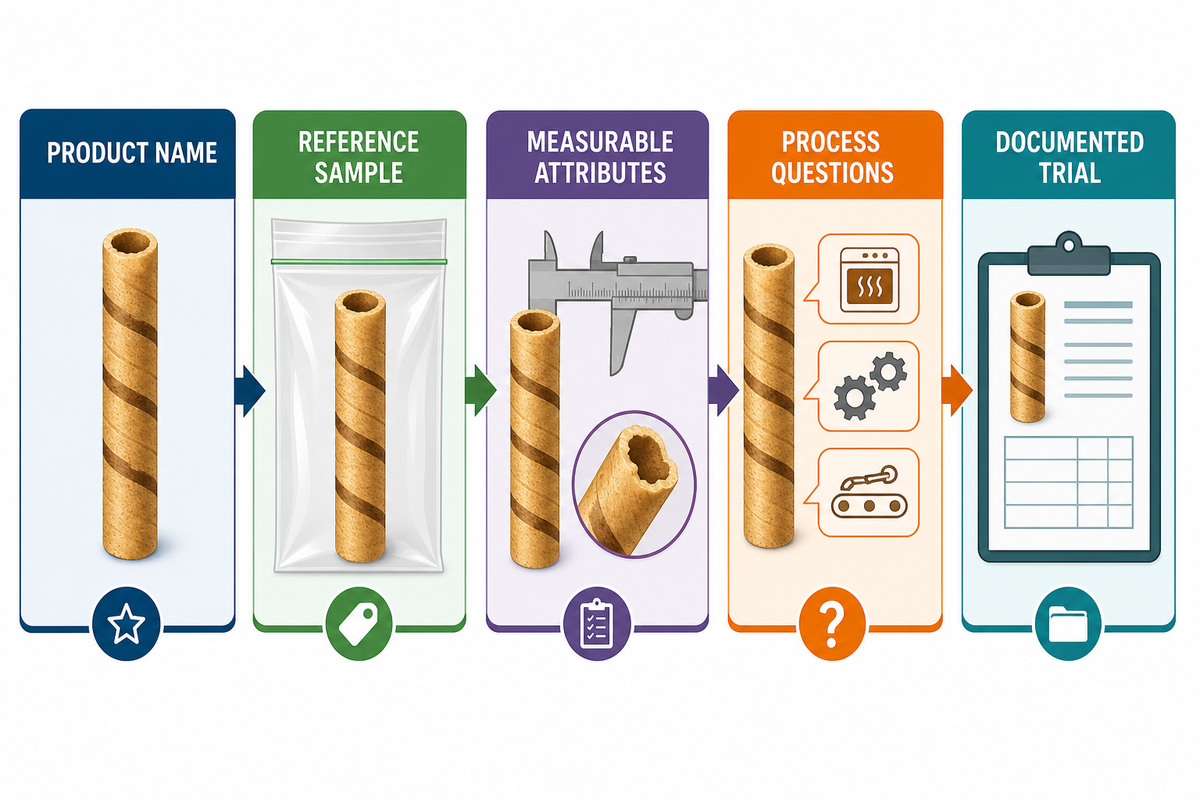
A sweet snack name opens a discussion, not a machine setup. Record the sample, the intended market, the ingredient and allergen profile, the visible form, the dimensions, the bite and the packaging. Equipment can then be discussed. Such a name can be a useful discussion and search label for the product the buyer intends.
The U.S. Department of Agriculture’s cookie description asks buyers to specify style, shape, flavor and other characteristics in the solicitation, contract or purchase order. This procurement example is not a global standard for every Asian sweet; it explains why “egg roll” by itself cannot be an acceptable definition. In the United States, the FDA’s food allergy guidance page also states that providing information on ingredients and allergens is a separate concern and should be addressed on the label or packaging.
5-Stage Name-to-Trial Evidence Ladder
As a five-stage handoff, the Name-to-Trial Evidence Ladder moves a trade name through documented evidence a buyer can review. It’s an editorial document and isn’t a logged record of a UDTECH factory test.
- Name the reference: link the glossary entry and attach a dated photograph or physical sample.
- Describe the product: state cross-section, ingredients, dimensions, piece weight, target bite and pack format.
- Map the operations: ask which baking, forming, filling, cooling and handling steps the sample needs.
- Set the trial: agree on measurement methods, repeats, storage intervals and reject rules before production.
- Review the evidence: sign the quality record and separately review food-safety and site-integration requirements.
Buying teams can send this record through the existing finished-product brief builder. That page guides the request; it doesn’t verify whether the machine can make the product. The buying teams’ objection is simple: A category name alone does not give a supplier enough information for a meaningful acceptance quote.
Egg-roll, phoenix-roll and wafer-roll forms at a glance
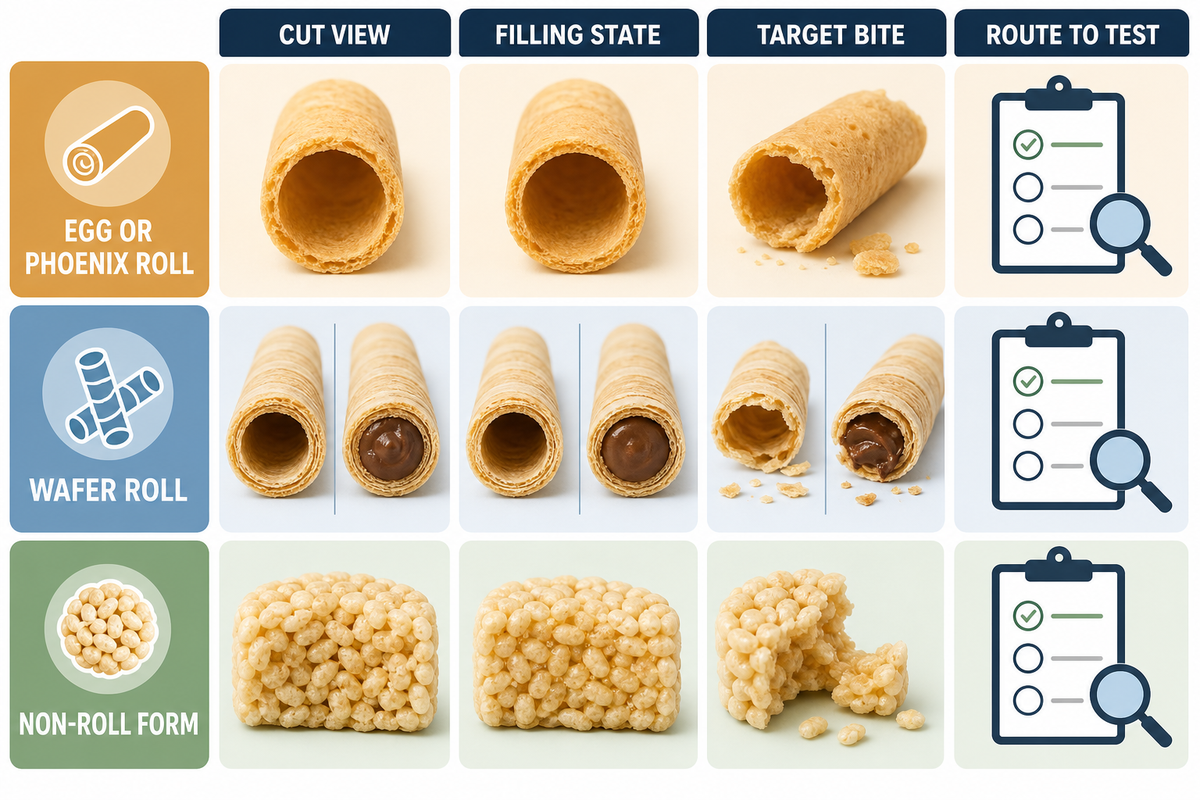
Egg-roll cookie, phoenix roll and wafer roll can be used as market labels, so classify the sample based on its physical form and handling needs. Ask for a cut view, filling state, target bite and dimensions before assigning a process family. Even though some names may seem to indicate a crisp rolled product, those names don’t give a universal recipe or geometry.
Below is a briefing matrix, not another listing of Asian sweets. Each row suggests what a production team needs to examine and where a rolled-cookie route may become less valid. Form and equipment cues in every row are screening hypotheses, not verified characteristics of all snacks bearing those labels; test each cue against the actual sample before quoting. For an unsure label, the snack classification builder helps organize the first sample questions.
| Product type / sample cue | Inspect before quoting | Trial implication | Limitations / Not suitable for |
|---|---|---|---|
| Egg-roll cookie | Rolled shell and seam | Measure curl, bite and handling loss | Name alone gives no shell thickness |
| Phoenix-roll label | Photo, cut view and packing count | Confirm actual forming and fill steps | No universal Phoenix dimensions |
| Hollow wafer roll | Open core and shell continuity | Check roll integrity after cooling | Cannot infer later filling behavior |
| Filled wafer stick | Fill distribution and end seal | Test bite after filling and packing | Dry-shell result is not filled result |
| Flat wafer biscuit | Sheet or sandwich construction | Confirm separate cutting/laminating route | Flat wafer data are not roll limits |
| Mochi or other soft rice sweet | Elastic body and rice-flour recipe | Ask for a different forming route | Crisp roll-line fit is unproven |
| Rice cracker, sweet or savory | Sheet, puff or molded form | Define its own bake and moisture trial | Cracker analog is not wafer proof |
| Tart or filled pastry | Open shell and filling deposition | Map shell forming and fill placement | Do not assume a rolled-sheet line |
| Candy or gummy dessert | Gel or sugar matrix | Request its own process family | No baked-shell route is implied |
A short Phoenix-roll check
A 2008 report from the Hong Kong Centre for Food Safety shows a 150 g pack with 10 egg rolls and a 150 g pack with 16 Phoenix rolls. For both packs, the number of pieces implies a nominal weight average of about 15 grams and 9.375 grams, respectively, per piece. This example illustrates that labels and unit formats vary; these calculated averages aren’t measured piece weights, current standards or evidence that all Phoenix rolls are small. Request the present sample and describe its cross section.
Source boundary: the 150 g package examples illustrate purchasing uncertainty, not an equipment tolerance. Selecting a line remains the buyer’s prerogative until the actual shell, filling, and pack count for the product are documented.
What to specify for an egg-roll cookie trial
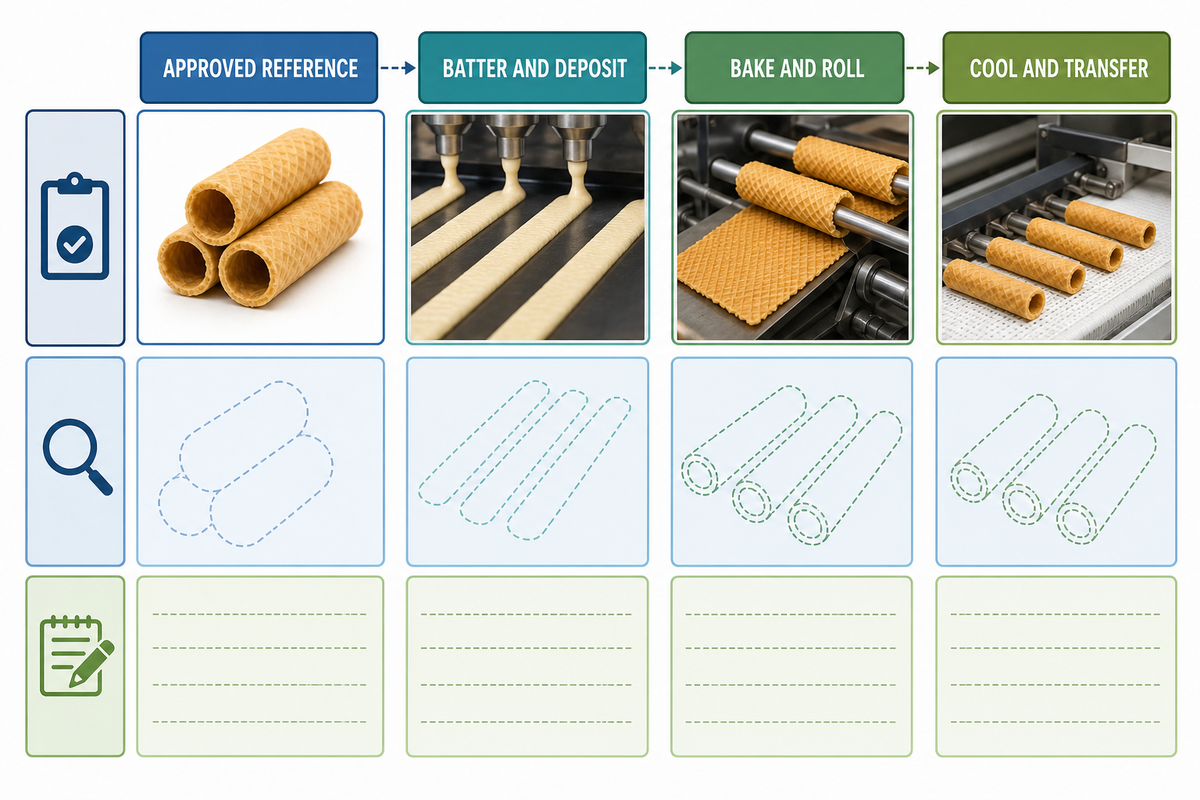
An egg-roll cookie trial should compare the finished sample with a buyer-approved reference under recorded conditions. Determine the acceptable range for visual color, continuous roll, roll size, uniform bite and breakage before starting the line. Record the recipe version, sample batch number and handling method. A pretty roll that appears to have been made under different batter conditions isn’t an acceptable repeat of the approved product.
Imagine a private-label buyer sending crisp rolls without a cross-section or ingredient sheet. If shipped without either, the plant may match the rolls’ exterior color. The best course of action is to take a picture, section the rolls, decide which face is measured, record how the sample will be handled, and keep all samples that are rejected. This is more of a planning scenario and isn’t a UDTECH lab test result.
This trial seeks to identify the batter, determine deposit consistency, examine the appearance of the baked roll, measure time between baking and rolling, inspect seam closure, record cooling conditions and damage during transfer. A published egg-roll machine patent application provides one example of bake and roll. That patent doesn’t speak to the UD machine or the capability of the current model or the process window. Suppliers must demonstrate the proposed sequence on the buyer’s recipe and reference sample.
Some prospective purchasers might think that having a single good-looking batch is adequate. It may be a useful prototype, but it doesn’t validate whether the process can deliver repeated batches or the impact of repeatedly conveying the product. Require defined repeated observations, an agreed storage interval and the proportion of pieces that remain acceptable after handling. No general hardness number should be copied from a different egg-roll formulation.
Hollow and filled wafer rolls
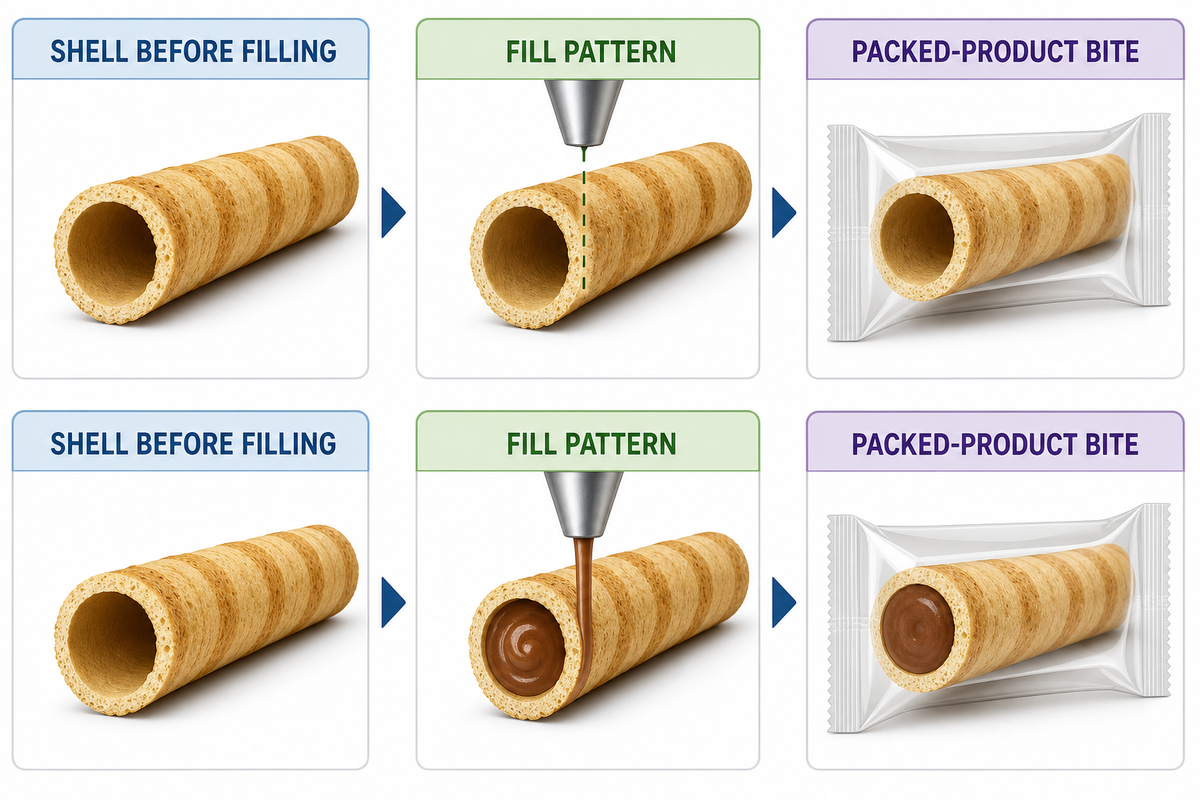
Hollow and filled wafer rolls require different evidence because filling adds a contact surface and another handling step. Evaluate the shell before filling, the fill pattern afterward, and the finished bite after the agreed pack interval. Fresh shells may appear crisp, but the delivered filled product may react differently to moisture, temperature and the handling that the product experienced.
The peer-reviewed fish-cracker moisture-sorption study relates water uptake and crispness of the product. Fish crackers are an analogy for a dry-starch texture mechanism, not a validated wafer-roll threshold. The wafer-type biscuit texture study also compared sensory assessment with instrumental assessment, but its flat commercial products and method aren’t a buyer specification for filled rolls.
Suppose a sample passes an exit line snap check and then loses the target bite after filling and sealing storage. For a filled-roll trial, the buyer needs a minimum of two labeled observation points: the shell before filling and the final packed product after the required time. Note the storage conditions, fill formulation and package barrier together with the observations. Without those notes, the trial record cannot isolate whether the change began during filling, cooling, or storage. This is a hypothetical diagnostic scenario and isn’t a measured UD case.
The crispness risk checklist and wafer route selector may give focus to the question prior to the trial. However, they can never replace a controlled product trial.
Source boundary: the fish-cracker paper studied samples at 25 and 35 °C, not a UD filled-roll line. Moisture observations belong in the trial record only with the buyer’s product, filling and storage conditions. Procurement shouldn’t accept a quotation that brings in an unrelated study’s critical point as a guarantee.
From reference sample to process steps
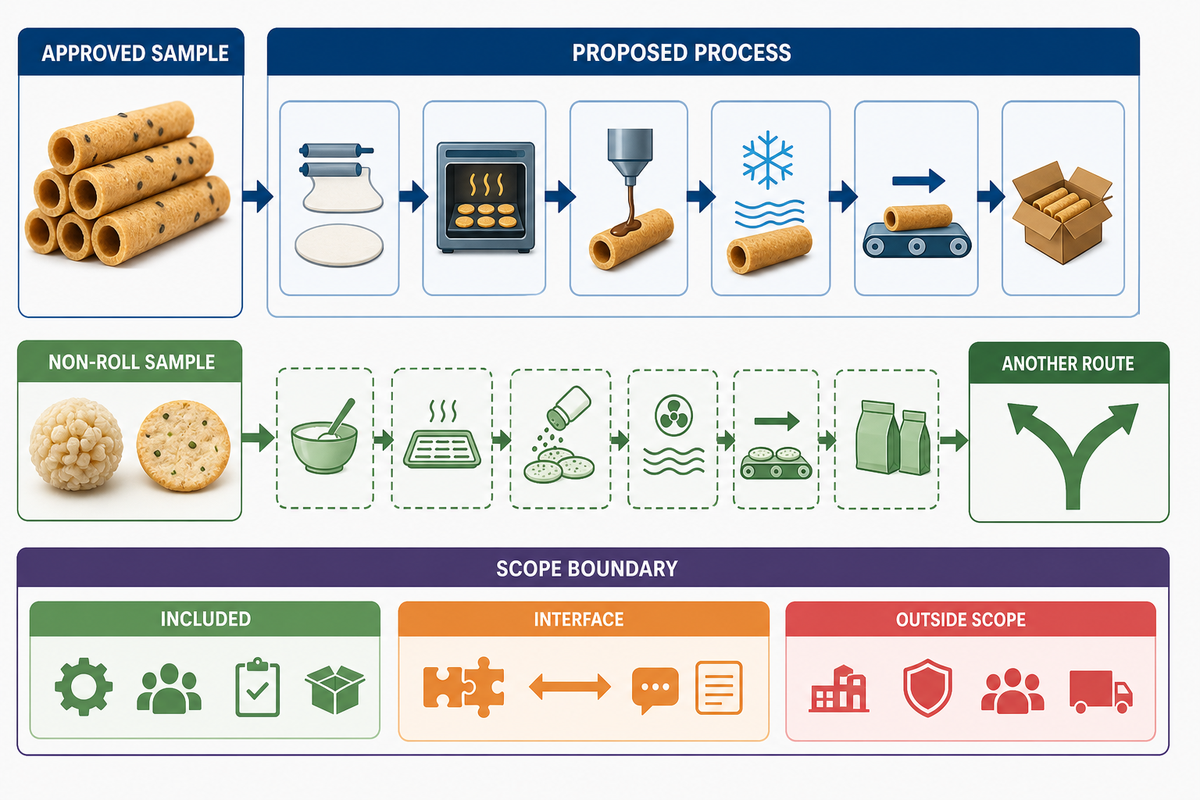
Process mapping starts with the sample that was approved and works backward through forming, baking, filling, cooling, transfer and packing. This map provides an indication of the steps that need to be proven; it doesn’t specify a machine from the word ‘roll’. Buyers should require that the supplier provide a proposed route and indicate which operations are included, upstream, downstream or outside the supplier’s scope.
A published patent application describes one egg-roll process using a heated sheet and rolling stage. Filled wafer sticks add a separate filling and post-fill handling question. Soft mochi, red-bean sweets or tarts may require a different route altogether. A filling stage on rolled-cookie equipment doesn’t make these other products compatible. This comparison matrix is a screening tool, and each claimed product family must be substantiated by the actual supplier.
When a rolled-cookie line is the wrong route
A food brand asks whether one “Asian snack machine” can make a Japanese sweet, a savory rice cracker and a filled wafer roll. These names describe snacks with different materials and finished forms. If one sample is elastic and moist, another sample is a crisp sheet, and the third sample needs a hollow core, stop at the reference-sample stage. Request separate process proposals or a documented multi-route system.
One photograph in a brochure can’t imply shared tooling, a reasonable amount of time for different cleaning operations, and/or an acceptable output for all three. Even if a supplier offers multiple forming heads, treat recipe preparation, changeover, heating and downstream packing as separate proof points. A rejected alternative is a quote which appears economical but can’t be accepted against the actual product.
Do
- Attach a current reference sample.
- Mark each required operation.
- Ask which stages the quotation includes.
Do not
- Infer tooling from the product name.
- Transfer patent ownership from a cited mechanism.
- Assume one line covers every snack form.
Build a trial record and acceptance criteria
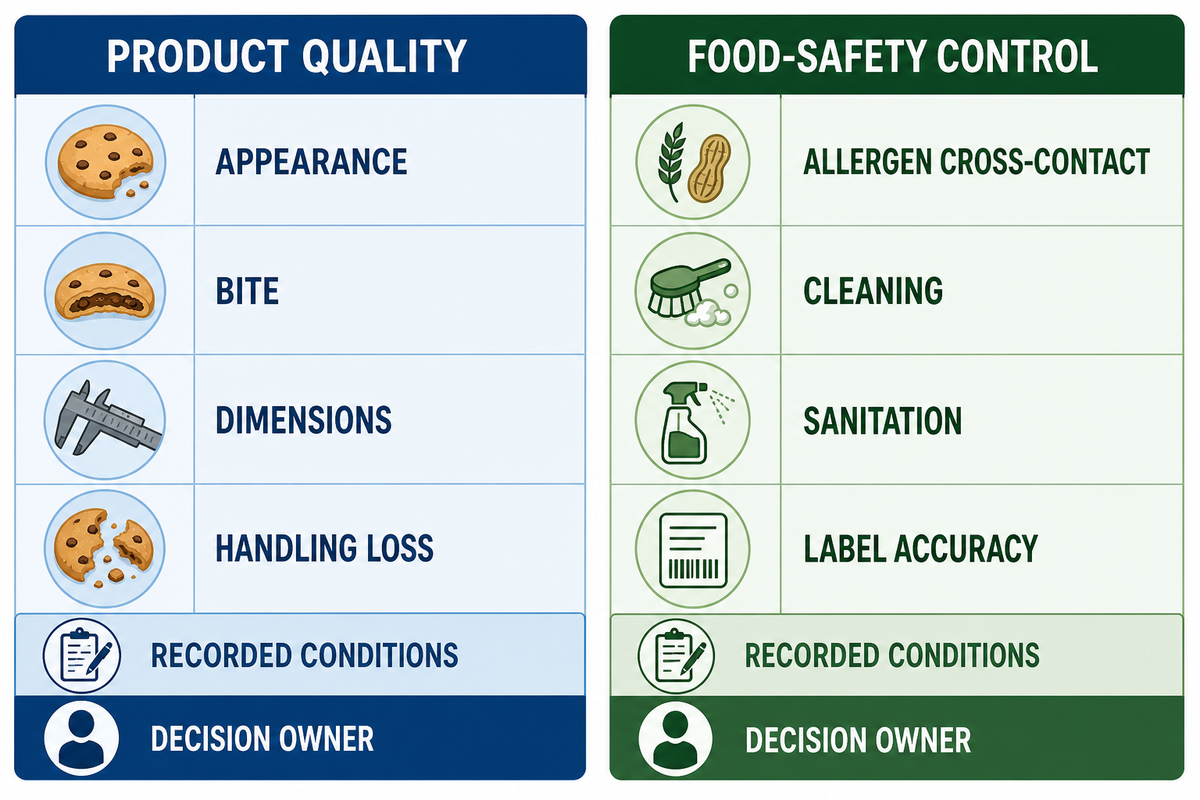
A trial record must tell both sides what was tested, how it was measured and who can accept it. Evidence concerning the quality of products should be separate from control of food safety in the facility. Samples that pass appearance or bite checks don’t establish control of allergen cross-contact, cleaning, label accuracy, or compliance in every intended market.
The USDA cookie description distinguishes buyer-specified characteristics from the choice to verify analytical requirements. In a six-brand wafer-type biscuit study, researchers used five repetitions on samples measuring 90 mm by 20 mm by 10 mm at 5.0% deformation, with 2.0 mm/s pre-test, 5.0 mm/s test and 10.0 mm/s post-test speeds. Those are published study settings, not a recommended acceptance method or limit for a rolled product. QA should choose methods that fit the real sample and handling goal.
| Record field | Evidence to retain | Decision owner | Limitations / Not suitable for |
|---|---|---|---|
| Reference identity | Dated photo, cut view, recipe version | Product team | Name-only brief is insufficient |
| Sample plan | Units per condition, repeats, run order | QA and plant | One display piece proves little |
| Dimensions and mass | Method, units, instrument, observations | QA | Supplier brochure value is not a sample result |
| Appearance and curl | Approved photograph and reject examples | Buyer and QA | Color alone cannot establish bite |
| Bite and texture | Sensory or instrument method, conditions | QA | Another recipe’s hardness is not a target |
| Handling loss | Count before and after transfer/pack | Plant and finance | Exit-line yield omits downstream rejects |
| Filled-pack interval | Pack type, storage condition, timed result | QA | Fresh shell is not delivered-product proof |
| Allergen and cleaning | Ingredients, changeover, sanitation records | Facility food-safety team | Texture pass is not safety release |
| Disposition and change | Accept/reject rule, deviations, sign-off | Buyer and supplier | Changed recipe needs a new comparison |
For a worked arithmetic example only, suppose a buyer inspects 20 pieces after cooling and finds 2 broken: handling loss is 2 ÷ 20 = 10%. If the same hypothetical product yields 5 broken pieces among 20 after packing, the observed loss is 25%. An additional 15 percentage points in these hypothetical observations may indicate a downstream concern, but a matched repeat is needed before identifying a cause or acceptable loss. To illustrate, a worksheet might show checks for packed products after 0 hours, 24 hours, and 48 hours. Actual intervals belong to the buyer’s shelf-life plan. Buyer QA teams decide on the sampling plans and acceptance levels.
For facilities covered by U.S. rules, 21 CFR 117.135(c)(2), (3) distinguishes allergen cross-contact controls, finished-food labeling and sanitation controls. Shared food-contact equipment therefore raises a separate changeover and cleaning question. A buyer’s food-safety team must decide applicable hazards and validation; a machine trial can’t sign that decision away. The existing production trial measurement builder can help structure quality observations.
Source boundary: five repetitions, 90 × 20 × 10 mm and 5.0% deformation describe a published flat-wafer experiment. For the actual roll and pack, the buyer must select a method. Here, the 10% calculation illustrates a hypothetical loss and is not a UDTECH yield or a commercially acceptable tolerance.
Diagnose a poor sample with interaction-aware tests
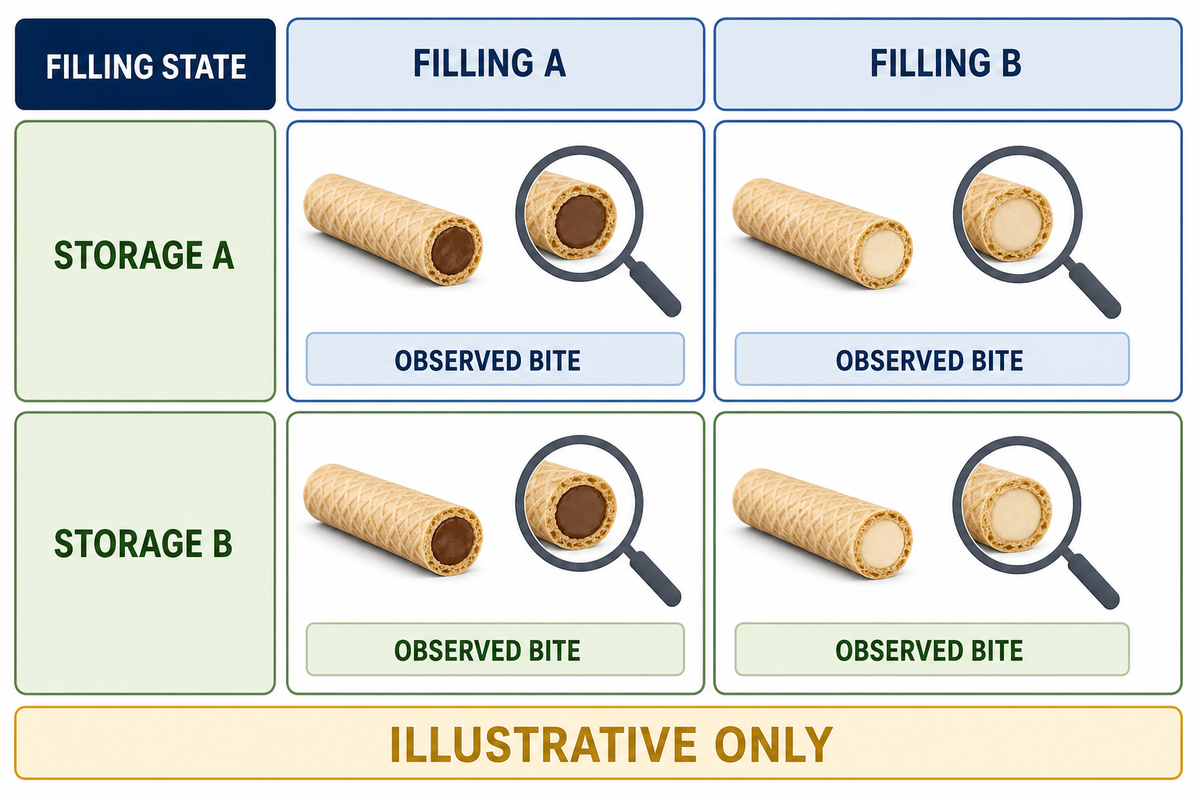
A poorly made sample should result in a documented comparison but not a series of untracked adjustments. Keep the reference product and measurement method stable, then identify the suspected cause. Determine what variables may be present and whether they interact. Changing one variable can test a hypothesis but won’t describe how filling, cooling, humidity and packaging interact.
One team sees good shell snap right after baking but then an inconsistent bite after filling and a humid storage interval. If it changes the bake setting, filling dose and package at once, the next sample may improve without explaining why. If it changes only the bake setting while filling and storage interact, it may wrongly reject a viable route. Keep the original conditions and choose the next comparison around the buyer’s actual failure, including the point where the defect first appears. This is a synthetic scenario and not a measured site event.
The NIST engineering statistics handbook says that one-factor-at-a-time experiments can overlook interactions. It isn’t related to the recipe or to the food industry. As an illustration, combining two storage states with two filling states gives four conditions; executing each condition twice gives eight runs before any extra controls. These numbers and conditions describe a possible design exercise, not a universal sampling prescription for all cases. Process or QA specialists should determine the test conditions, randomization and replication needed for the risk and available line time.
“OFAT experimentation leaves us in the dark about factor interactions.”
The baking-variable interaction planner can help prepare the question. A one-factor check can still test a single suspected cause under controlled conditions; it can’t serve as the complete acceptance design.
Decision boundary: an example focusing on a four-condition, eight-run illustration can show where the question of whether an interaction is present begins; however, it can’t establish statistical power, food safety or a commercial guarantee. Buyers should reject a confident root-cause claim when run order and repeats, as well as the filled-pack interval, were never recorded.
Integration, utilities and the RFQ handoff
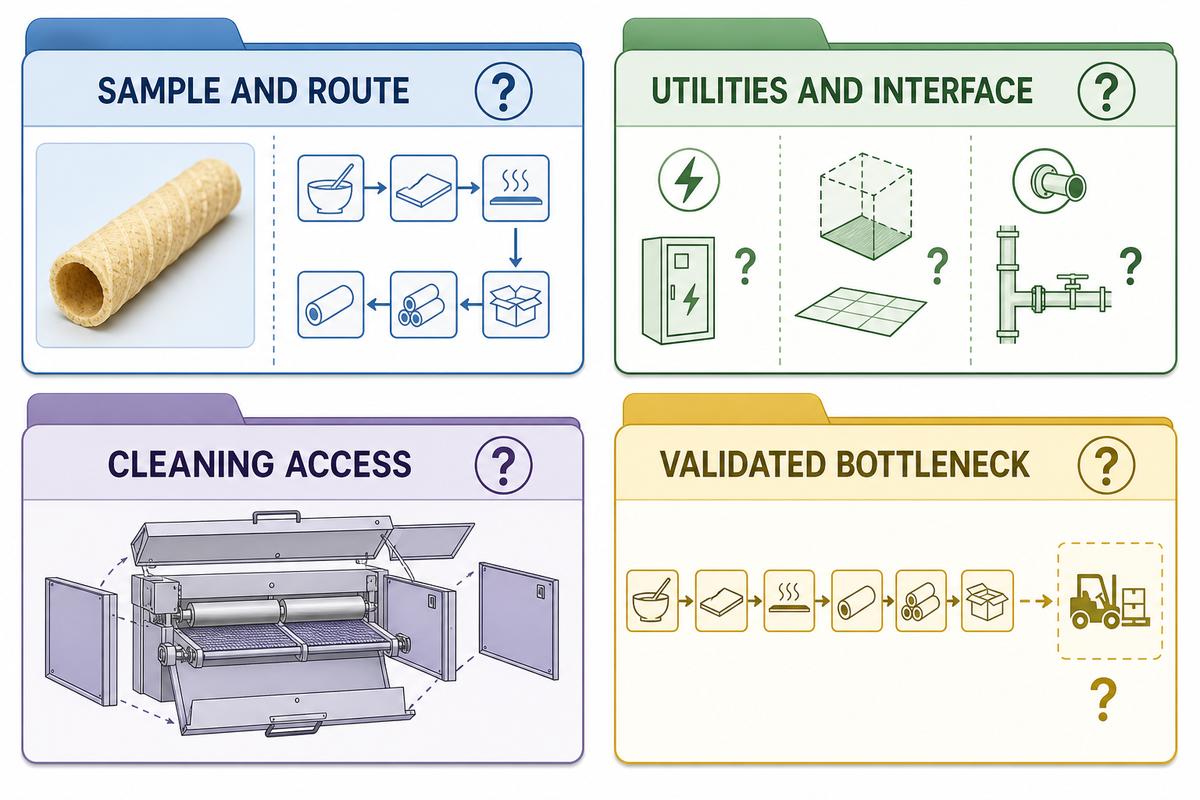
An equipment RFQ should ask for a route that works on the chosen sample and fits the surrounding line. Request the proposed model’s capacity basis, power, footprint, interface, cleaning access, changeover method and downstream handling. A line quote remains provisional until the buyer checks the slowest validated stage and the facility’s own safety and utility constraints.
One Hong Kong government food-line RFQ example lists equipment-specific fields rather than treating a line as one electrical load. Its illustrative mixer uses 220/380 V, a 3.7 kW motor and an adjustable 10 RPM to 100 RPM range, while a filling-machine example uses 220 V single phase. The template also lists a 50 kg mixer batch, 50/60 Hz supply and 1500 mm mixer length; none gives saleable filled rolls per hour. All of those are example-document figures, not UDTECH machine specifications or recommendations for this project. OMAC’s PackML overview describes a common machine-behavior convention for supporting systems; ask whether the proposed model provides a documented interface instead of assuming support.
| Stage | Question for supplier | Evidence to request | Limitations / Not suitable for |
|---|---|---|---|
| Recipe supply | Can batter stay within the agreed condition? | Input and change-control record | Headline speed omits recipe drift |
| Bake and form | Does the sample keep its approved curl? | Run conditions and reject count | One display piece is not repeatability |
| Filling | What happens to shell and fill together? | Filled sample and deposition record | Hollow-roll proof is insufficient |
| Cooling | When is the product fit for transfer? | Temperature/time and damage record | Fresh hot sample may mislead |
| Conveying | Which handoff creates breakage? | Before/after good-piece count | Machine-exit yield excludes losses |
| Inspection | How are rejects recognized? | Reference defects and method | Camera claim needs sample proof |
| Packing | Does bite survive intended pack? | Timed packed-product checks | Open-air snap is not shelf proof |
| Changeover | Can contact surfaces be cleaned? | Access, material and sanitation documents | No blanket cross-contact clearance |
| Site integration | Will utilities and controls connect? | Model drawings, loads and interface list | PackML is conditional, not assumed |
For covered U.S. food facilities, 21 CFR 117.40(a), (b), (d) discusses cleanability, ease of installation/service, food-contact surfaces, and seams. Requests for drawings and evidence for cleaning and changeovers should be made for the specific product. After the food safety team at the facility reviews the documents, the cleanability of the equipment should be evaluated. This regulation doesn’t endorse any particular UDTECH model. Finance reviewers should evaluate the quoted output against the good pieces that survive filling, conveying and packing, as an upstream rate alone isn’t a definition of saleable output.
Send the supplier the reference sample, process map, quality register and site questions together. UDTECH focuses on automation of food production and supplies egg-roll and phoenix-roll machinery. A review of public information for this article didn’t confirm model-by-model output, power, patent information, or the results of trials. For site navigation, see the food-site contact page; send technical product briefs through the main-site enquiry path below.
RFQ boundary: 220/380 V and 3.7 kW come from one public procurement example, not this supplier’s data. The lowest proven stage throughput, the 24-hour packed-product result if that interval matters to the buyer, and cleaning access can each change whether a quote is usable.
Key takeaway
The request begins with a product name; the signed sample record and stage-by-stage RFQ determine whether a particular line deserves a commercial trial.
Frequently asked questions
What are some sweet Asian snacks?
Read the production-focused answer
Egg roll cookie, phoenix roll, mochi, and filled wafer stick are among some of the names you see in the Asian sweet-snack markets, but a short name list won’t help a factory decide what route to quote. For that, you need to refer to the dedicated glossary page for names and regions. Please select one real reference sample, and note the form, recipe, and target bite and pack of the sample, before asking for a line.
What are some popular Asian-style snacks?
Read the production-focused answer
Examples to classify include candy, matcha desserts, rice crackers and filled biscuits; the sample form varies by market. Searches for Asian sweet crackers or sweet Asian rice crackers identify labels, not production routes; this guide doesn’t rank demand or repeat glossary entries. Procurement teams should identify whether the snack is a crisp rolled shell, soft rice-flour sweet, savory cracker or another form, then request a trial for that form.
What information should I send after I identify a snack?
Read the production-focused answer
Send a dated reference sample with clear photos, particularly cross-section views. Include the ingredient and allergen profile, recipe version, final size and weight, the state of the filling, the desired texture, the intended packaging and the market, and detail the quality checks and who accepts them. Japanese sweet names, red bean paste or seaweed garnish may help identify the reference, but the supplier needs the physical product brief to propose a defensible process.
Can one machine make every snack in the glossary?
Read the production-focused answer
Do not assume so. A rolled wafer, mochi and tart have different structures. Task each supplier to provide tooling, changeover and sample trial documentation for every family of products.
What should a line trial measure?
Read the production-focused answer
Record the approved reference, recipe version, run conditions, sample count, repeat observations, dimensions, appearance, bite, handling loss, and packed-product result at the agreed upon time. Record who measured each field and which version of the recipe was in the machine. A worked example might turn 2 broken pieces out of 20 into a 10% observed loss, but those figures are illustrative; the buyer’s QA team sets actual sampling and limits. Those were only examples. Actual sampling and limits are set by the buyer’s QA team. Shared-equipment allergen controls, sanitation, and label review are other food-safety decisions where applicable. A product that passes quality testing may still require the mentioned controls to be assessed for the facility to grant a release.
Why can a crisp roll soften after filling or packing?
Read the production-focused answer
Bite can change due to the type of filling, moisture movement, and the pack environment. That fish-cracker study doesn’t provide a threshold for filled wafer rolls. Compare the actual shell and packed roll at the buyer’s stated interval and conditions.
Ready for a specific trial discussion?
For direct enquiries, use the company’s main-site contact page. Provide the product brief, reference sample, and acceptance questions. Request the documented scope for the proposed model and a sample run plan.
Source and scope note: This article is based on public sources and an editorial trial framework. It reports no UDTECH factory measurement, model capacity, patent ownership, investment, or site-area verification. These regulations pertain to their own jurisdiction and facility scope. Product-quality acceptance, food-safety release and equipment conformity require separate, product-specific reviews.
References & Sources
- Commercial Item Description: Cookies (A-A-20295E) U.S. Department of Agriculture, 2025.
- Food Allergies U.S. Food and Drug Administration.
- Historical tested-products list Hong Kong Centre for Food Safety, 2008.
- US20110192289A1 egg-roll machine patent publication Google Patents record.
- Fish-cracker moisture-sorption study peer-reviewed research, 2020.
- Sensory and instrumental texture profile of wafer-type biscuits peer-reviewed research.
- 21 CFR 117.135: Preventive controls Electronic Code of Federal Regulations.
- One variable at a time NIST Engineering Statistics Handbook.
- Food-line RFQ reference template Hong Kong government procurement example.
- PackML overview Organization for Machine Automation and Control.
- 21 CFR 117.40: Equipment and utensils Electronic Code of Federal Regulations.