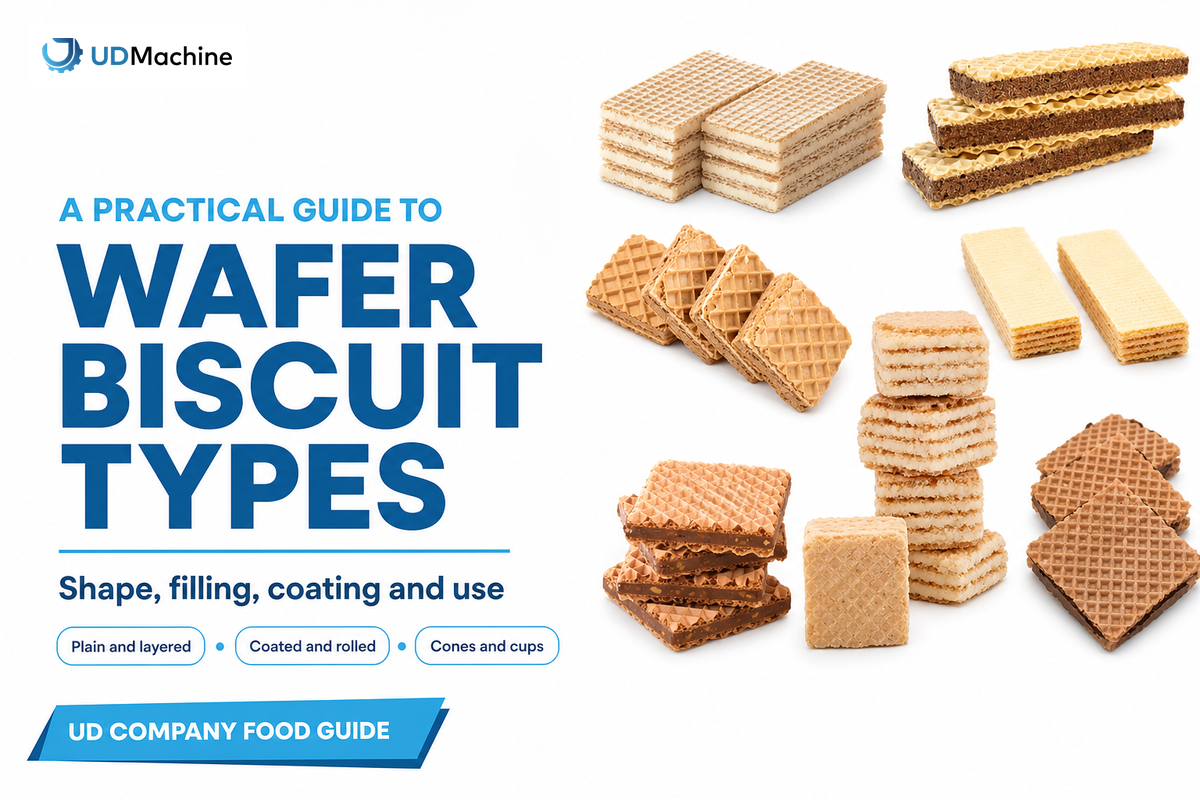
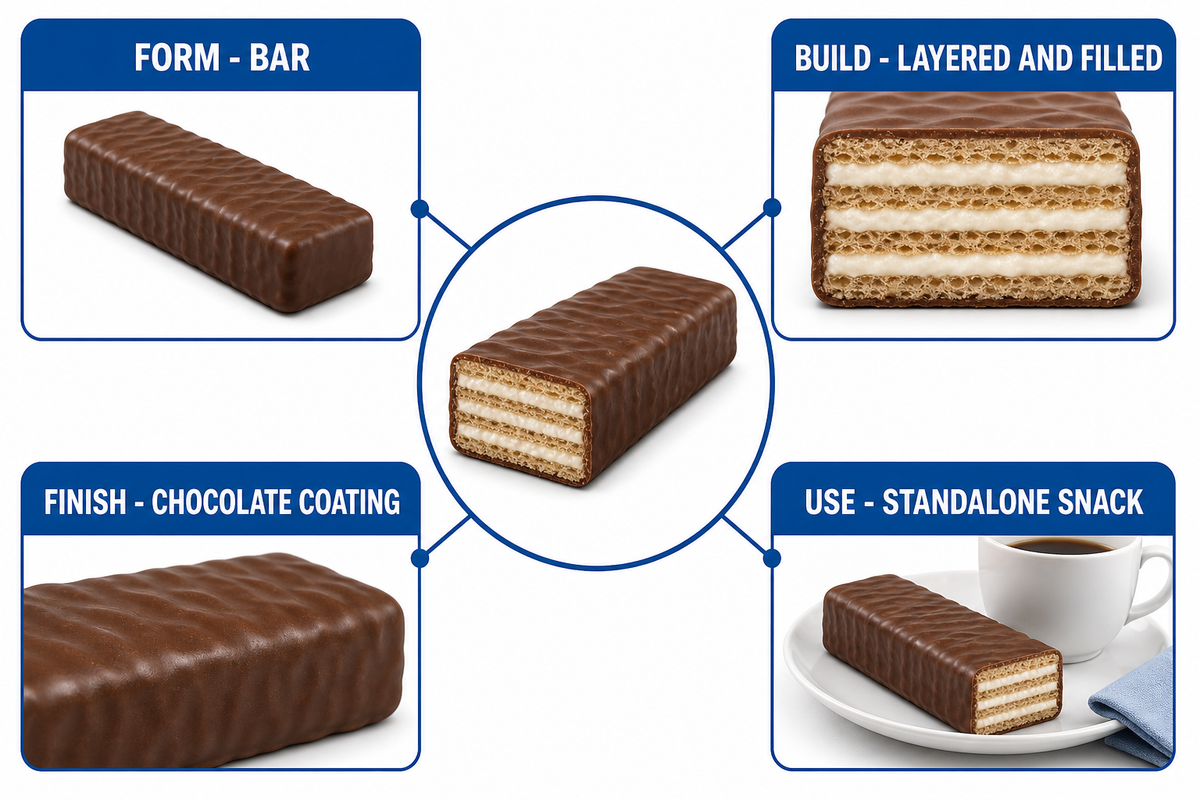
Wafer biscuit types are easier to organize when you stop cramming every label into one list. One wafer biscuit could be rolled in form, cream-filled in build, chocolate-coated in finish, and intended for coffee service simultaneously. The different statements provide different answers, so all can be correct.
Quick answer: To identify a wafer, answer four simple questions: what’s the shape or structure, what’s in the middle or between layers, what’s on the outside, and how is it intended to be consumed? This four-part identification check is an editorial aid, not a food standard, legal classification, or quality measurement.
The simplest way to classify a wafer
Read form, build, finish, and use separately. Then check the ingredient and allergen information for the actual product. Names such as “chocolate wafer stick” cannot answer all five questions.
What counts as a wafer biscuit?
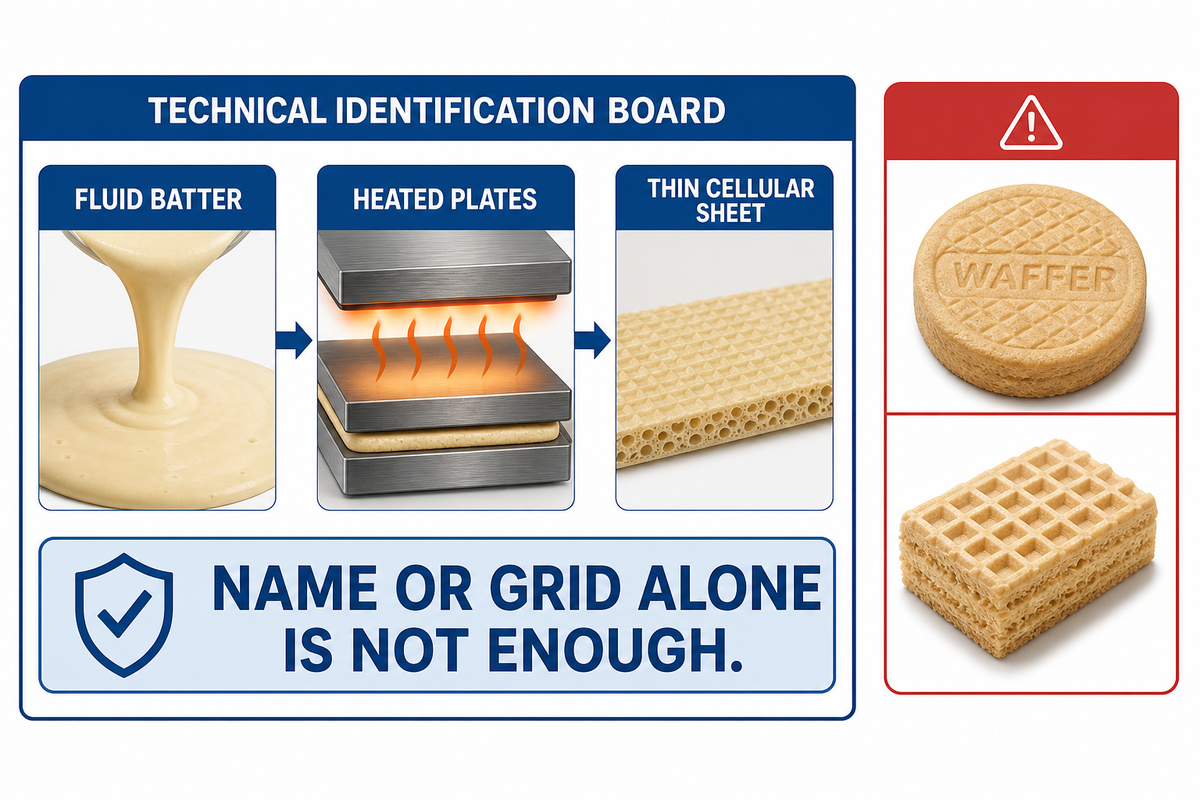
In food science, a wafer sheet is defined as a low-moisture baked product from fluid batter that has been formed between heated plates. The term wafer is generally used to describe a thin, light, crisp and cellular baked product. However, wafers may be served as plain sheets, layered snacks, coated bars, tubes, cones, cups or even as shells.
Factors affecting wafer sheet quality describes peer-reviewed paper abstract metadata for wafers as batter-based, low-moisture foods baked between hot plates. I would argue that’s a more useful technical description when compared to “anything thin and sweet”. It’s also helpful in differentiating cellular wafer sheets from other thicker sweets that contain wafer as a part of their name in the market.
Regional language adds another complication. In North America, the term “vanilla wafer” is often used to describe a thicker round cookie that isn’t a thin wafer. Waffles are generally crisp or soft pressed cakes with their own patterns and structures. A surface that has a similar pattern to a waffle doesn’t mean that it’s a waffle.
In this context, a wafer biscuit refers to a finished snack or a carrier made from or based on a thin wafer sheet that has been baked. The practical risk is confusing a regional cookie name or waffle pattern with the cellular wafer structure, so inspect the cross-section before comparing labels. This definition isn’t a substitute for customs codes, food labeling regulations, local naming systems, or product specifications established by the manufacturer. Browse the snack guides hub for related finished-product guides.
Why one product can belong to four wafer types
The terms “rolled,” “filled,” “coated,” and “ice-cream wafer” aren’t mutually exclusive. They can describe a single product because they address form, internal construction, surface treatment, and eating. Ensure you’ve documented all the dimensions of the product before you determine what the package contains.
Consider a hazelnut cream wafer bar covered in chocolate. Its form is a bar, and its build is layered and filled. The finish of this bar includes chocolate coating. This bar has a standalone snack as its function. Calling this bar simply “chocolate” wouldn’t give you this information. A tube that’s rolled may also be hollow, bare in finish, and can be used as an ice cream garnish. For a guided version of the attribute check, use the snack classification builder.
Which package words are not wafer types?
Packages integrate construction and flavor labels with sensory language and serving cues as well as market positioning. For example, “premium” or “extra crunch” can describe positioning or texture without defining the sheet, filling, or coating. Keeping all of these jobs separate prevents a falsely constructed structural category within the front-of-pack text.
Therefore, a wafer may be a hollow roll or a bite that’s coated or a bar that’s layered. These descriptor words help narrow the interpretations that are possible, but the cross-section still is the final determiner for the build.
The 8-Type Wafer Quick Matrix
Eight commonly encountered wafer types mapped by the most informative visible feature
Type
Primary clue
Secondary check
Typical overlap
Plain sheet
One thin cellular piece
No inserted filling
Dessert carrier or garnish
Layered filled wafer
Alternating sheet and filling
Count layers
Bar, bite, or sandwich
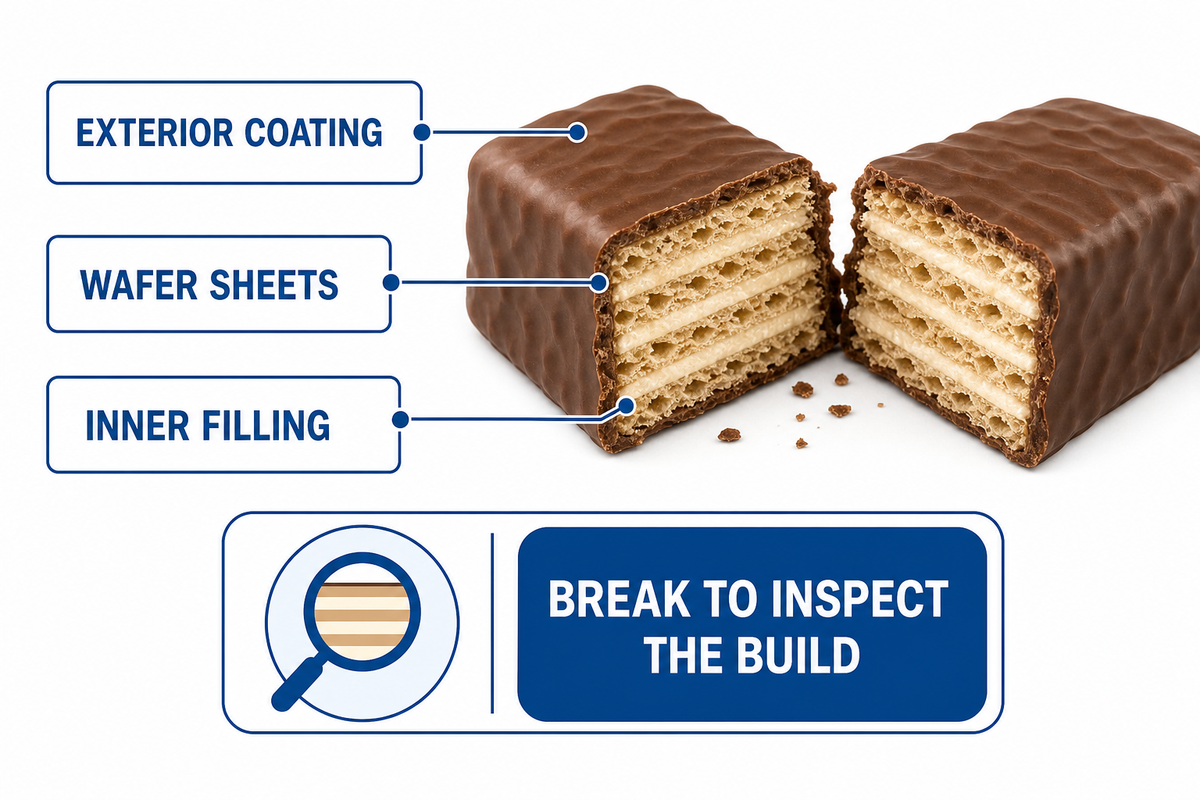
Coated wafer bar
Outer coverage
Break to inspect build
Often layered and filled
Hollow wafer roll
Open tubular center
Check inner lining
Stick or garnish
Filled wafer stick
Cream or paste in a tube
Inspect the end
Roll or snack stick
Cone or cup
Open edible container
Base and rim shape
Ice-cream or dessert carrier
Spa wafer
Large thin round form
Regional naming
Plain or filled style
Pink or Neapolitan-style wafer
Color or named style
Verify layers and filling
Layered filled wafer
The framework intentionally has a low level of detail. Official systems classify food for specific purposes. In the U.S., for example, the reference-amount tables specifically place biscuits, waffles, cones, wafers, and filled items in different regulatory contexts. Also, the material for the customs in Europe may combine filling and status of being salted. From these examples, it should be clear that no editorial, four-column table should be confused with a general law.
Plain wafer sheets and layered filled wafers
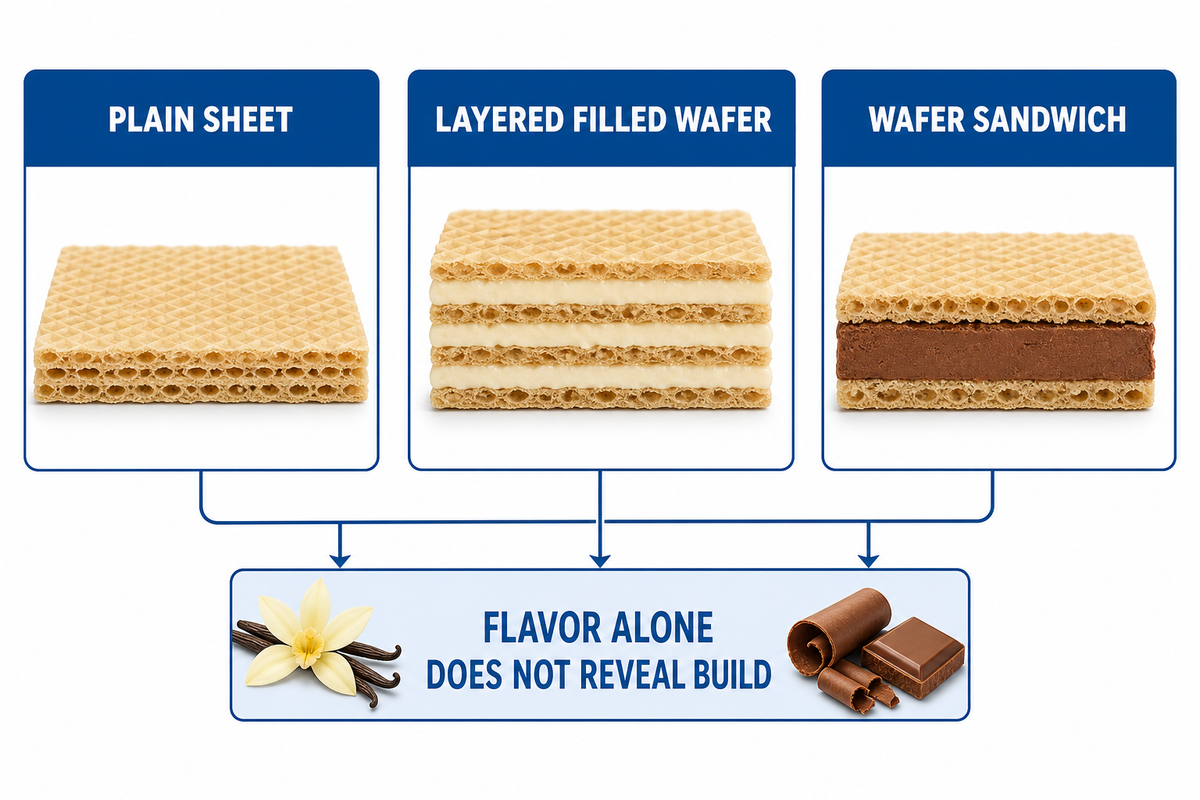
Plain wafers do not have filling between their sheets. A layered wafer filled with cream or paste, or perhaps caramel or similar filling, alternates crisp sheets with filling. The common mistake is classifying by flavor before checking the build; when buying, inspect the cut face because the layers provide stronger structural evidence. Count layers and inspect the cross-section before using a flavor word as the product type.
Plain sheets may be eaten on their own, paired with another food, or used as components of a dessert. It most often displays its identity due to its thin, cellular, brittle, and patterned surface. “Plain” doesn’t mean unflavored, unsweetened, or allergen-free. It means that the wafer build lacks an inserted filling layer.
Layered wafers consist of at least two sheets with filling in between. Market names include filled wafer, cream wafer, sandwich wafer, or wafer sandwich. These names may not indicate the same construction. There’s no guarantee about the number of layers or the ratio of the filling to the sheets. According to a food-science overview of biscuits, wafer biscuits are often sandwiched with cream and may also be chocolate-coated. It’s also possible for a build and a finish to be incorporated together.
Reading a wafer cross-section
What you see
Likely build label
Check before assuming
One thin cellular sheet
Plain sheet
Flavoring, surface dusting, intended use
Alternating crisp and soft layers
Layered or filled wafer
Filling identity, allergens, outer coating
Two larger pieces with one center
Wafer sandwich
Whether “sandwich” is a brand description or construction term
Vanilla, cocoa, chocolate, hazelnut, fruit, and coffee usually describe flavor, filling, or both. Nevertheless, in legal and retail contexts, flavor can matter in a purpose-specific classification, so it cannot be said that “flavor never counts.” Rather, the correct statement is that “flavor alone doesn’t reveal the build.”
Coated wafers and wafer bars
Some or all of a wafer’s surface can have an outer layer applied to it. In terms of construction, we can call this layer a coating, rather than describing the entire construction. The common mistake is treating a chocolate covered wafer cookie as a separate build; when buying, inspect the cut face because coating only describes the finish.
The level of coating can be anything from a light base dip to full enrobing. Coated wafer bars can conceal their wafer structure and stay in one piece until broken, while partially coated bars, sheets, or layers remain visible. Long coated bars and bite-size coated pieces may have the same finish but different forms and purposes.
The term “chocolate wafer” can be problematic. It can mean a cocoa-flavored sheet, chocolate-flavored filling, an outer chocolate coating, or a combination of all three. Front-of-pack photography can be helpful, but the cut surface and the ingredient list can provide more information. If the exterior is brown, but the cross-section shows bare cream layers, the brown color is insufficient to indicate the location of the chocolate.
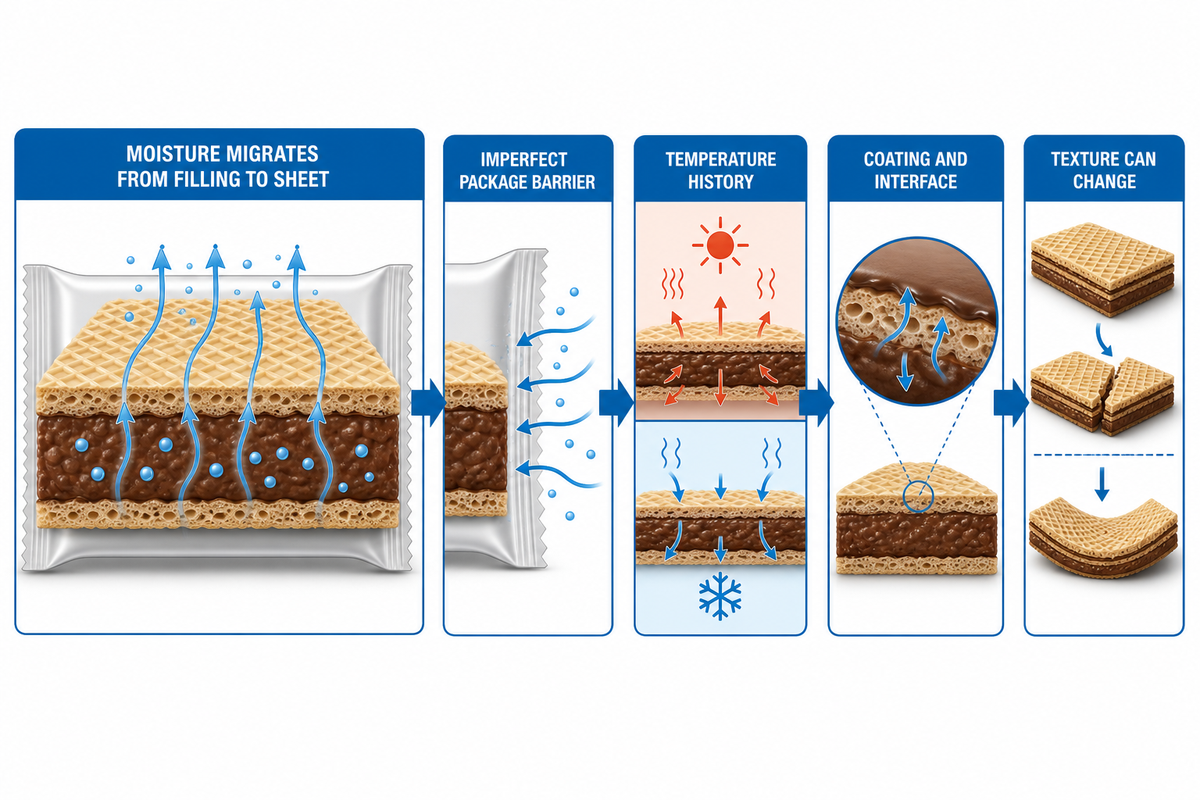
Coating also creates an interface with the wafer. Depending on formulation and storage conditions, it may slow some moisture movement, introduce another source of fat or moisture migration, or change the way a bar breaks. It also can change how a wafer bar breaks. Simply coating a wafer sometimes won’t keep a wafer more stable than not coating it. The seal, formulation, history of temperature changes, and the time a wafer is held should be considered as well.
Rolled wafers, wafer rolls and wafer sticks
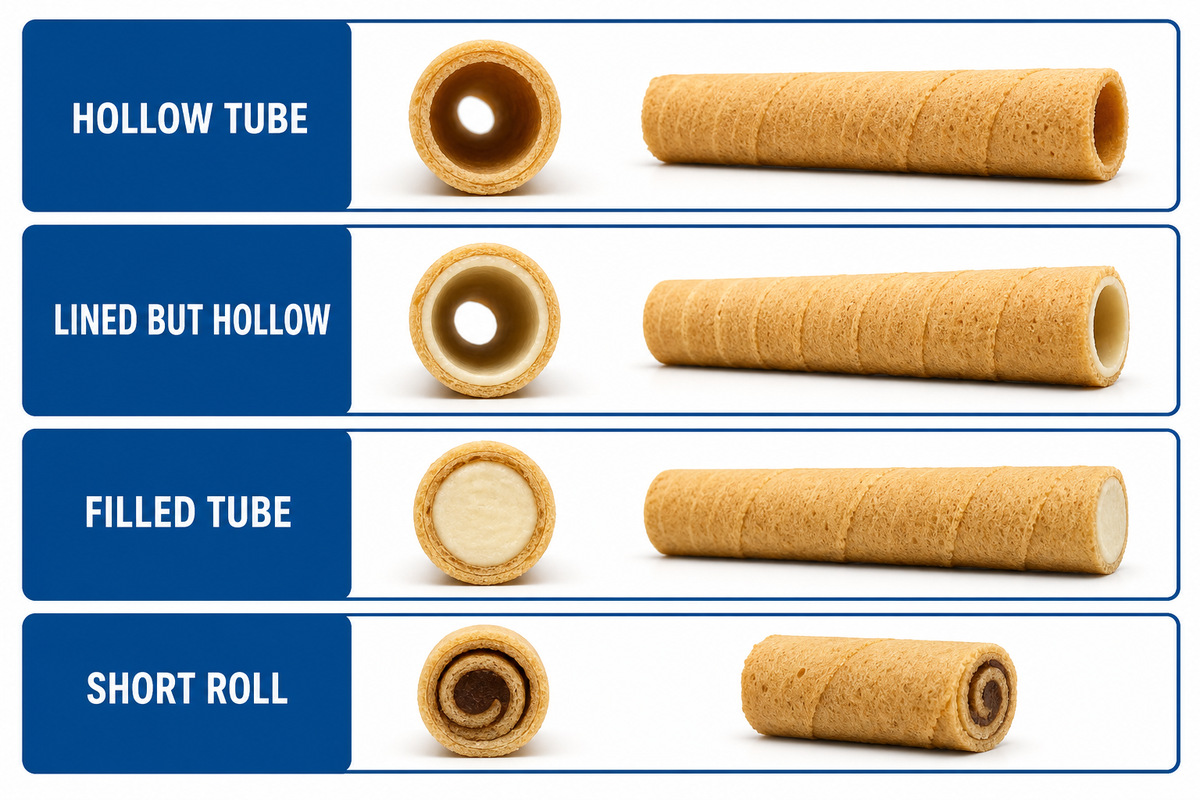
Rolled wafers are formed as thin tubes or curved rolls. “Wafer stick” often describes the long, narrow presentation, but neither stick nor roll reliably proves that the center is filled. Look at an end view or cross section. Unlike coating, rolling changes form; when buying rolled wafer sticks, inspect the tube end because a package image can hide a hollow center.
Four common presentations sit under this naming cluster: a hollow tube has an open center, a lined tube has a thin inner layer but remains visibly hollow, a filled tube contains cream or paste across most of the cavity, and a short roll uses the same general tubular form in a smaller serving piece. Packages may use “stick,” “roll,” “pirouette,” or other regional/brand terminology that overlaps for similar products.
This ambiguity isn’t theoretical. Consumer discussions include people asking about rolls without jam or cream, asking what English term fits a rolled wafer cookie, and showing disappointment when a “filled” package delivers a mostly hollow tube. These examples don’t define the category, however they show why labeling alone isn’t sufficient for a construction test.
Use three visible checks: inspect the end, break one piece cleanly, and compare the inner surface with the ingredient description. If the center is open, record the build as hollow even if the package calls it a stick. If a cream core fills the tube, record it as filled. Diameter, length, and sweetness are product details, not universal boundaries between a roll and a stick.
Cones, cups, moulded shells and regional names
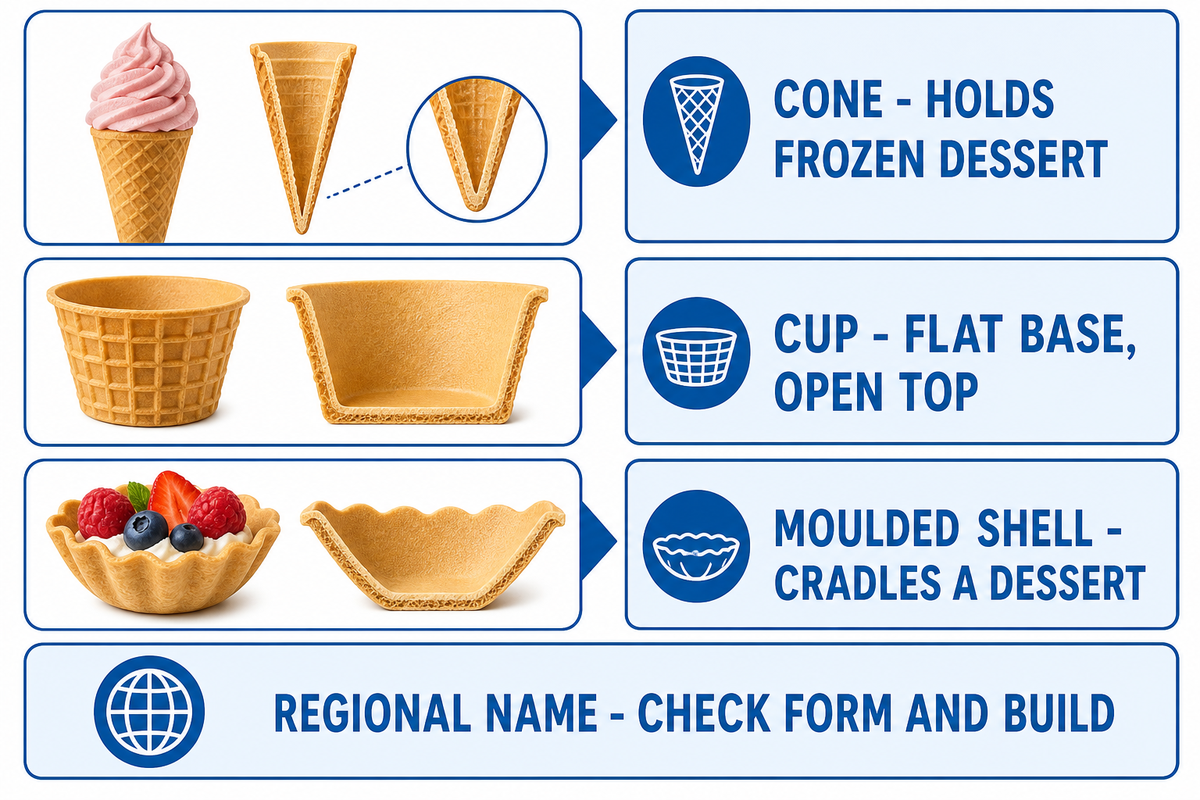
Wafers are differentiated by function and shape by classification as cones, cups, and shells. Names like spa wafer, pink wafer and Neapolitan wafer can have either cultural or stylistic connotations, though they don’t add a complete international classification. The classification risk arises because a regional name does not state the carrier shape or internal build. Unlike rolled tubes, these forms are defined partly by serving use; when buying a wafer ice cream cone, inspect whether the product is a cone, cup, or moulded shell.
An ice cream cone is a vehicle that’s made to hold a frozen dessert. Cups have flat bases and open tops, while moulded shells may cradle cream, fruit, or another dessert. An ice cream cone is still a cone before it’s filled with ice cream. Build and finish can then be added to the description, such as a chocolate-lined cone or a coated dessert cup.
Spa wafers are usually associated with thin, round wafers from Central European spa traditions. Radio Prague International on oplatky, notes the spa town tradition, but also notes the uncertainty of the origin. Regional association can be noted without inventing a first birthday, inventor or official definition.
Pink wafer is commonly a color and style name for a filled wafer made with pink-colored sheets. Neapolitan wafer usually describes a filled wafer in the layered and filled style that is associated with a hazelnut and chocolate-hazelnut combination flavor. Neither of these names describes a wafer in all its details. Look for the actual count and type of layers, filling, coating and ingredients on the package.
Ceremonial and savory wafers expand the term even further. Communion and Christmas wafers are used in religious and cultural contexts, whereas some customs systems distinguish salted products. They help illustrate that “wafer” is a family of uses and constructions, rather than a ten-item checklist that works in identical ways in disparate contexts.
Why a crisp wafer can turn soft
The texture of a wafer is impacted by many factors, including moisture and other mobile components, which move between the sheet, filling, coating, package headspace, and surrounding air. This matters across every form because moisture migration can make a crisp sheet soggy or cause an interface to fail during storage. In studied wafer cookies, water activity has been shown to correlate with mechanical texture. However, for different recipes and packages, no specific water-activity threshold can predict mechanical texture.
Dry wafer sheets and softer cream fillings don’t begin in the same state. During storage, equilibrium becomes the goal. Moisture can migrate from filling toward sheet, enter through an imperfect barrier, or redistribute after temperature changes. Movement of fat and crystallization of sugar can affect the product’s fracture and mouthfeel. Because of these factors, a product can lose its clean snap, become leathery, separate at an interface, and change hardness even without following a simple “more water equals softer” rule.
A 2023 peer-reviewed study of wafer-cookie storage, using products supplied by wafer manufacturer Babbi Group SpA, assessed water activity, mechanical parameters, sensory acceptance, and spectral measurements. The reported relationships are useful evidence that water state and fracture behavior are connected in the studied coated wafer cookies. These relationships don’t provide a universal home-storage rule for every wafer. The specific water activity, recipe, coating, package, and evaluation time cited in the paper can’t be used to set a pass/fail criterion for another wafer.
Moisture absorption and water activity were also identified as important textural factors in a 2026 study of cream-filled wafers. The composition and structure of both the sheet and the filling, the state of the fat and water system, and the coating and initial balance also affect the outcome.
Practical storage reading: an intact moisture barrier and a cool, dry storage environment generally help preserve the intended crispness, but the package directions and best-before information belong to that specific product. Once opened, reseal promptly and judge a changed smell, appearance, or package condition separately from texture. The crispness risk checklist helps separate texture observations from package-condition checks.
Don’t think you’ve the recipe just because two packs behave differently. Look at package damage, time of opening, time of exposure, lot information, and the filling and coating. Crispness is the result of a system, not a guarantee of a product that has wafers. For broader mechanism context, see the baking texture guide.
How to identify a wafer before you buy or serve it
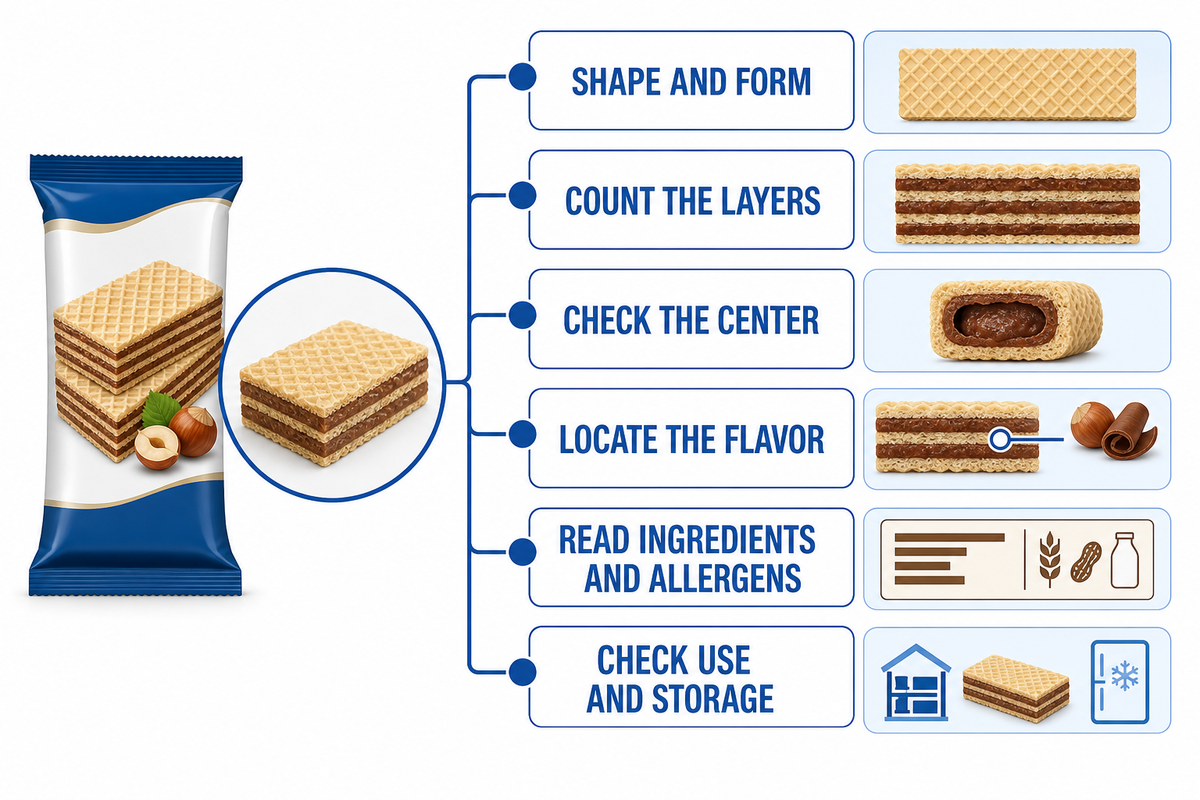
There are a few steps you can follow in identifying a food product. Take a look at the shape and form, then count the layers, check the center, separate flavor from finish, and read the ingredient and allergen declaration. From there, assess the product in the context of its intended use and storage. The main risk is a mismatch because a package name can hide the visible build, so inspect the cross-section before buying or serving.
Start with the shape and form of the product to identify whether it’s a sheet, bar, bite, tube, cup, cone, or a shell.
Count how many layers the product has. A plain sheet, two-piece sandwich, and multilayer bar have different builds even if they share a flavor.
Take a look at the ends of the tube to see whether it’s filled, hollow, or lined.
Determine which elements contain the flavor. “Chocolate” may be on the outer coating, cream, or the sheet. Determine where the chocolate is.
Read the product label. For most prepackaged foods regulated by the U.S. Food and Drug Administration, major allergen sources must be identified. The FDA food-allergy overview explains this U.S. framework.
Consider the intended use and storage of the product. A cone will need to have structural integrity in order to serve its purpose. A coffee wafer may keep enough structural integrity for the food to serve its purpose.
U.S. requirements do not cover every freshly packed or point-of-purchase situation, precautionary cross-contact statements such as “may contain” are not a universal guarantee, and other countries use different allergen lists and disclosure rules. A package label therefore helps you ask better questions; it doesn’t certify that a food is safe for a particular person.
For an allergy, packaged foods that are missing or damaged labels, or for foods not packaged, call the manufacturer or food-service operator. Don’t think packaged foods are safe just because they’re ‘Dark Chocolate’, ‘Plain’, ‘Vanilla’, ‘Dark’, or contain no warning. Don’t think the packaged food is safe just because it has no warning. Check the date and the seal, and also check if the packaged food was stored as per the instructions.
When your question is really about production
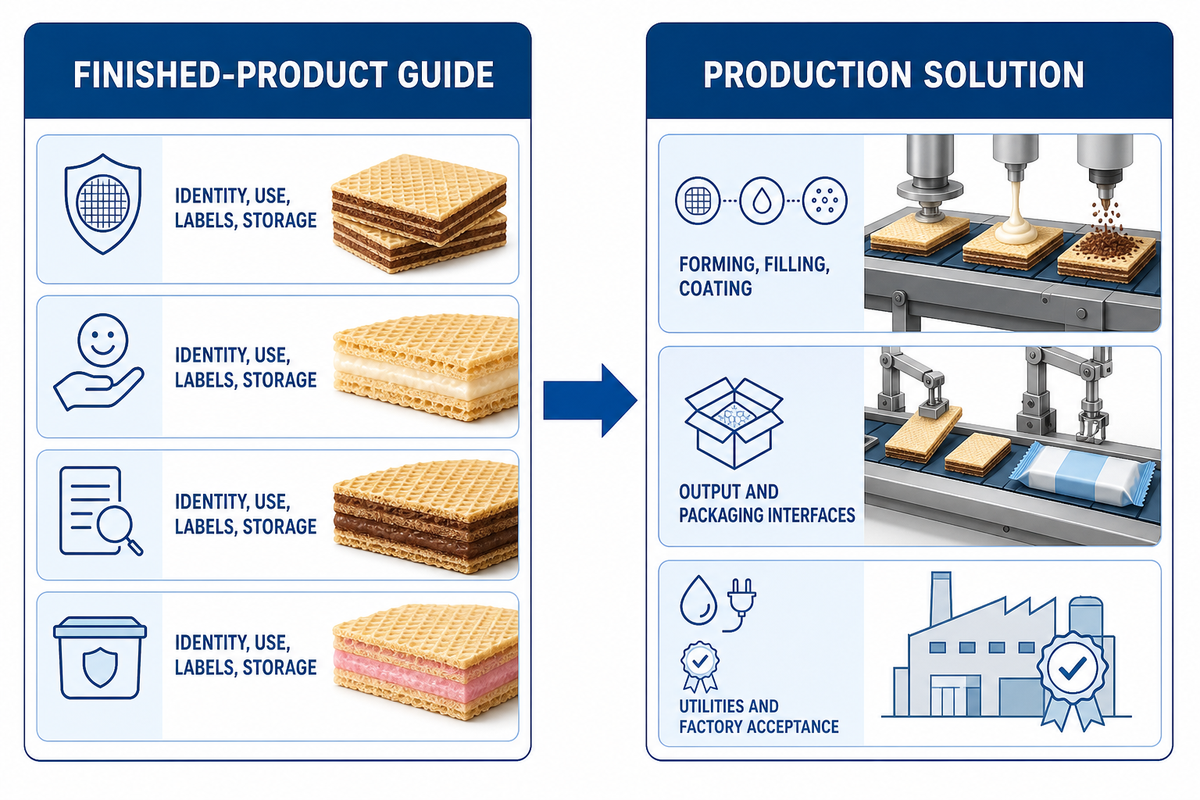
Finished food labels help provide some control over what product you describe, but they can’t choose a production route or select a commercial system. If your question concerns forming, filling, coating, output, packaging interfaces, utilities, or factory acceptance, move to the wafer production solution page.
This guide stops at product identity, use, label reading, and storage-related texture. The risk of a route mismatch rises because the same finished-product name can conceal different forming, filling, and coating requirements. Other sections covering equipment, specifications, processes, and cost comparisons are still visible on the original solution page. The two URLs aid two different search requirements.
Frequently asked questions about wafer biscuit types
What are the different types of wafers?
Read the answer
Common wafer forms include plain sheets, layered filled wafers, coated wafer bars or bites, rolled tubes, rolled wafer sticks, cones, cups, and moulded shells. Some names include spa wafer, pink wafer, and Neapolitan wafer. These names aren’t mutually exclusive official boxes. A chocolate-coated cream wafer bar, for example, has a bar form, layered filled build, coated finish, and snack use. Record these four attributes together. This finished-product map answers a different question from the linked production solution.
What are some popular wafers?
Read the answer
Recognizable styles include layered vanilla, chocolate, hazelnut, or fruit-cream wafers; chocolate-coated wafer bars; hollow or cream-filled rolled sticks; Neapolitan-style layered wafers; pink filled wafers; and ice-cream cones. It should be noted that popularity can vary by country, store, season, and brand, so this list isn’t in order of sales worldwide. There is no universal ranking of the best wafer biscuit types; popularity varies by country, store, season, and brand. The list of words for flavors is good, but they can’t indicate whether the product is layered, rolled, hollow, or coated.
What is wafer biscuit made of?
Read the answer
A technical wafer sheet begins with a fluid batter, commonly based on flour and water with other ingredients chosen for the product. The batter is cooked between heated plates that help develop the thin, cellular structure of the batter. The finished product may contain cream, cocoa or nuts, and a coating of chocolate or compound coating in addition to flavors, colors, emulsifiers, and other ingredients. There’s no single formula for every wafer. Read the ingredient and allergen statements on the specific package rather than treating this general description as a recipe or suitability guarantee.
Is a wafer biscuit the same as a waffle?
Read the answer
No. Although they may have common embossed lines, generally they’ve differences in formulation, thickness, texture, method and use. A surface embossed pattern doesn’t make a waffle a wafer biscuit.
Are wafer sticks always filled?
Read the answer
A wafer stick can be hollow, lightly lined, or filled. For that reason, it’s necessary to examine one end of a wafer stick.
Why do filled wafers lose crispness?
Read the answer
Moisture can move from filling or air into the sheet, while formulation, coating, package barrier, temperature, and time also matter. There’s no one water activity or shelf life number for a filled wafer.
A useful name should answer a useful question
Start with the technical wafer boundary, then record form, build, finish, and use. Add flavor, regional name, and label details without treating them as one universal hierarchy. Describe the product’s conditions of storage as a separate attribute. That way, someone else can interpret the description.
How this guide was built
The guide synthesizes government labeling sources, peer-reviewed food-science research, current classifications, trade coverage, and consumer naming questions.
The four-part identification check is an example of editorial synthesis. It isn’t an official standard, client test result, or production recommendation. Company investment, property, patent, performance, leadership, and sales claims were excluded because the research set did not independently establish their ownership and scope.
UDTECH has been manufacturing food machinery since 2003. This is where we write down what we learn from product samples, trial runs and commissioning—the batter, the bake and the texture, rather than the sales sheet.
These guides help production managers, buyers and food entrepreneurs work through batter faults, sample runs, output targets and factory acceptance. When a question turns into an equipment question, the same enquiry form reaches our engineers.
OUR EXPERIENCE
Food machinery manufacturing since 2003, with practical experience from product samples, trial runs and commissioning across egg roll, wafer, waffle, biscuit and snack production.
OUR EXPERTISE
We work from real recipe and output conditions, covering process, product and machine specification questions. Technical enquiries are passed to the engineer responsible for that equipment.