Waffles are soggy when they leave the iron crisp but turn limp after release; this guide starts with the post-cook air path before changing recipe or appliance variables.
Quick answer
Waffles are soggy when they leave the iron crisp but turn limp after release, so start by checking the post-cook air path. Keep it in one layer and add space between the layers. Waffles can soften immediately after exiting the iron when an incomplete appliance or recipe completion cue is involved. These do not establish a single reason.
Waffles are soggy when they leave the iron crisp but turn limp after release, so start by checking the post-cook air path. Keep it in one layer and add space between the layers. Waffles can soften immediately after exiting the iron when an incomplete appliance or recipe completion cue is involved. These do not establish a single reason.
When you ask, “Why are my waffles soggy?”, the best response isn’t “Change the recipe immediately.” A waffle may soften after cooking because hot moisture is trapped, because it left the iron before the exterior was ready, or because a batter or process variable needs attention. These may be simultaneous. The intent is to avoid changing multiple variables at once.
This guide follows a simple order: describe when the texture changes, make one low-risk handling comparison, and decide whether the next check is cooling, cook completion, holding, or batter texture. It is a general cooking guide, not a tested UD Company method or a promise that one step will work for every waffle maker and recipe.
Begin here: place one waffle, on a wire rack (or open surface), rather than covered or in a stack. When a waffle retains its crisp status over one placed on a plate, it points to a handling variable. For two waffles that are both soft immediately, use the iron’s normal completion guidance before blaming cooling.
Why waffles turn soggy after cooking
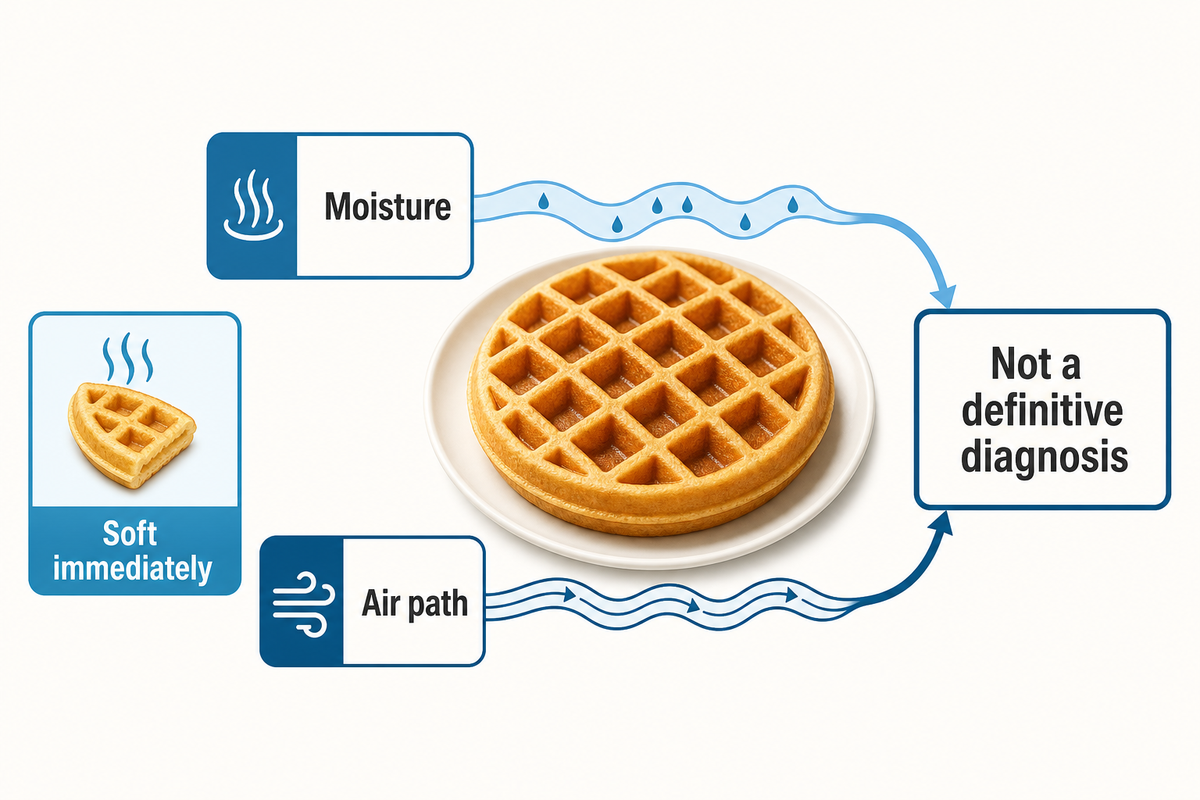
Moisture can soften a waffle after it leaves the iron when its holding arrangement offers little opportunity to escape. It is different from a waffle that was already soft when you removed it. It can provide you with a good starting point, but it isn’t a definitive diagnosis.
Moisture can change the texture of a waffle that has been cooked. University of Wisconsin explains how raspberry waffle filling can soften a waffle and make it soggy through moisture migration. That example does not imply all waffles have the same reason for softening. What this example illustrates is that a crisp exterior coupled with moisture doesn’t always remain separate. [University of Wisconsin]
Don’t think of this as a general rule that steam is always the answer. Waffle texture also depends on the iron, the amount of batter, the distance between waffles, batter, and the type of waffle you want to make. Holding everything constant while you assess one variable at a time is a better troubleshooting process than making guesses about why one thing happened.
“How to keep waffles crispy after cooking?” and “How to keep waffles crispy in lunch box?” are holding questions before they are recipe questions. In meal prep or a foodservice batch, a soggy result can appear after release because a closed, warm hold changes the air path. Treat that as a texture problem to compare, not proof that one ingredient or appliance caused it.
Start with a single-layer cooling check
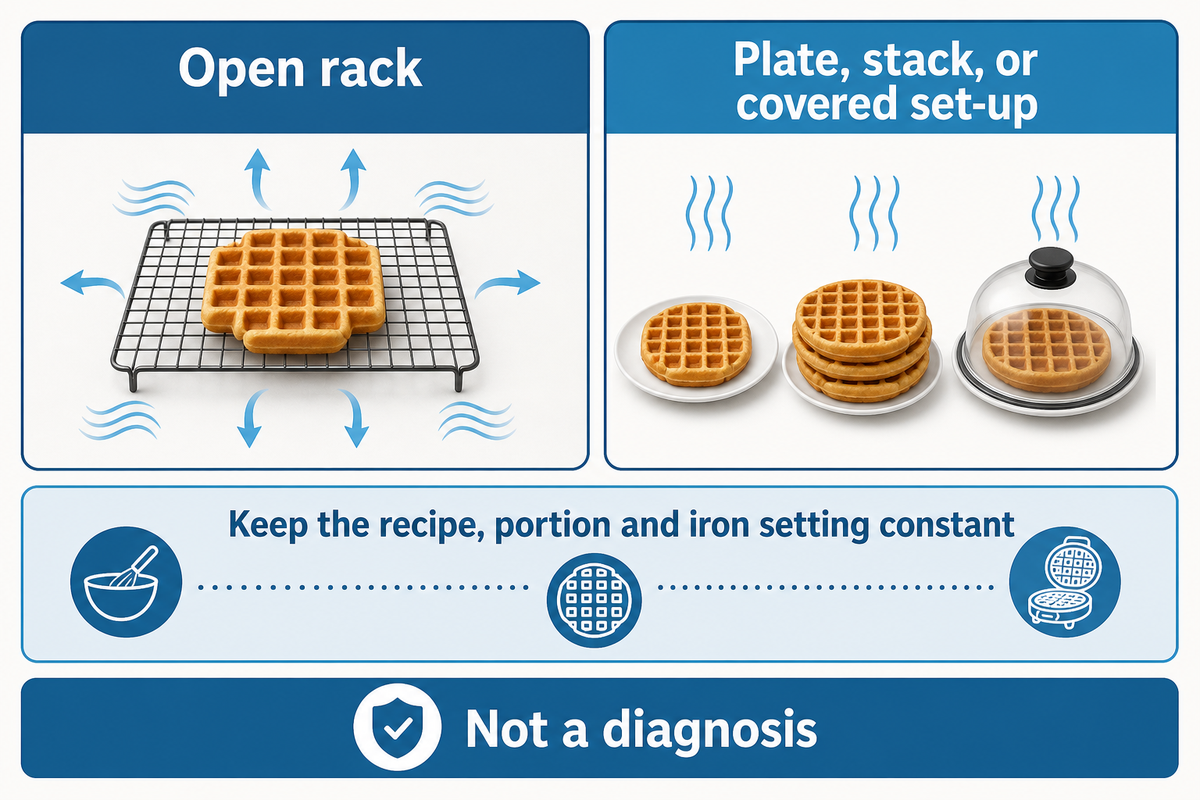
Place the next waffle with the other waffles in one layer, leaving space around it. Compare that open arrangement with your normal holding method before changing batter amount or cook time.
The point of this isn’t complicated. It lets hot air and moisture move away from the bottom and sides instead of trapping the waffle against a warm, closed surface. I only mean for this to be a small comparison for how handling helps during experimentation with the recipe or iron, not a diagnosis. This won’t guarantee general results for every recipe or iron.
This isn’t a countdown. There is no single number of seconds that proves a waffle is properly cooked, identifies a batter issue, or works across all irons. This is simply a comparison of two handling techniques. To make this small comparison, keep the recipe, portion and iron setting constant. Openly handled waffle differences are a reason to keep the air path in your routine and observe further. When both waffles soften immediately, move to the completion branch rather than repeating the same holding test.
Try this on the next batch
- Cook one waffle as you normally would.
- Place it with space on all sides in an open rack or on a single-layer surface.
- Set up a second waffle in your plate, stack, or covered set-up.
- Look at both after giving them each a short rest.
- Change only the holding method for the next comparison.
That last point is relevant. An improved recipe after swaps of oil, heat, and rack, all within the same batch, won’t tell you why it was better. Low risk, next check rack order comparison is not a verdict.
“Change one handling variable, then compare the texture you actually observe.”
If it is soft immediately, check completion first
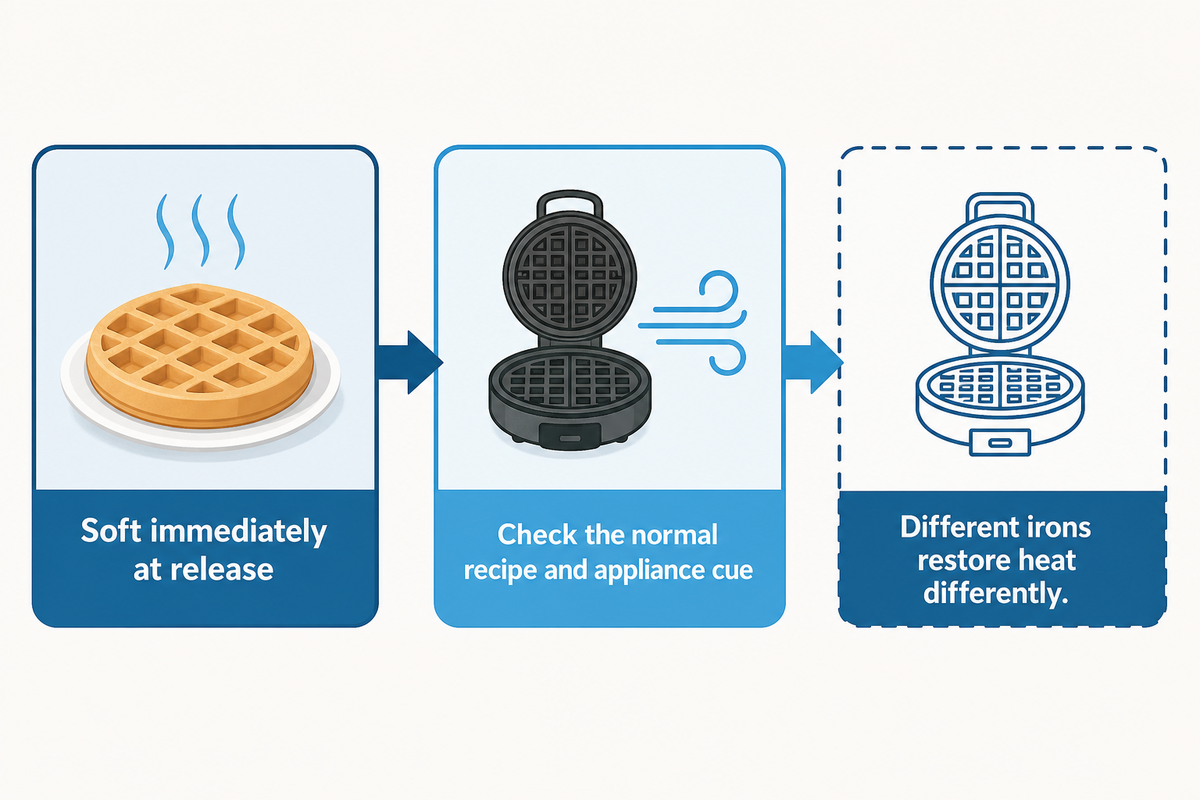
If the waffle is soft immediately as it leaves the iron, first check the appliance or recipe completion cue before randomly adjusting cook time. Immediate softness can signal cook completion, but it can signal several other factors like batter, contact with a heating surface, filling, etc.
Relevant instructions are the ones that apply to your iron and recipe. NIST Metric Kitchen’s waffle recipe calls for preheating the waffle iron, testing its temperature, and fully cooking each waffle according to the appliance instructions. This is helpful since it considers ready status as part of the cooking routine, and not as a universal value on an unspecified dial.
Find a pattern instead of guessing. Depending on the appliance and recipe, that might be the iron’s indicator, the expected visual finish, or the recipe’s stated instruction. Avoid needlessly opening and closing the iron in search of the other kitchen’s fixed time. Different irons restore heat differently. Also, different batters can behave differently in the same iron.
If it softens later, check how you are holding the batch
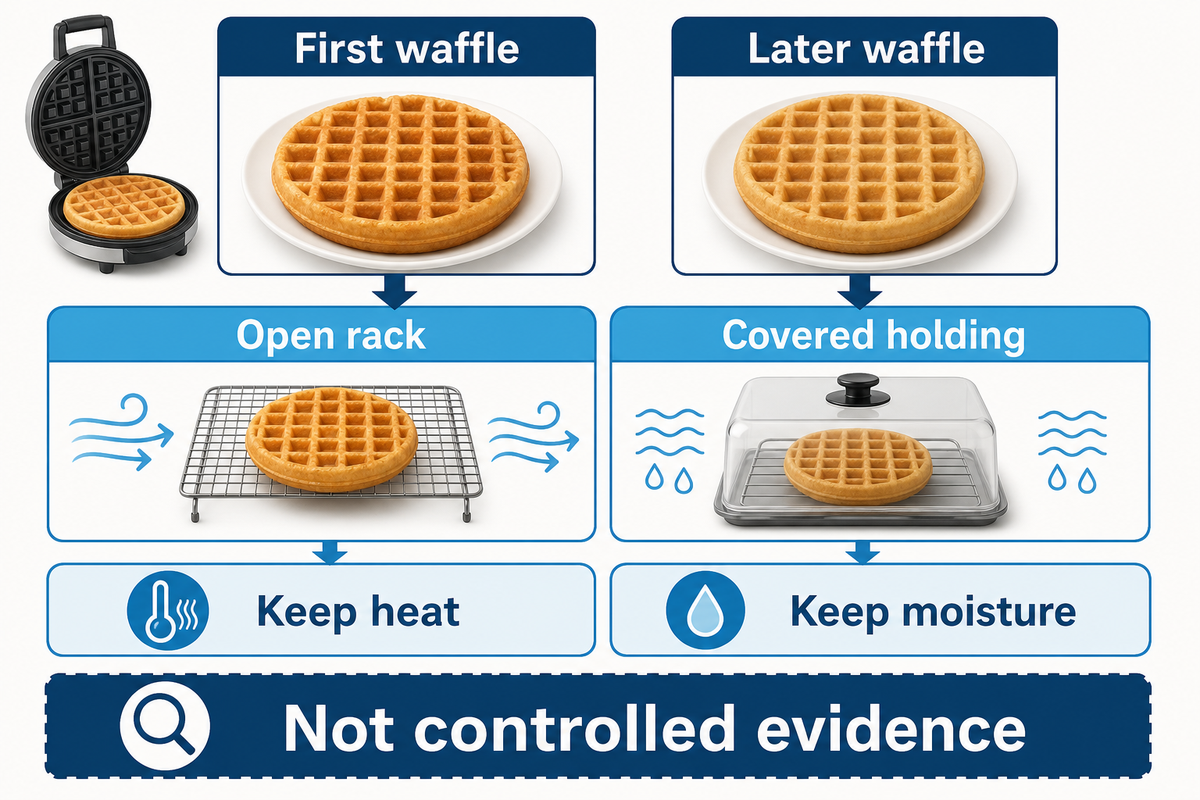
A waffle that starts crisp but becomes soft while you finish a batch should be treated as a holding question before it becomes a batter question. This means that you should separate the first few minutes of cooling from the rest of the time where many waffles need to be kept ready.
Stacking has its convenience, but it can hold the bottom surface close to other warm surfaces. A covered plate or a sealed container can also alter the air around the waffles. Epicurious advises holding cooked waffles on an oven rack or wire rack rather than a sheet pan that can trap steam and soften the bottom. This is practical context for soft or soggy waffles, but it does not establish that stacking is the cause in every kitchen. [Epicurious]
Meal prep, a lunch box, and foodservice holding create different practical situations. A later-softening problem merits a comparison because a stack or cover can change the surrounding air after release. Keep the recipe, portion, and appliance conditions steady; a difference between open and covered paths is a reason to inspect holding before batter.
For a batch, if appliance guidance and serving allow, try a warm oven rack or a wire rack. Separate waffles slightly to allow for air flow. Don’t think that “warm” and “covered” do the same thing. One keeps heat, the other may keep moisture.
When testing the batch setup, compare the first waffle and a later waffle from the same cook session. A first waffle that remains crisp on an open rack while a stacked one softens points to the holding path for the next check. Immediate softness in both waffles calls for a return to completion and batter-related checks. When neither result is consistent, outline the symptom rather than force it into a particular category.
When batter texture is the real issue
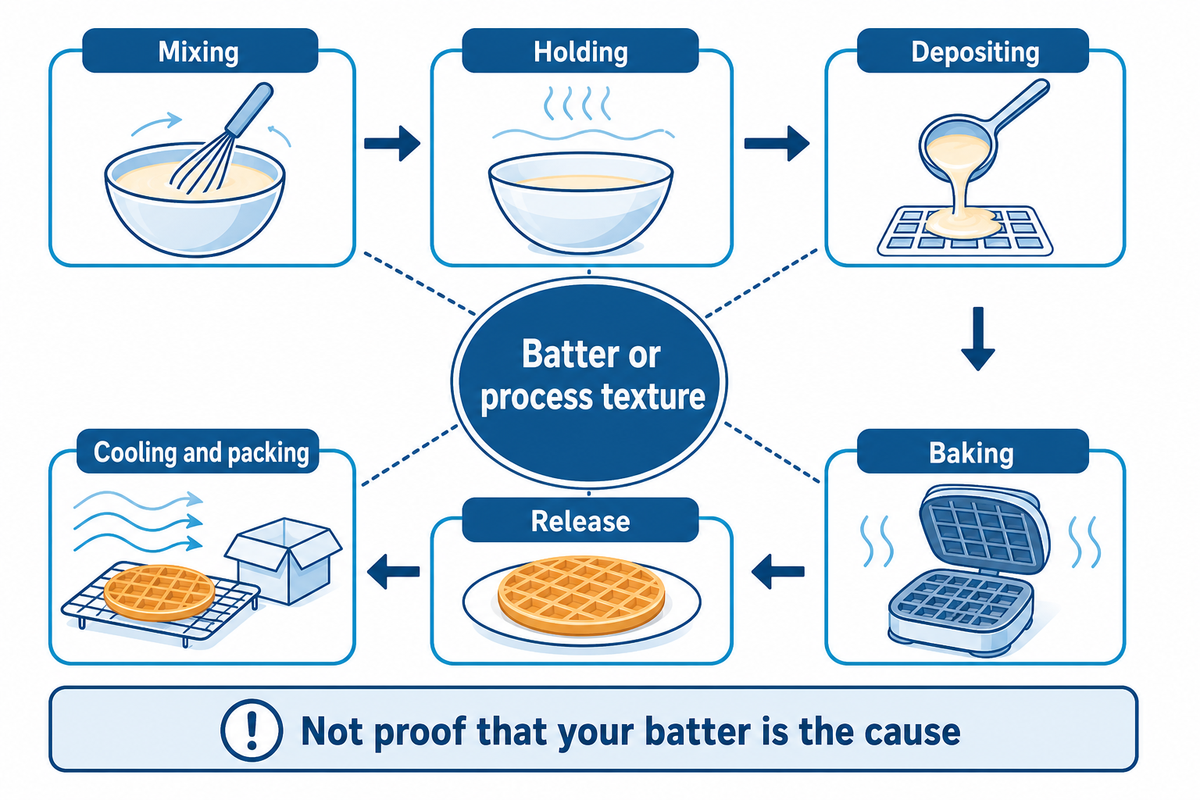
Move upstream to batter or process texture when the same symptom occurs repeatedly after comparing cooling, holding, and normal completion cues. A repeatable problem is a reason to assess a larger part of the process, not a reason to hypothesize one ingredient.
The following steps may be relevant: batter texture, mixing, holding, depositing, baking, release, cooling and packing. For a more complete, factory-wide way to organize these variables, see these batter texture checks. The linked guide uses a six-zone diagnostic; it is a contextual handoff, not proof that your batter is the cause or a claim that a particular machine will solve the issue.
Published waffle-formulation research includes sensory texture evaluation; it is not a setting recommendation for a particular home iron or recipe. [PMC study]
When passing off a problem, narrow your observations. It is hard to do anything with the statement “All waffles are bad.” “The waffle is soft immediately after the iron’s normal completion cue, and the rack comparison made no difference” is a better starting point. It doesn’t provide a formula diagnosis; however, it can help you not to solve a post-cook handling challenge as a recipe failure.
A crispy waffle recipe is not a substitute for recording a repeated symptom. Because variables can overlap, a meal-prep or foodservice batch should be described in full before the batter handoff: note whether the waffle was soft at release, whether open cooling changed it, and whether the normal completion cue was followed. Use the linked guide to organize the next observation, not to prove a batter or machine cause.
The Steam-Path Texture Check: a symptom-to-next-check table
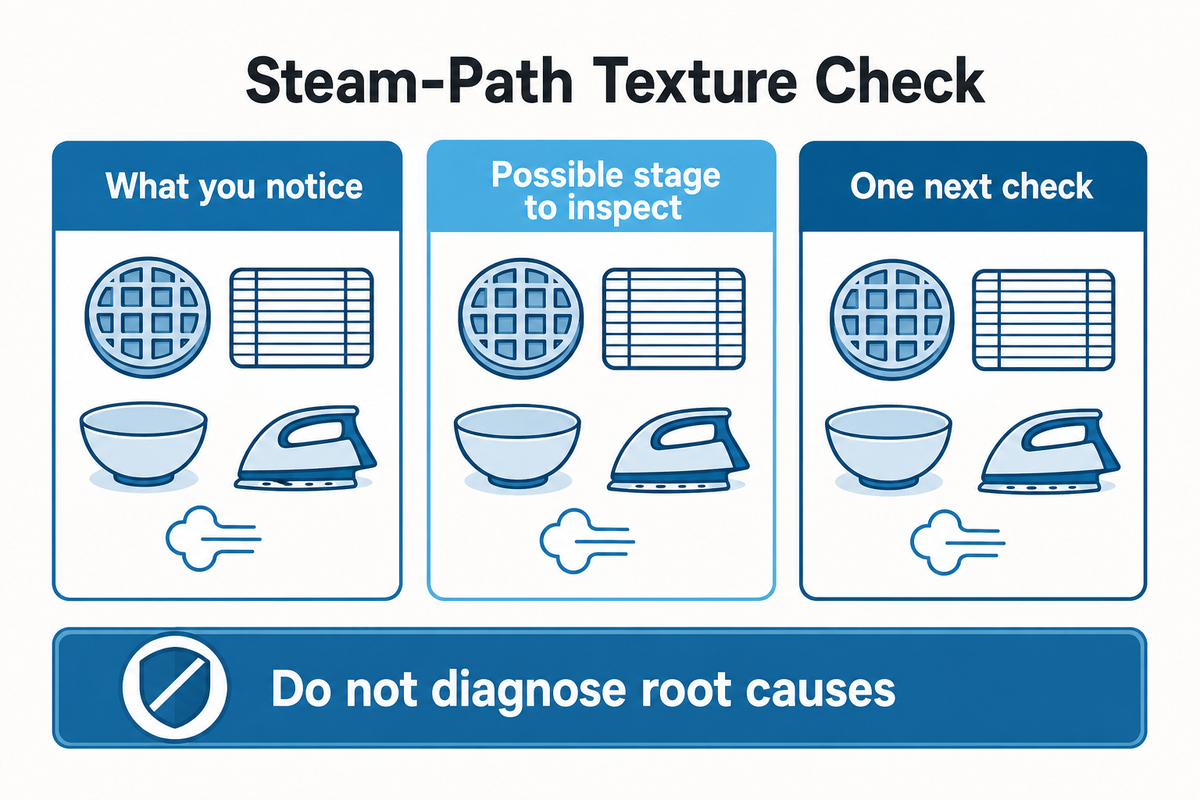
Use this table to choose one of these next observations rather than diagnose a root cause. Don’t use this table to diagnose root causes. I’ve purposely used a cautious approach for the “possible stage” column, as texture results may have multiple causes.
The table uses the same limited appliance-completion context noted above; it does not establish a single root cause.
| What you notice | Possible stage to inspect | One next check | Do not change yet |
|---|---|---|---|
| Crisp at release, soft on a plate | Post-cook air path | Compare a single-layer rack with the plate | Recipe and iron setting |
| Soft immediately at release | Completion or another in-iron variable | Check the normal recipe and appliance cue | Several settings at once |
| First waffle is fine; later ones soften | Batch holding | Separate waffles and compare the hold setup | Batter formula |
| Softness repeats after these checks | Batter or process texture | Record the repeatable symptom and inspect upstream variables | A one-ingredient guess |
| Crisp at release, soft under a cover | Covered holding | Compare an open rack with the covered setup | Cook time |
| An uneven in-iron result | Record the appliance cue | Follow the normal recipe and appliance cue | All settings at once |
| Texture changes after re-crisping | Post-cook air path | Use dry heat, then let the waffle sit openly | Batter formula |
| A change follows a portion adjustment | Record the portion or batter variable | Return to the same portion for one comparison | Several variables |
This framework is editorial: it is designed to limit guesswork. It is not a recipe, appliance manual, or controlled test. If the symptom is unusual, persistent, or relates to an appliance concern, follow the manufacturer’s guidance rather than table treatment suggestions.
What to do with waffles that are already soggy
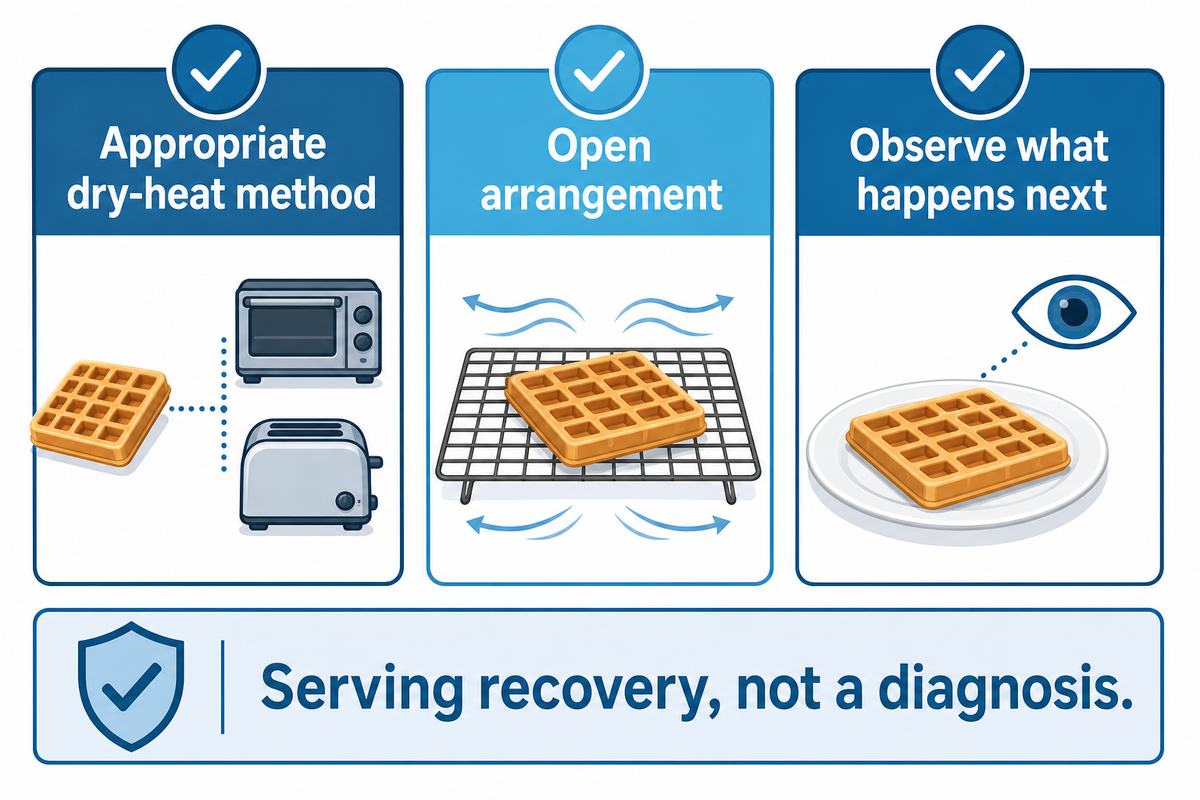
Use a dry-heat re-crisping method that is appropriate for your waffle and appliance, then go back to the cooling and holding comparison. Now, return to the cooling and holding comparison if the change happened after release. Re-crisping may improve surface crispness for serving, but it cannot answer why the waffle softened.
A toaster or oven, or any other dry heat re-crisping option can be a handy rescue method as long as it’s appropriate for the waffle and used according to the instructions for the appliance. Avoid steaming, covering the waffle, or placing it in a closed container after re-crisping if you want to see how surface crispness will be. Let the waffle recover fully in an open arrangement, then observe what happens next.
Keep the safety boundary and texture question separate. This article addresses texture only. Re-crisp food according to your appliance instructions, and follow storage rules separately.
Serving recovery is different from prevention. A soggy waffle can be disappointing at home, in meal prep, or on a foodservice tray, but dry heat does not identify the problem’s cause. Because a closed container can recreate the same holding risk, return to the open-versus-covered comparison after re-crisping. Use the appliance instructions for any recovery step.
Frequently asked questions
What is the secret of making crispy waffles?
There is no general secret that works for all batters and waffle irons. The first step is a reliable cook cycle from your own recipe and appliance. After cooking the waffle, give it free access to air by not covering or stacking it.
An improved outcome after this one change is a reason to keep it and change other variables only when the problem returns. If the waffle is soft immediately, check completion cues before assuming cooling caused it. Do not assume the waffle maker is the only cause; check the completion cues.
How do you crisp a soggy waffle?
Using an appropriate dry-heat method for your appliance and waffle, do not let the waffle rest with trapped moisture. This should be viewed as a serving recovery, not a diagnosis. For the next lot, compare an open rack vs the usual plate or stack. If the rack held waffle is crisper, the next likely area to address is handling.
If it does not, note whether the waffle was soft straight from the iron and continue with a completion or batter-related check.
Should you let waffle batter rest before cooking?
Follow the directions provided for the batter you are using. Rest time is sometimes relevant for some formulas, but it is not a universal cure for sogginess after cooking. However, it is not a cure for sogginess following cooking; first observe whether softness was immediate or developed after release.
Prior to changing rest time, check to see if the waffle was soft immediately or only after release. A clear post-cook change directs you towards cooling and holding first. It is a better reason to investigate the batter process in more detail when the waffle is repeatedly soft straight from the iron.
Should waffles be crunchy or soft?
Whether waffles should be crunchy or soft depends on the waffle style and the result you intended. The signal is not that every waffle needs to be crunchy; the relevant issue is whether its texture has strayed from the intended result.
The texture has strayed from the desired result, which is the bigger issue. Describe if the exterior became damp, the waffle was soft at release, the waffle became rubbery, or the waffle lost crispness while it was held. Describe whether the exterior becomes damp, the waffle is soft at release, it becomes rubbery, or it loses crispness only while being held. These descriptions make the next comparison more useful than a generic instruction to cook at a higher temperature.
Why does my waffle maker make soggy waffles?
Don’t just assume the waffle maker is the only issue. See if it has been preheated and if you’re following the normal completion instructions for the iron and recipe. Finally, compare an openly held waffle to one held on a plate or in a stack. If both begin soft, note the pattern before changing any settings. If the texture changes only when released, the cooling or holding path is likely the next most useful option.
References & Sources
- University of Wisconsin food-science waffle story moisture-migration context.
- NIST Metric Kitchen: Waffles preheating and recipe context.
- AskCulinary discussion practical cooking and serving context; practitioner background only.
- Epicurious: How to Make Crispy Waffles common-mistake context.
- UD Company: Waffle and Pancake Batter Problems first-party process-diagnostic handoff.
Source and scope note: This article combines public cooking and food-texture context with a clearly labeled editorial troubleshooting sequence. It doesn’t describe a UD Company cooking test, machine specification, customer result, certification, or a validated household-waffle method.