Maltodextrin in baking is a bulk-forming, flavor-carrying ingredient made by partial hydrolysis of starch. Long chains of glucose get broken down to smaller sizes. The main question remains: which grade fits a given recipe and process?
Updated October 2026.
Maltodextrin in baking adds solids and can change texture. Choose a grade by its intended function, calculate the solids and water it carries, then compare a controlled bake with the unchanged recipe.
Key points
- The same dextrose equivalent doesn’t mean the same in baking.
- Dry-solids balance and dough water absorption answer different questions.
- A specialty tapioca oil-powder grade isn’t a substitute for general purpose flour.
- Results published for bread belong to the tested formulation which includes its flour and process.
What maltodextrin does in baking
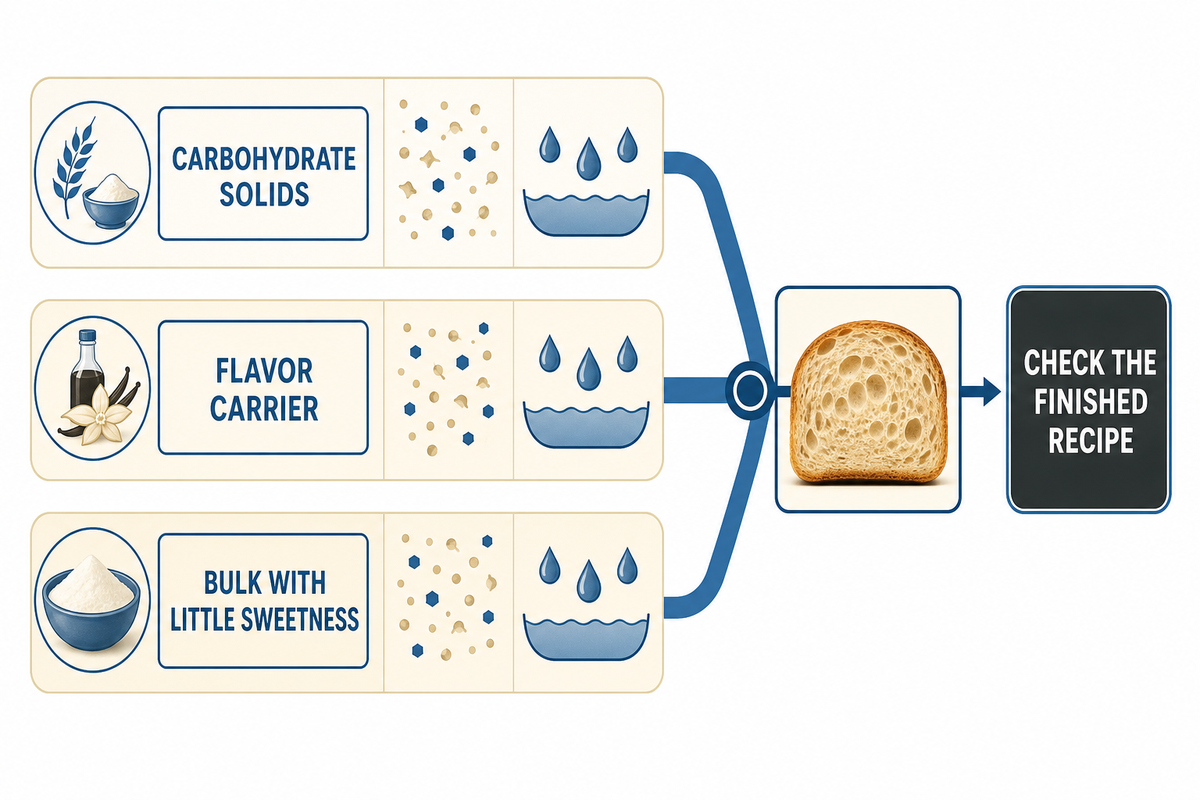
Maltodextrin supplies carbohydrate solids in a relatively less sweet form as compared to table sugar. In the baking industry, it’s known to perform carrier and bulking functions. Some grades of Maltodextrin change viscosity and mouthfeel. In baked goods, those functions need to be reviewed against the structure and balance of the recipe.
This type of carbohydrate is used in food production where additional solids are needed. For snack foods, the practical benefits of maltodextrin will depend on those solids in the final product. A neutral taste may be appropriate in a carrier function; however, a slightly sweet grade is still required to be checked from a sensory point of view.
Why is maltodextrin put in food?
Maltodextrin in food can be used in dry mixes to carry flavor or provide bulk. It may provide bulk with relatively little sweetness in a formulation. Its use requires a defined purpose in a product, e.g. to disperse an ingredient, change handling or test a different crumb structure.
Start with what’s missing. If a seasoning carrier disperses well but the biscuit loses its snap, dispersion alone hasn’t met the brief. The baking ingredient guide helps determine the role of an ingredient beyond its name.
For a small round baked-snack format, UDTECH mini biscuit equipment is a production reference; maltodextrin suitability remains a recipe-level question.
Choose a grade by function, not DE alone
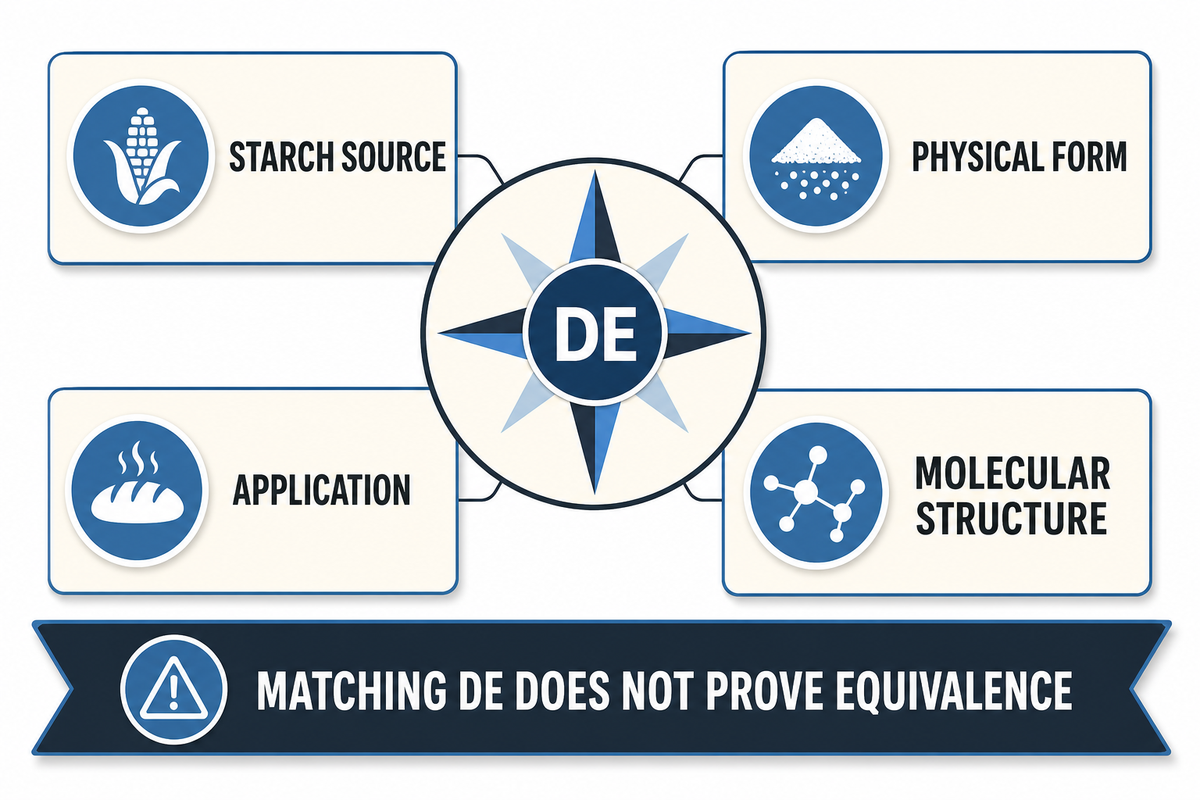
Dextrose equivalent, or DE, is used to describe the reducing power relative to dextrose on a dry basis. It isn’t the moisture content of the ingredient. The grade selected also depends on the starch source, physical form and the application, as for a given DE, two different ingredients can differ in molecular structure and therefore handling.
According to the first part of Witczak and colleagues’ bread study, ‘nominal DE’ can’t always ensure recipe equivalence. An agglomerated grade designed to achieve dispersion should be evaluated for that function rather than assumed to behave like every fine powder.
Products made from corn and those derived from tapioca use different starchy materials. Hydrolysis uses enzymes or acids, followed by processing that can include purification and drying. The food and beverage industry provides many grades of this versatile ingredient, so source alone doesn’t decide the application. Solubility and dispersion under the real conditions of the process have to be checked.
If a grade is derived from corn, that source description still leaves the physical form and application properties to be determined. Even a common ingredient requires a traceable grade when the experiment has to be repeated.
In a 2013 potato-starch model study, the tested DE 18.4 maltodextrin produced a stronger viscosity reduction than the DE 10.5 and 26.5 materials. This was a paste-and-gel study, not a bread recipe. This is good evidence against assuming a simple rule that a higher DE would give a stronger effect.
For purchasing, ISO 5377:1981 describes a Lane and Eynon method for determining reducing power and DE. Its public catalogue remained current when checked in October 2026; the paid standard was not reviewed.
It’s common to assume that DP and DE are the same; however, degree of polymerization describes the length of a chain and a paper reporting DP 18 doesn’t state DE 18. Ask the supplier which property and which method of measurement their number represents.
Balance solids before changing the recipe
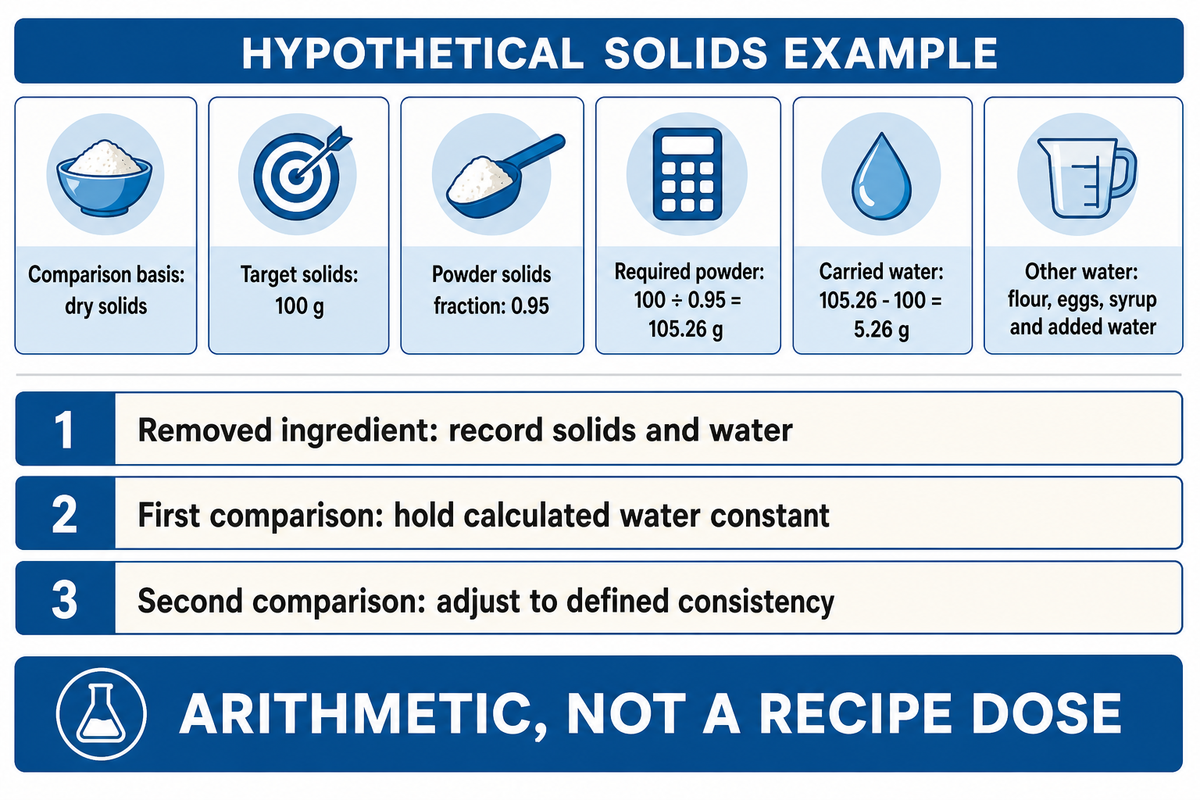
Dough ingredient solids are expressed as a mass for this comparison. Dry solids accounting separates the mass of dry solids from the water carried into a mix. Calculate both before changing an ingredient. Having equal dry-solids mass provides a reference point, but it doesn’t ensure equal dough consistency, sweetness, color or finished texture.
Solids-to-Recipe Balance Sheet
Use this worksheet for comparisons between a candidate ingredient and an existing ingredient. For illustration purposes, it will use a target of 100 g of dry solids and a powder containing 95% of dry solids. Inputs for this case aren’t based on supplier recommendations or addition rates.
| Balance field | Filled example | Decision or limitation |
|---|---|---|
| Comparison basis | Dry solids | Do not compare scoop volumes. |
| Target solids | 100 g | Assumed mass for this example. |
| Powder solids fraction | 0.95 | Assumed; replace with verified lot data. |
| Required powder | 100 ÷ 0.95 = 105.26 g | Rounded mass, not a recipe dose. |
| Water carried by powder | 105.26 − 100 = 5.26 g | Count toward total formula water. |
| Other water sources | Flour, eggs, syrup and added water | Use the actual formula’s ingredients. |
| Removed ingredient | Its solids and water, recorded separately | Its function may also need replacing. |
| First comparison | Hold total calculated water constant | Tests performance at fixed water. |
| Second comparison | Adjust water to a defined consistency | Record the adjustment as an outcome. |
The distinction between water carried and functional absorption is supported by the wheat flour studies cited below. The values used in the example are for illustration only.
A 2012 wheat-flour study showed water absorption was less for the additions evaluated in the study. Another panned-bread study examined water absorption with 2% maltodextrin and ziziphus gum. The two studies were different, so there was no direct comparison of the same grades.
Hypothetical solids trial:
A development baker needs to evaluate a new grade of dry ingredient. The procurement team sent a specification sheet only providing a max. moisture value. The baker is seeking the actual solids input. The team requests a batch result before completing the worksheet. It first tests both recipes at the same total water, and then performs a second test at a defined mixing consistency. If the second mix requires more water, that’s captured in the trial record. The 105.26 g calculation is valid for the assumed solids fraction, regardless of how the dough feels.
What bread research actually shows
Maltodextrin changes dough behavior and crumb properties; however, the direction of these changes varies with materials and formula. The flour or starch system and whether the dough is fresh or frozen are relevant. Therefore, the best approach for a useful trial is to reproduce the comparison of a study, rather than borrow the result of the study.
Is maltodextrin in bread?
Maltodextrin can be incorporated in bread making, and published studies have tested it in both wheat and gluten-free systems. It doesn’t necessarily confer a specific volume or softness to the loaf. Use the ingredient list for a specific loaf and use formulation-related evidence for adding maltodextrin.
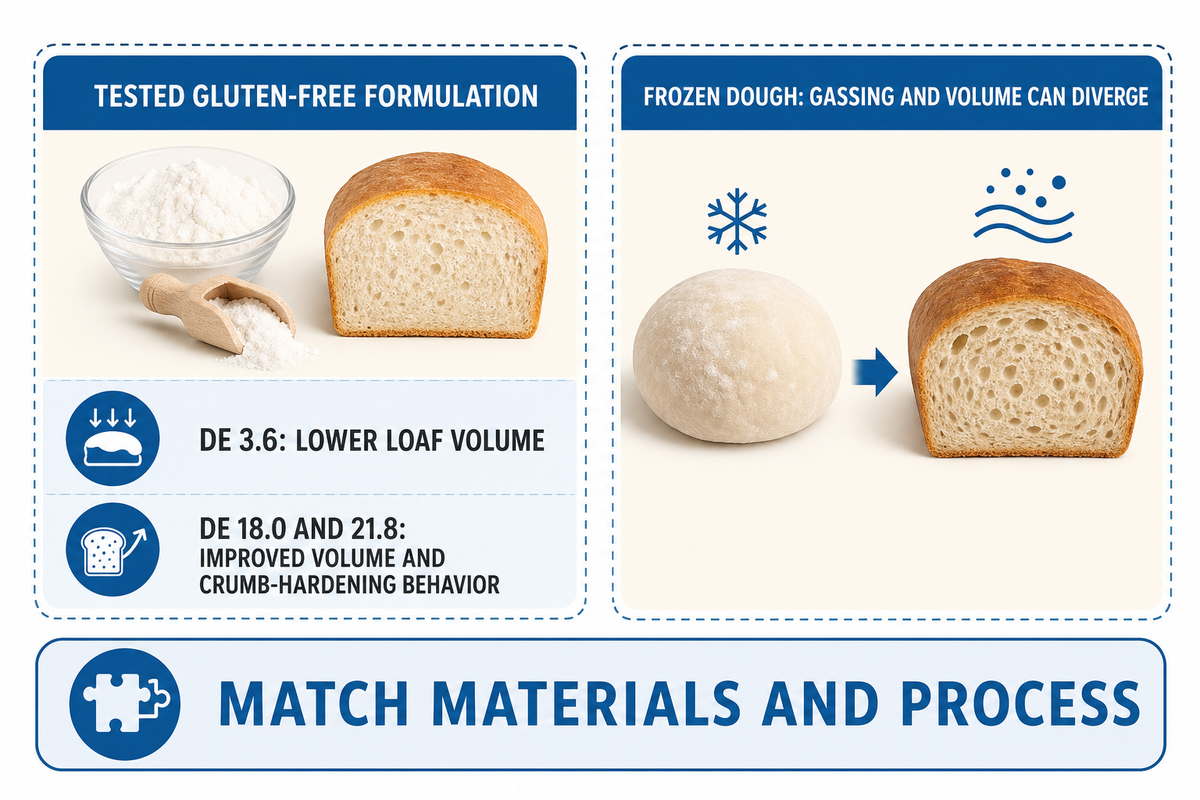
Witczak and colleagues’ 2010 abstract reports that DE 3.6 reduced loaf volume, while DE 18.0 and 21.8 improved volume and crumb-hardening behavior in their gluten-free starch formulation. The paper’s DE 21.8 designation is kept here as its terminology; it’s above the generally accepted below-20 maltodextrin boundary.
Frozen dough introduces a further distinction. A 2022 frozen-dough study found that molecular structure affected stability, and that faster gassing could coexist with reduced bread specific volume. Gas generation and gas retention must cooperate. That abstract doesn’t establish the shelf life of a fresh commercial loaf.
Trial implication: record the state of the dough during storage and measure finished loaf volume and crumb firmness. Fermentation speed alone is an incomplete measure of success.
Why cornstarch and sugar are not direct substitutes
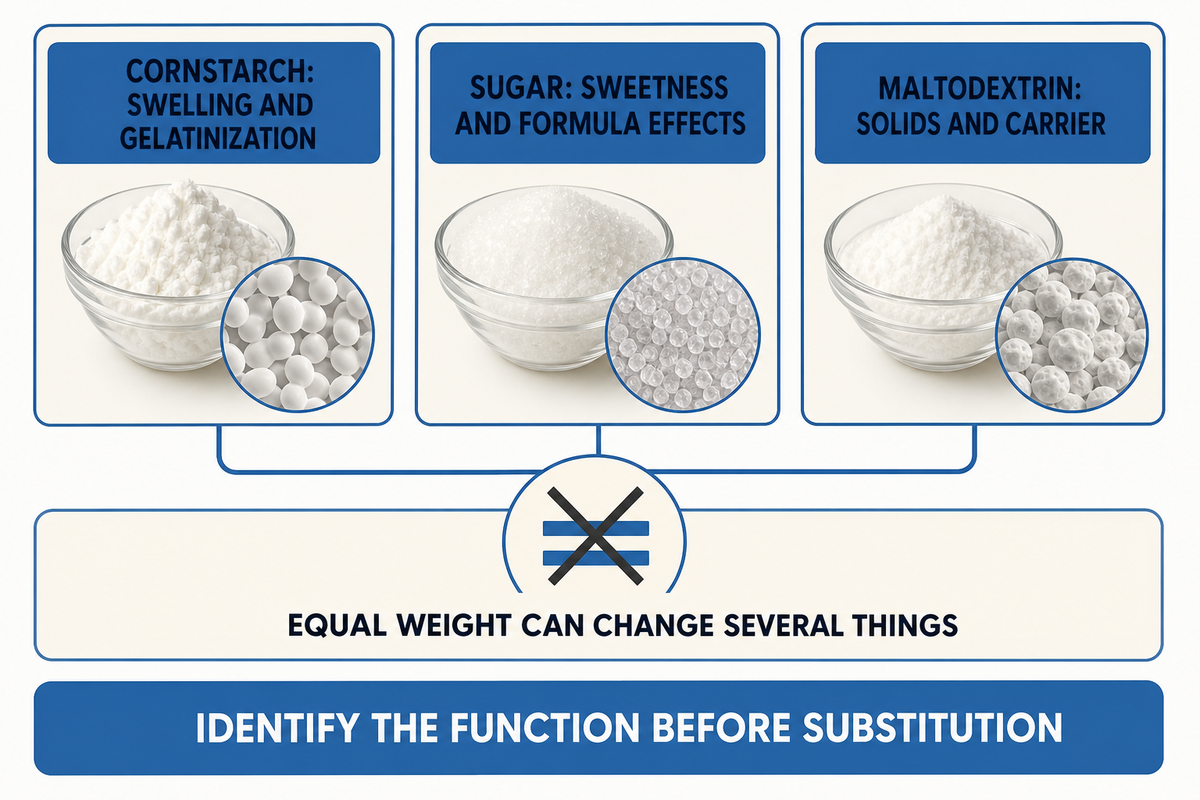
Cornstarch, sugar and maltodextrin play different roles in a formula. Native starch can swell and gelatinize under proper heat and moisture; sugar adds sweetness and affects the system of the remaining ingredients. Replacing equal weights can change several things, even when the total batch weight remains constant.
“it’s the stage where starch granules swell and absorb water, becoming functional.”
The association states that gelatinization is affected by available water and dissolved solids. Cookies with a low water, high sugar or high fat content may have incomplete gelatinization. A soluble starch hydrolysate doesn’t always emulate the behavior of native starch.
A thickener selected to make a filling set has a different function than a carrier that’s used to distribute flavor. Likewise, calling an ingredient a stabilizer doesn’t imply the mechanism the recipe intends to achieve. State the change desired in measurable product terms prior to selection of either description.
When not to buy a replacement grade
Hold the purchase if the request is simply to replace cornstarch or sugar one-for-one without identifying what the original ingredient does. A carrier specification does not prove that a filling will set, a biscuit will spread correctly or a cake will retain its intended sweetness. The ingredient function matrix can help check functions needed.
An inexpensive price per kg is also an incomplete purchasing comparison. With an alternative addition rate or increased rejections, the ingredient price alone would mislead the buyer. Keep the existing recipe as a control and compare the usable output before requesting a larger quantity. In the absence of the bakery’s actual trial and price data, no cost saving can be calculated.
Also, a proprietary blend isn’t the same as the individual ingredients. A replacement blend may contain sweeteners or other solid ingredients. A successful blend trial doesn’t prove maltodextrin delivers the same result. Ask for the candidate’s full technical identity and a starting formulation prior to substituting it.
Tapioca maltodextrin and powdered toppings
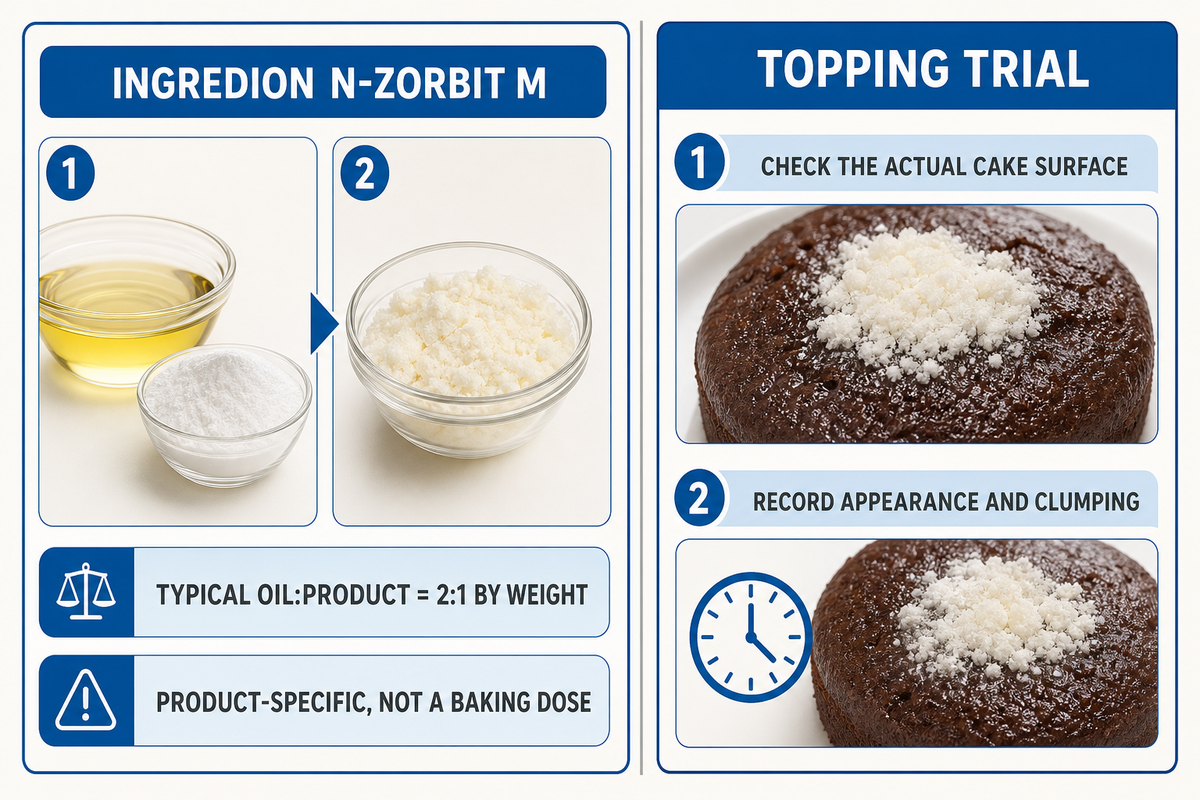
Certain specialty tapioca maltodextrin grades can transform oil into a powder topping, but having tapioca origin alone isn’t indicative of that ability. A product’s physical form and use case must also be considered. Keep the preparation of oil-based powders separate from the development of doughs: a successful dusting powder isn’t evidence for a flour replacement ratio.
The N-ZORBIT M spec by Ingredion describes a specialty product that forms a free-flowing powder at a typical 2:1 oil-to-product weight ratio. This example is manufacturer specific and not a general baking dose. The moisture spec is a maximum and doesn’t indicate the actual moisture in the batch that’s shipped.
In a recipe on the Institute of Culinary Education website, chef Robert Ramsey combines walnut oil with tapioca maltodextrin, and then sifts the mixture. The recipe was published in 2017 with Direct Eats and demonstrates preparation rather than storage stability.
Hypothetical Topping Trial: A member of the pastry team wants to apply powdered oil to a moist cake. The first sample looks loose out of the bowl, and the developer suggests ordering a larger bag. Quality Control asks for one more comparison: powder on the actual cake surface, held for the requested service time. The team documents appearance and clumping, with an undressed control, and uses the same amount of topping. Procurement waits for those results before taking action. This illustrates a missing test, not that every topping will fail on moisture. An initial good powder texture of the topping doesn’t guarantee the finished product will hold.
A 2020 study of spray-dried matcha-tuna oil powders reinforces that distinction: added maltodextrin improved flowability but increased water uptake. That different process doesn’t predict N-ZORBIT performance, yet it shows why flow and moisture behavior deserve separate measurements.
Run a controlled bake trial
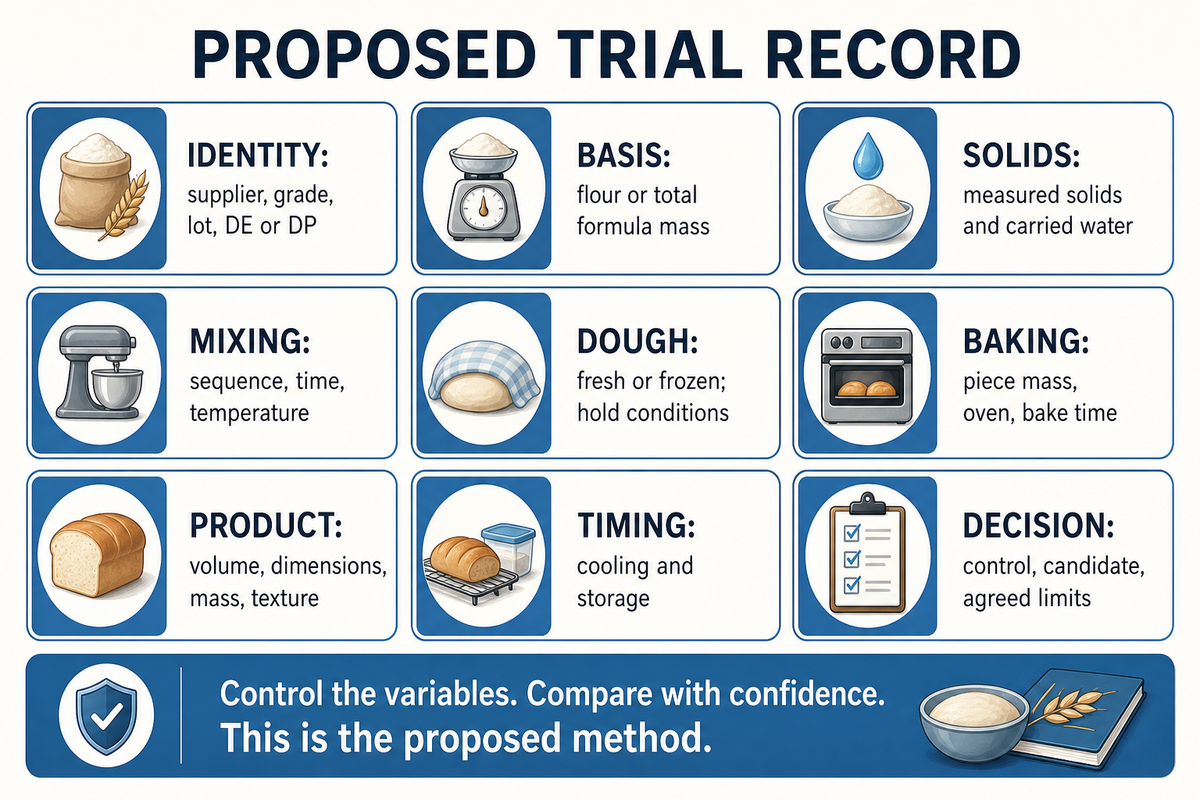
Bake trials test the impact of one change at a time. They use a control (the unchanged sample) to compare the results to the sample that underwent the change. They record the formula of the baked sample based on the defined basis. Finally, they measure the change that prompted the bake trial and make the observations.
Grade-to-Bake Trial Record
This is a proposed comparison method. This is not a validated customer protocol. Development owns the formula; the production lead records handling; quality control accepts the product; and procurement compares costs of accepted output. Refer to the recipe and process brief to implement these decisions.
| Record field | What to enter | How it changes the decision |
|---|---|---|
| Ingredient identity | Supplier, grade, lot, DE or DP and method | Reject ambiguous substitutions between grades. |
| Addition basis | Mass and percent of flour or total formula | Percentages need a named denominator. |
| Solids balance | Measured solids and calculated carried water | Keep the mass comparison traceable. |
| Mixing conditions | Sequence, time, temperature and consistency method | Separate ingredient effects from process changes. |
| Dough state | Fresh or frozen; actual hold conditions | Do not transfer results across storage processes. |
| Baking conditions | Piece mass, oven settings and actual bake time | Compare like-shaped products under recorded conditions. |
| Product measurements | Volume or dimensions, mass and texture method | Select measures tied to the original defect. |
| Assessment timing | Cooling interval and storage conditions | A warm sample cannot stand in for a later comparison. |
| Acceptance decision | Control result, candidate result and agreed limits | Approve only against the bakery’s documented brief. |
Source basis: Studies on gluten-free bread, wheat-flour and frozen dough elaborate on material and process conditions. The trial record structure is an editorial synthesis and doesn’t set a universal pass threshold.
Hypothetical purchasing decision: A biscuit producer compares two grades of the same nominal DE. The first grade disperses quickly, and the second grade is less expensive per kilogram. The production lead prefers the faster mix, the procurement lead prefers the cheaper bag, and QC hasn’t yet compared cooled samples. The evaluation team runs the same formula and records mixing conditions. The evaluation team determines dimensions and texture at the same interval. The evaluation team then compares ingredient usage and rejected output. The evaluation team measures the disagreement to inform a purchase decision. Recorded data makes the disagreement measurable, preventing a purchase decision on the basis of a single property.
– Use a production trial measurement sheet to make repeatable observations.
– Record color and moisture changes as distinct outputs. Don’t adjust multiple ingredients in the same observation.
Specify the ingredient before ordering
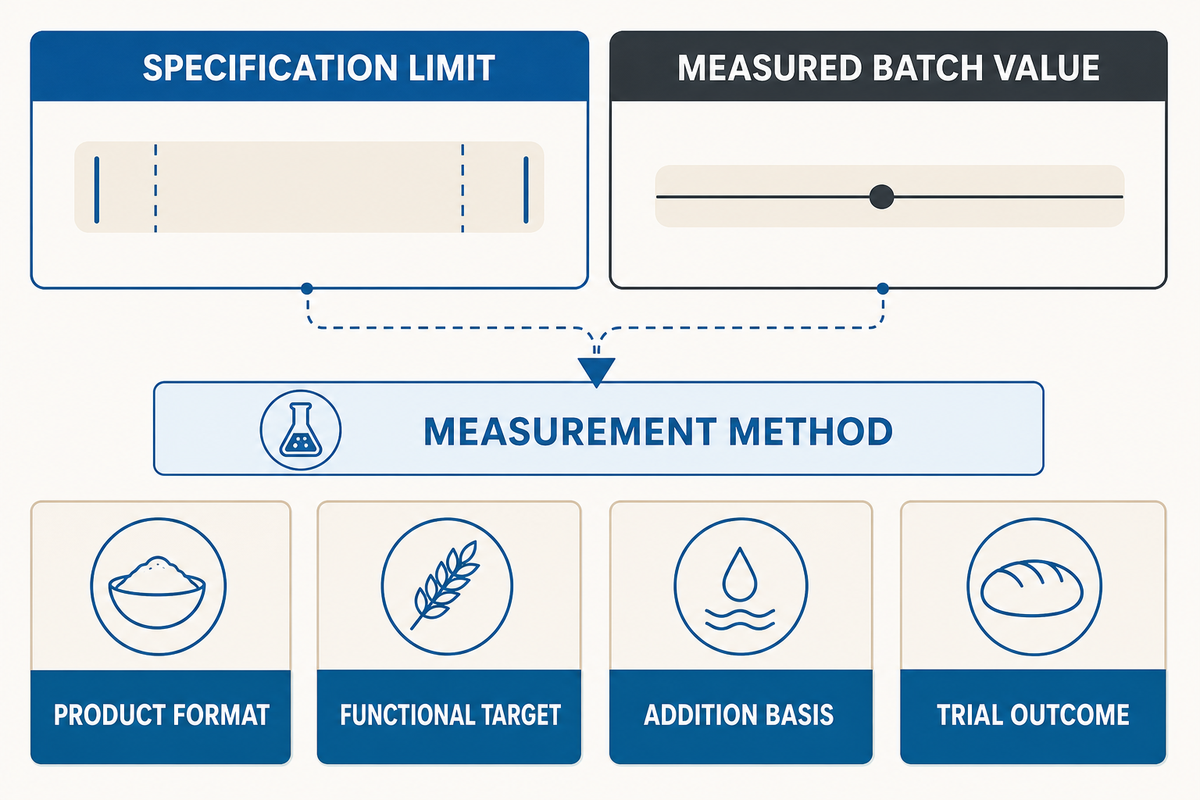
When an ingredient order is placed, the specified grade of the ingredient should also be identified, in addition to the properties required for the order to be fully reproduced. In addition to the specification, request the relevant batch data and the suggested operating conditions. Maintain each specification limit separately from a measured batch value, with the method of measurement beside each property reported.
Provide the supplier with the product format, functional target, addition basis and outcome of the trial in the brief. Include the starch source and the physical form in the brief where they relate to handling. Ask the supplier whether an alternative proposed is of the same grade or a different product offered for a similar use.
Food labels can verify processed foods contain maltodextrin, but reading labels won’t usually disclose its grade or mixing conditions. Therefore, a food additive name on a pack is just the starting point of a technical comparison. Request the specification that belongs to the ingredient actually supplied.
The phrase “highly processed” doesn’t define a material’s DE or moisture. It doesn’t address dispersion behavior. Therefore, it doesn’t quantify enough to evaluate the offered grade. For a brief that requests non-GMO sourcing, request documentation for the offered grade. A botanical source name alone doesn’t establish a non-GMO claim.
Buying rule: The absence of a method or uncertainty with the grade identity is a reason to resolve the specification prior to scaling the trial. A positive result with one recipe doesn’t qualify or support every cake, bread or snack format.
Continue the next investigation narrowly. The site’s texture resources and browning and moisture troubleshooter help document the specific output that still requires work.
Frequently asked questions
Ingredient names can sometimes be misleading, so double check product identity before adjusting a recipe. The answers below tell how maltodextrin differs from leaveners and malted flour, and how to read grade info. Dosage needs to be kept linked to a defined trial. A white powder doesn’t prove an ingredient is interchangeable.
Is maltodextrin the same as baking powder?
No. Maltodextrin is a starch hydrolysate; baking powder is a leavening preparation.
A recipe needs its leavening system to perform a different job from a carrier or bulking ingredient. If maltodextrin appears in a compound ingredient, read the complete ingredient list and its technical description. Its presence doesn’t mean that the whole preparation can replace ordinary maltodextrin, or that the hydrolysate can replace the recipe’s specified baking powder.
What is another name for maltodextrin?
Commercial grade names identify particular products; they are not reliable synonyms for every maltodextrin.
Check the ingredient’s technical identity rather than choosing by a familiar trade name. Dextrin is a broader naming issue, and dried glucose syrup or a specialty tapioca product may have a different specification and intended use. Ask for the grade, starch source, DE and relevant handling information. Those details give a trial a reproducible starting point; a name alone doesn’t.
How do you use maltodextrin powder in baking?
Define its function, select an appropriate grade and compare a recorded trial with the unchanged recipe.
Use the supplier’s relevant application guidance as a starting point, then state whether the addition is based on flour mass or total formula mass. Account for the solids and water introduced. Keep the mixing and baking conditions recorded, and assess the finished product at a consistent interval. An oil-powder example should stay with that application rather than becoming a dough addition rate.
Is maltodextrin the same as malted flour?
No. Maltodextrin is a starch hydrolysate, while malted flour is flour from malted grain.
Confirm whether the recipe calls for diastatic or non-diastatic malted flour. The name “malt” doesn’t establish equivalent function or enzyme activity.
How much maltodextrin should a baking recipe contain?
There is no single addition rate established here for all bread, cake and biscuit recipes.
A useful quantity belongs to a specified grade, formula and purpose. Start from a relevant supplier formulation or a study whose conditions match the question, then record the basis of the percentage. The hypothetical 100 g solids example in this guide is arithmetic, not dosage advice. Keep an unchanged control and agree on the product measurements before testing. If the formula needs several simultaneous changes, document them as a reformulation rather than attributing the result to one ingredient.
Before the next sample: write down the grade, the function it must perform and the result that would warrant buying more. Put the control recipe with the trial record.
The information in this example is drawn from publicly available documents including specifications from manufacturers, and a culinary school example reviewed in October 2026. Some papers were available only as abstracts or public previews. The worksheets and examples are illustrative only. No UDTECH formulation trial, ingredient certificate, or customer performance evidence is claimed.
References & Sources
- The effects of maltodextrins on gluten-free dough and quality of bread, Witczak and colleagues, Journal of Food Engineering, 2010; public abstract and preview.
- Effect of Maltodextrins on the Rheological Properties of Potato Starch Pastes and Gels, Juszczak and colleagues, 2013.
- ISO 5377:1981 public catalogue, International Organization for Standardization.
- Changes in baking properties of wheat flour impacted by maltodextrins added, Karolini-Skaradzińska and colleagues, 2012; public abstract.
- Panned-bread study of maltodextrin and ziziphus gum, PubMed record; abstract and figure captions.
- Study of maltodextrin molecular structure in frozen dough, PubMed record, 2022; abstract.
- Starch Gelatinization, American Society of Baking.
- Three Oils To Add to Your Pantry, Institute of Culinary Education, 2017.
- Oxidative stability of spray dried matcha-tuna oil powders, Shi and colleagues, Food Research International, 2020; PubMed abstract.