When creating a recipe using hydrocolloids, the starting point is typically the expected end result. Choosing hydrocolloids in food starts with the result you need: a sauce that pours evenly, a filling that holds its shape, or a batter that stays consistent before baking. Each of those requires a different test. A powder that thickens water may not perform as well when sugars, salts, flours, or other ingredients are added.
This guide connects applications of hydrocolloids with ingredient type, processing conditions and sample checks with food industry buyers. The tables provide users with practical frameworks drawn from the published literature of food science and technology alongside attributed application guidance. They aren’t finished recipes, and shouldn’t be construed as evidence of UDTECH formulation trials.
Foundational studies retain their original publication dates.
What are hydrocolloids in food?
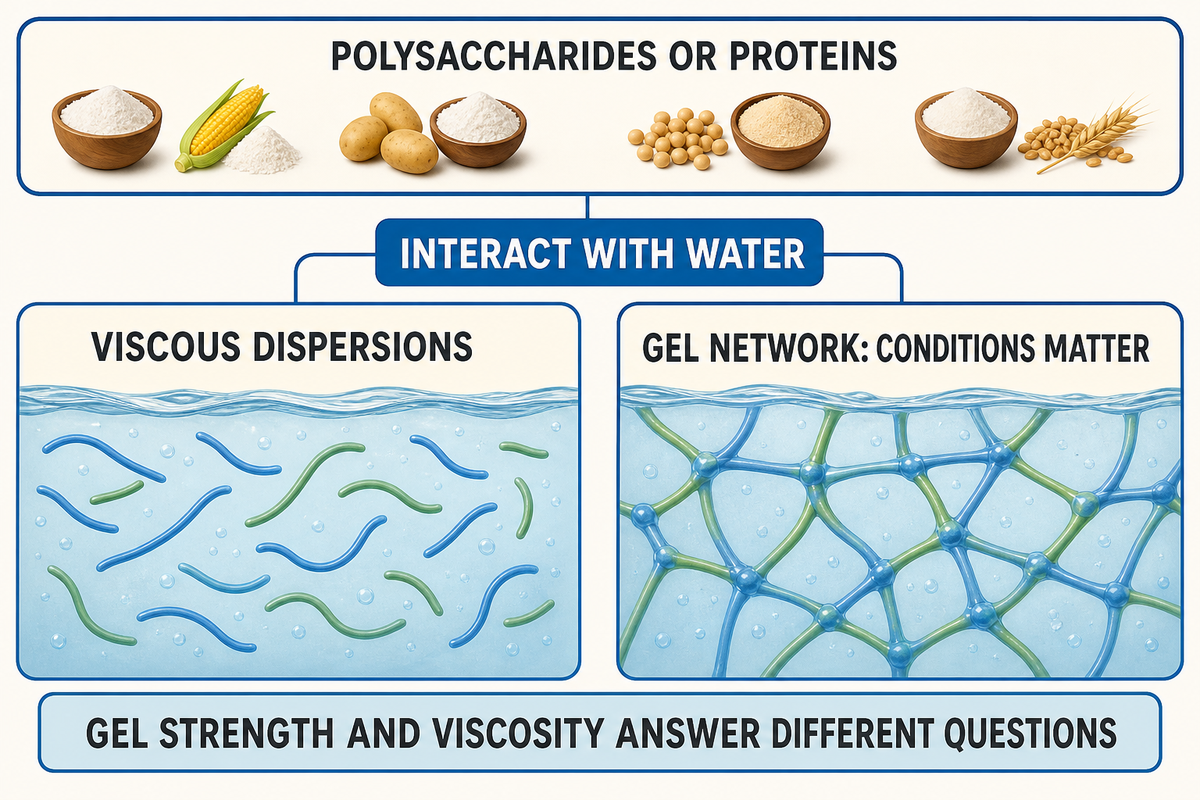
Food hydrocolloids are long chain polymers, typically polysaccharides or proteins, that interact with water to form viscous dispersions or gels. In food, they’re used to modify the flow, structure or physical stability. The category includes a wide variety of gums and selected starches and gelatin; belonging to the category doesn’t mean that every ingredient performs every function.
At the molecular level, a polysaccharide chain can resist movement through water. It’s the ability to form a connected network that determines whether a gel forms under those conditions. Saha and Bhattacharya distinguish thickening and gelling mechanisms in their review of food hydrocolloids. Gel strength and liquid viscosity answer different questions.
The importance of hydrocolloids becomes particularly clear when something goes wrong with a formula or process. The importance of hydrocolloids becomes clearer when a product fails: particles settle, a sauce separates, or a dessert loses its intended texture. Identifying defects is more productive than naming the strongest thickener. A liquid may be too viscous to pour even though its appearance during storage is excellent.
For purchasing, use “food gum” as a category label. Request the ingredient name and grade before comparison shopping. The wider baking ingredient functions guide assists in differentiating the jobs of starch, proteins, sugars and other components.
Types of hydrocolloids and their food sources
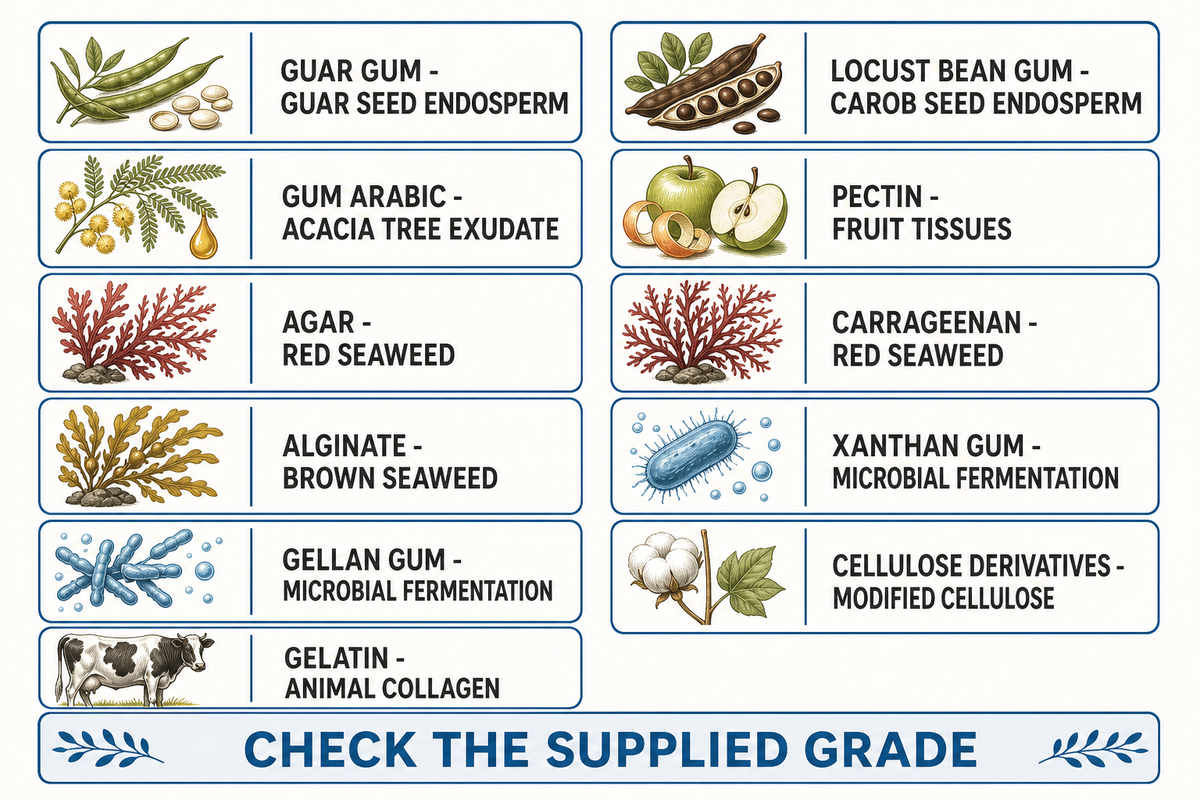
Hydrocolloid sources include plant seeds, fruit tissues, tree exudates, seaweed, microbial fermentation and animal proteins. Origin identifies the raw-material family, while processing and chemical structure help determine performance. Two products derived from natural sources may require different hydration conditions, and a cellulose derivative should be identified by its specific chemical name.
Knowing the purpose of each ingredient in a particular blend may be more valuable than knowing the number of hydrocolloids. It may be necessary to use a blend to achieve the desired flow, set and mouthfeel.
| Ingredient | Source or route | Typical formulation role | Limitations / Not suitable for |
|---|---|---|---|
| Guar gum | Guar seed endosperm | Thickening aqueous systems | A generic name does not specify hydration rate or particle size |
| Locust bean gum | Carob seed endosperm | Thickening; interaction with selected gelling gums | Do not assume the same hydration procedure as guar |
| Gum arabic | Acacia tree exudate | Selected emulsion, carrier and film applications | Not a like-for-like high-viscosity substitute for xanthan |
| Pectin | Fruit tissues, commonly citrus peel and apple pomace | Fruit preparation gels and texture control | Grade, solids, acidity and calcium conditions matter |
| Agar | Red seaweed | Gelling | A gel texture may differ from gelatin or pectin |
| Carrageenan | Red seaweed | Grade-dependent thickening and gel systems | Kappa, iota and lambda are not interchangeable |
| Alginate | Brown seaweed | Thickening and calcium-responsive gels | Calcium timing can change when structure develops |
| Xanthan gum | Microbial fermentation | Flow control and suspension support | Thicker does not automatically mean a more stable emulsion |
| Gellan gum | Microbial fermentation | Grade-dependent gels and suspension systems | Acyl grade and ions change the resulting structure |
| Cellulose derivatives | Modified cellulose | Ingredient-specific flow and structure control | Carboxymethyl cellulose and methylcellulose behave differently |
| Gelatin | Animal collagen | Protein gel formation | Unsuitable where animal-derived ingredients are excluded |
Are algin and carrageenan hydrocolloids?
Yes. Algin refers to alginic acid and carrageenan is a seaweed-derived hydrocolloid. The FAO seaweed handbook differentiates brown-seaweed alginate from red-seaweed agar and carrageenan. Carrageenan types matter for applications. A lambda grade selected to thicken is not a direct substitute for a grade selected to form gels.
“Natural,” “modified” or “synthetic hydrocolloids” descriptions of common hydrocolloids can’t substitute for a specification. Identify the ingredient, what processing altered it, and verify if the supplied product is a blend. Hydrocolloid gums are one of many members in the class of additives in the food industry. Modified starch is a different broad class, not a single product with a single predictable texture.
Thickening, gelling and stabilizing are different jobs
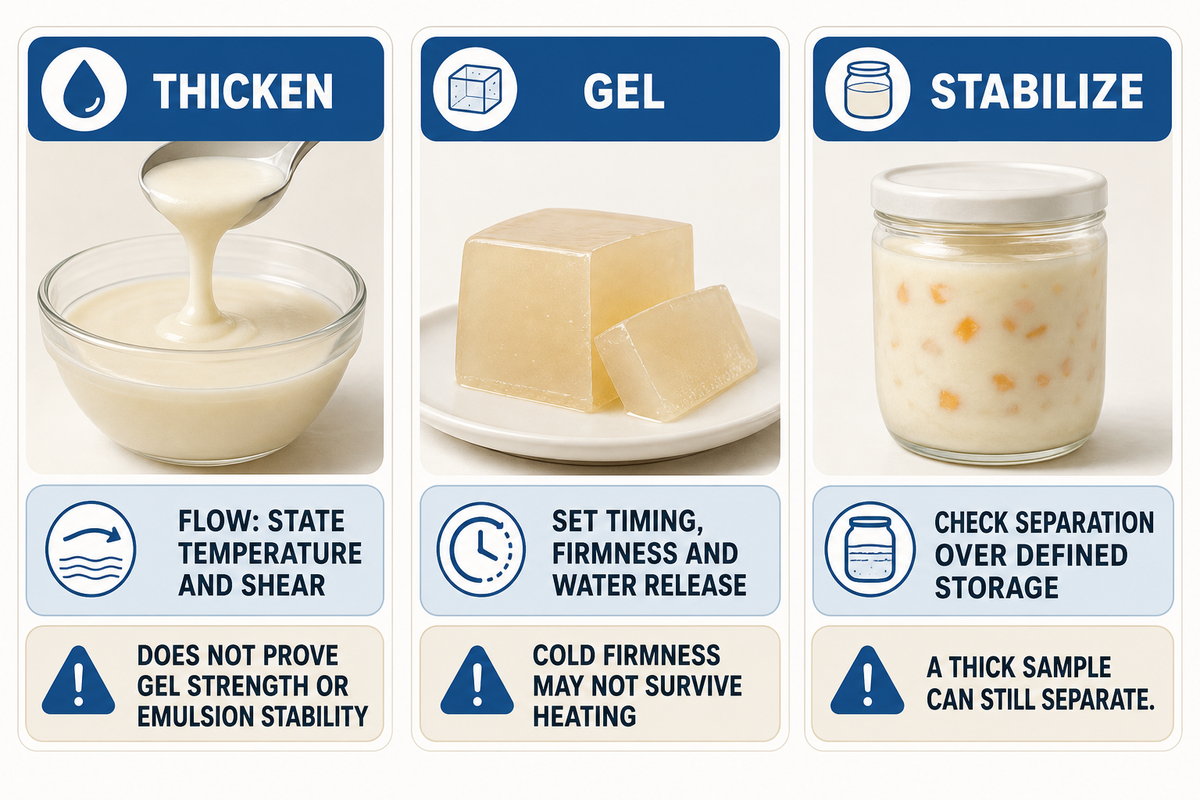
An emulsifier acts at an interface, whereas a stabilizer may work through the surrounding liquid. Thickening raises resistance to flow; gelling creates a network. Different hydrocolloids may perform multiple functions, but a viscosity reading can’t show all the functions. Stabilization slows an unwanted physical change such as droplet separation.
What are hydrocolloids used for in food?
Hydrocolloids are widely used to control or alter the flow of sauce, set gels, help in the texturization of baked products and help to keep dispersed ingredients in a mixed state. Some aid in the formation of a coating or a film. These uses of hydrocolloids depend on the other constituents of a complete food system, including proteins, fats and starch.
3-Function Selection Map
| Required job | Observe | Buyer action | Limitations / Not suitable for |
|---|---|---|---|
| Thicken | Flow and viscosity at a stated temperature and shear condition | Compare pump, pour or deposit behavior through the working hold period | Does not prove gel strength or emulsion stability |
| Gel | Set timing, firmness and water release after the intended cycle | Match the grade to the recipe’s setting triggers | A firm cold gel may not tolerate the intended heating step |
| Stabilize | Settling, creaming, separation or water release over defined storage | Measure the actual defect, alongside texture | A thick sample can still separate through another mechanism |
In their 2001 emulsion study, Huang, Kakuda and Cui looked at gums in a canola-oil model, and found that viscosity explained only a part of stability. Some ingredients affected the process of droplet formation or the interface. Therefore, gum arabic is a reminder that, for an emulsion, a gum need not necessarily yield a very thick liquid.
In a 2005 caseinate-emulsion study, it was found that moderately low xanthan addition promoted depletion flocculation and gravity-driven separation; high levels of xanthan immobilized the structure. This model isn’t a batter recipe. It explains why “add more thickener” isn’t a sufficient explanation of emulsion behavior.
The consequence for quality teams is: define stability by the defect you’re measuring. In hydrocolloid applications where separation is the problem, enhancing food texture alone is insufficient. Procurement should request evidence of the stability test as opposed to accepting a claim of a thickening agent for ensuring each of the required functions.
Hydrocolloids in bakery batters
Batter consistency is critical for even dispensing of the right amount of ingredients, and consistent performance during handling. Bakery batters also have to flow through their processing system. Hydrocolloids used in a batter can alter its rheological properties and cooked texture. A result from wheat bread dough, a gluten free rice system or gelled filling, doesn’t establish the correct grade for a pourable waffle batter.
“a batter that is too thick is more difficult to handle in terms of pumping and depositing.”
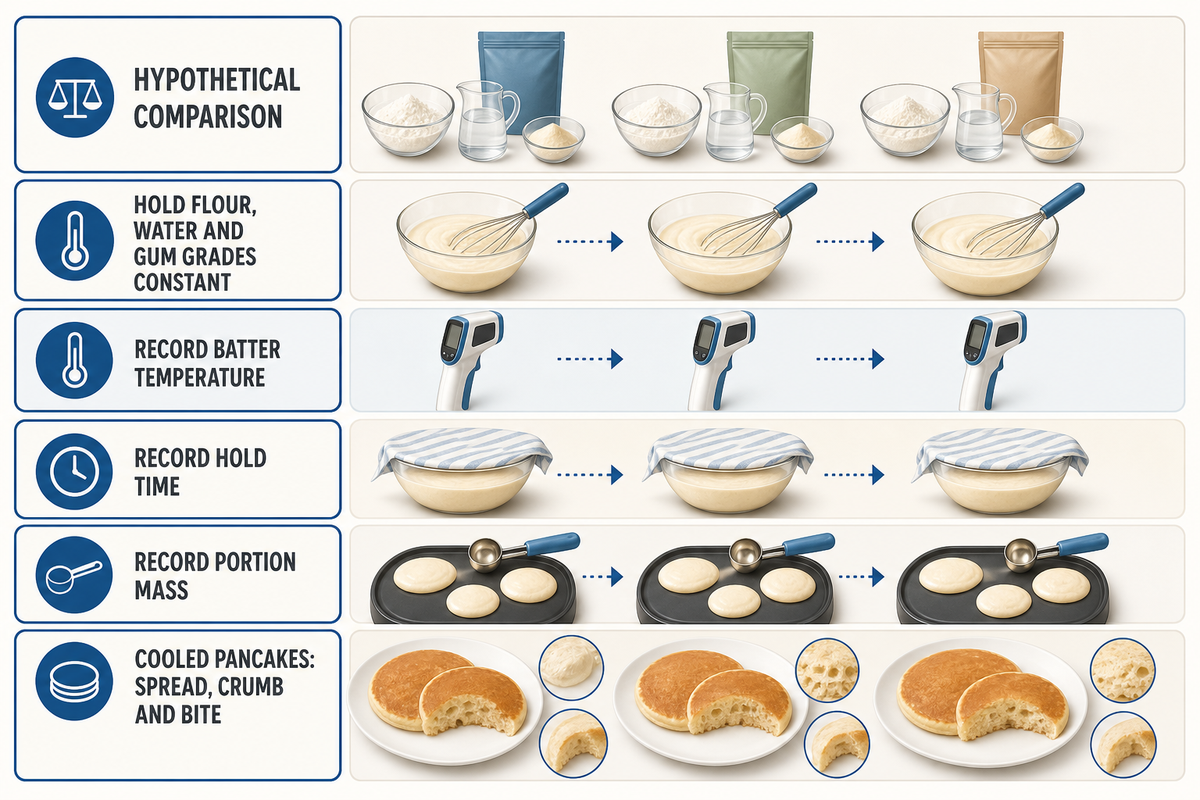
An example of a development study may illustrate the point better. A moulded pancake product was being developed. The first deposits from the feed system looked consistent, but later deposits spread differently after the batter waited. Keep the flour, water and gum grade constant and record the batter temperature, how long it was held and the mass of the portion. Evaluate the cooled pancakes for spread, crumb and bite. If the batter thickened during the hold time, evaluate hydration development before believing it was a weighing error. If viscosity stays steady but the deposit consistency changes, evaluate the delivery conditions separately. This example is a hypothetical comparison, not a measured study from a production situation.
This difference is important when talking about moulded waffle and pancake lines. Process checks for formulation should consider the actual mixing, holding, depositing and moulded baking. Differences in waffle and pancake batters provides context about the products being made, but doesn’t indicate that a particular gum dose is interchangeable.
State the concentration basis. Using the example calculation, 20 g of gum in a 10 kg final batch is 20/10,000 × 100 = 0.20% by mass of the batch. If that batch contains 4 kg of flour, then the same 20 g is 0.50% by mass of flour. Neither percentage is a recommendation; confusing the two changes the apparent dose by a factor of 2.5.
Reject sample comparisons that simply state ‘gum percentage’. Baking with xanthan gum requires a trial that includes handling and finished-product evaluation, rather than acceptance on thickened water alone.
Pectin and other gels in fruit fillings
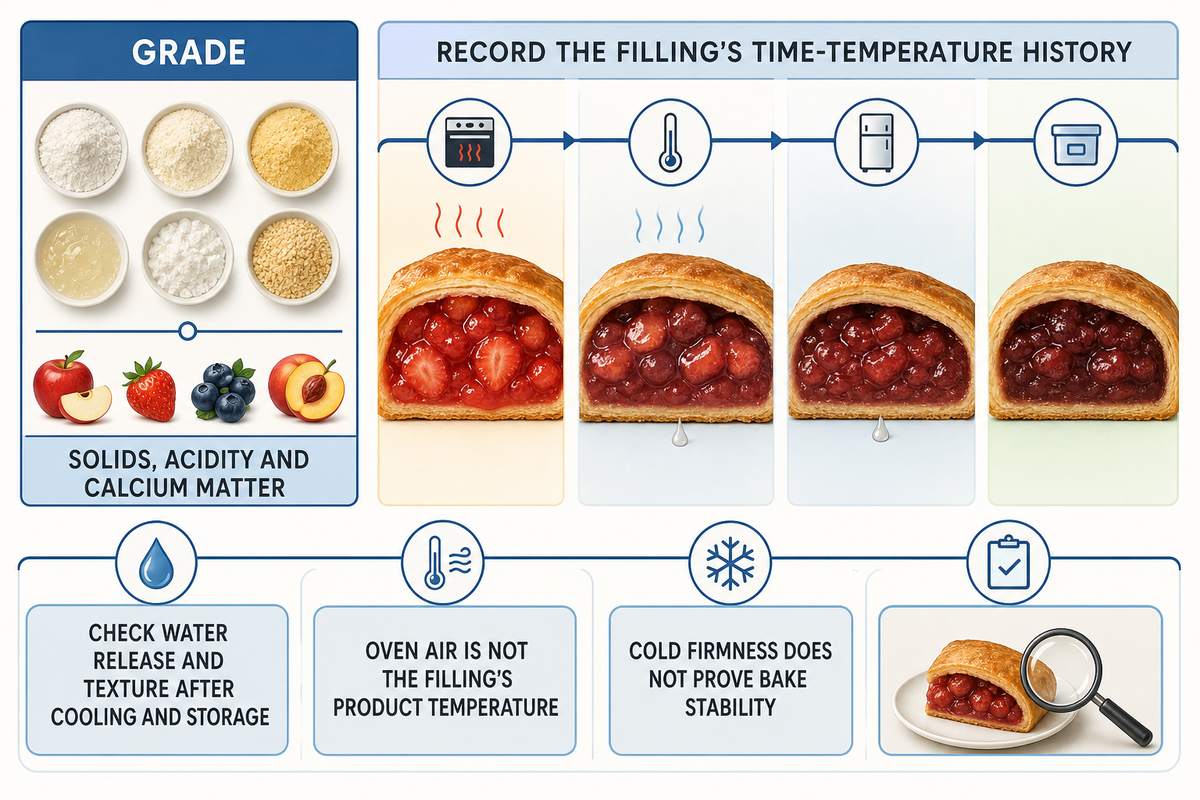
Fruit fillings require gelling systems that are compatible with solids, acid, calcium and the point at which the filling enters production. High and low methoxyl pectin require different setting conditions. What’s suitable for a dessert cold-fill may not be suitable for a pectin-based product that’s baked in another food.
Cargill’s fruit-pectin guidance separates HM pectin and low-methoxyl pectin (amidated and conventional) with distinct pre-bake and post-bake offerings. These are supplier application categories and don’t set a universal substitution ratio, or a single temperature limit for all pectin.
The 2016 JECFA pectin specification notes that commercial pectin may be standardized with sugars and buffer salts. A bag therefore is more than a family name. Model-pectin research by Yapo and Koffi indicates that the distribution of demethylated blocks and branching affects calcium-mediated gel formation.
Imagine a fruit preparation that holds its shape when cold, but releases liquid after baking and cooling. A larger dose may make the cold sample firmer without resolving the process mismatch. Compare the existing grade with a supplier-recommended baked-in grade for the same fruit preparation, measured solids and acidity. Record the filling’s own time-temperature history. Inspect water release and the texture of the filling after the intended cooling and storage steps. Oven air temperature can’t stand in for the product temperature throughout the filling. The decision is whether the complete product survives its process, not which unbaked sample feels hardest.
Gelatin, agar, and other gelling agents can produce different textures, including elastic gels or firmer, more brittle structures. Substitution also changes ingredient-origin requirements. Keep this filling decision separate from the selection of equipment for moulded batter baking.
Check heat, acidity and salts before changing gums
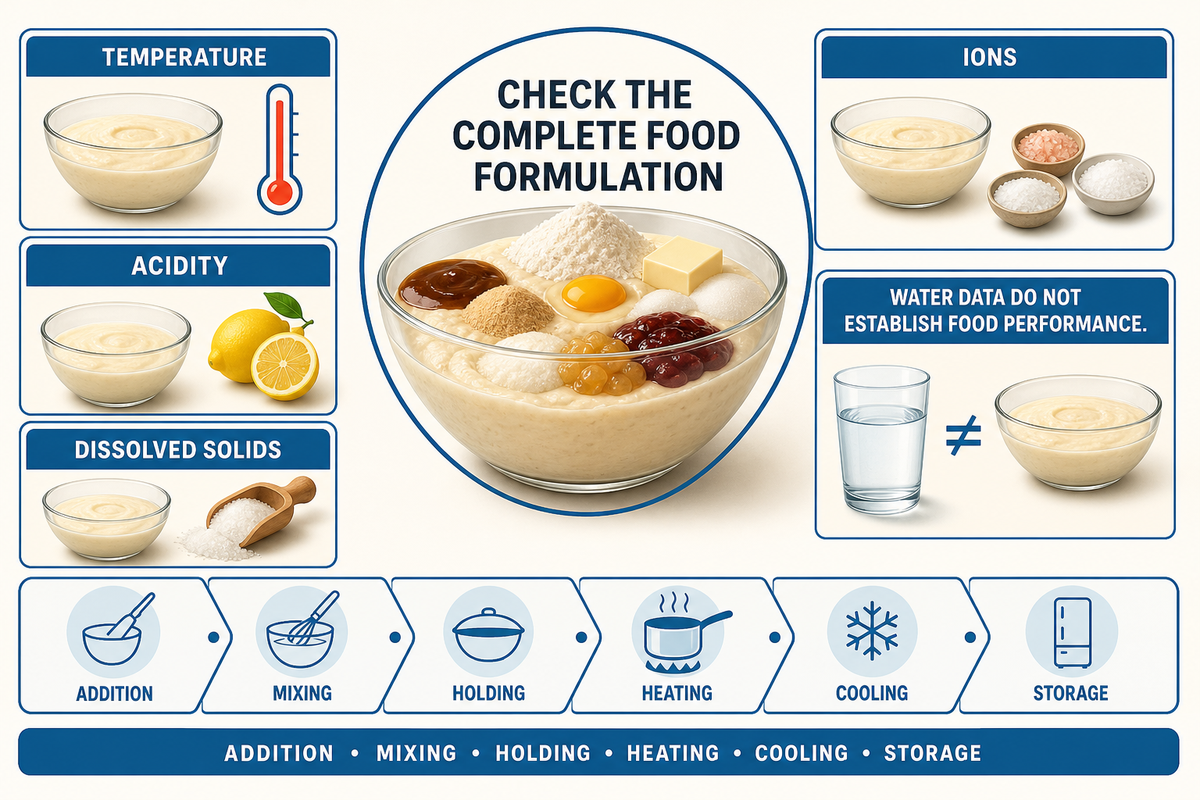
Temperature, acidity, dissolved solids and ions can assist or disrupt hydrocolloid performance, depending on the ingredient and its grade. Calcium can be the desired gel trigger, while premature exposure can complicate processing. Full food formulation testing is required, because solubility and structure development in plain water don’t describe the complete recipe.
In its bakery hydration feature, Baking Business quotes specialists from Cargill, IFF and Ingredion on water availability and processing effects. Sugar and flour compete in the same mixture. Adding a gum to that mixture is different from hydrating it in an isolated water phase.
Map the processing procedures with addition of hydrocolloids, mixing, holding, heating, cooling and storage. Describe the conditions that can change the intended structure at each stage. Use the product’s measured temperatures in °C/°F, holding times in minutes and the stated method for determining pH and solids. Include freezing and thawing only if the product is subject to these changes.
Starch gelatinization and later retrogradation can also affect texture of food. A gum can’t be credited for every change in moisture or firmness in a starch-containing product. Compare to an unchanged control, and associate moisture content measurements with baking texture and moisture control.
For a supplier trial, provide the actual fruit solids, calcium-containing ingredients and heat sequence. A successful water test with a different ion environment isn’t sufficient to purchase the grade. The useful properties of hydrocolloids emerge from the combination of polymer and process, not from the powder name alone.
Troubleshoot hydration before increasing the dose
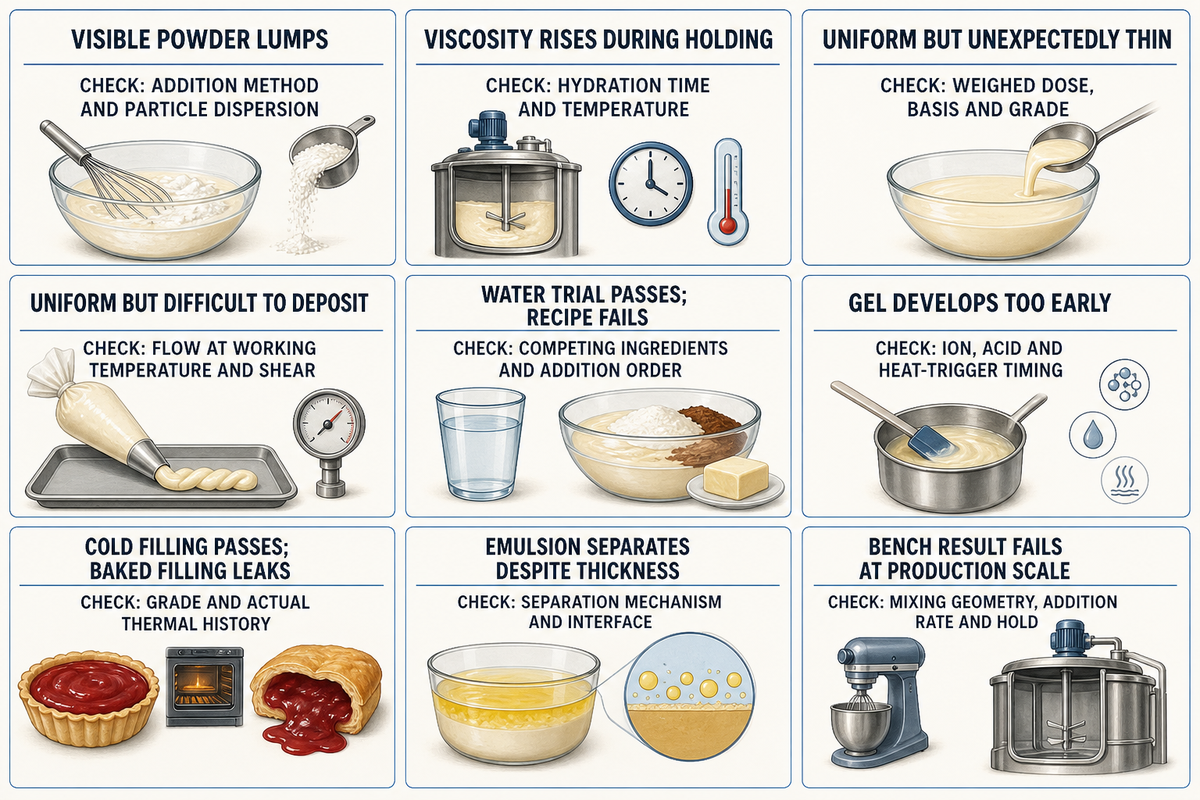
Troubleshooting hydration should differentiate particle dispersion from the development of the gum’s function in water. Visible lumps and delayed thickening aren’t the same. Before increasing the viscosity by adding more powder, compare a controlled batch at the same dose with a documented change in dispersion or hydration procedure.
Michael P. Wanous differentiates these two stages in Prepared Foods: dispersion separates particles and hydration refers to gum’s association with water. Published studies on guar support the need for grade-specific checks. Parvathy and colleagues linked hydration behavior with particle characteristics; and Wang and colleagues documented hydration behavior’s dependence on concentration and molecular weight. Neither study provided a universal pancake-batter mixing time.
| Observation | First check | Controlled next comparison | Limitations / Not suitable for |
|---|---|---|---|
| Visible powder lumps | Addition method and particle dispersion | Compare a supplier-approved preblend at fixed dose | More gum can add more poorly dispersed material |
| Viscosity rises during holding | Elapsed hydration time and temperature | Measure at the same scheduled hold points | One immediate reading misses later development |
| Uniform but unexpectedly thin | Weighed dose, basis and grade identity | Verify the recipe record before changing dose | Absence of lumps does not prove complete hydration |
| Uniform but difficult to deposit | Flow at working temperature and shear | Compare handling and baked texture together | Highest viscosity is not necessarily the target |
| Water trial passes; recipe fails | Competing ingredients and addition order | Repeat in the complete formulation | Water data do not establish food performance |
| Gel develops too early | Ion, acid and heat-trigger timing | Review grade-specific sequence with the supplier | Extra mixing alone may not reverse setting |
| Cold filling passes; baked filling leaks | Grade and actual thermal history | Compare through baking and cooling | Cold firmness does not prove bake stability |
| Emulsion separates despite thickness | Separation mechanism and interface behavior | Evaluate separation alongside rheology | Increasing continuous-phase viscosity can be insufficient |
| Bench result fails at production scale | Mixing geometry, addition rate and hold conditions | Reproduce documented process conditions | Equal mixer rpm alone does not establish equal treatment |
Common failure modes: when more gum is the wrong next step
If adding powder results in small agglomerates and the remaining liquid is too thin, increasing the addition may conceal poor dispersion and raise ingredient use without developing a repeatable process. Silverson identifies this as a case of incomplete hydration and later viscosity development. Silverson’s mixing advice is not an instruction to apply high shear to finished wheat batter.
Second, modifying addition time and order of gum, water, and mix would also be considered changing more than one variable. If that batch looks better, the team can’t identify which change made the difference. Record the control first. Then, change one variable. The gum grade, addition order and measurement time should be documented. Note the condition of the finished food and the liquids, as well.
Flour development may also contribute to a rubbery final food product. Use rubbery pancake troubleshooting to consider these other factors. If observations indicate problems with flour development or process control, stop a gum-only adjustment; don’t have procurement replace the grade.
Do
- Identify the exact gum grade.
- Record temperature and elapsed time.
- Compare one change against a control.
Don’t
- Treat visible dispersion as proof of hydration.
- Transfer a solution test directly to batter.
- Change dose and mixing together.
Specify the grade and the trial before ordering
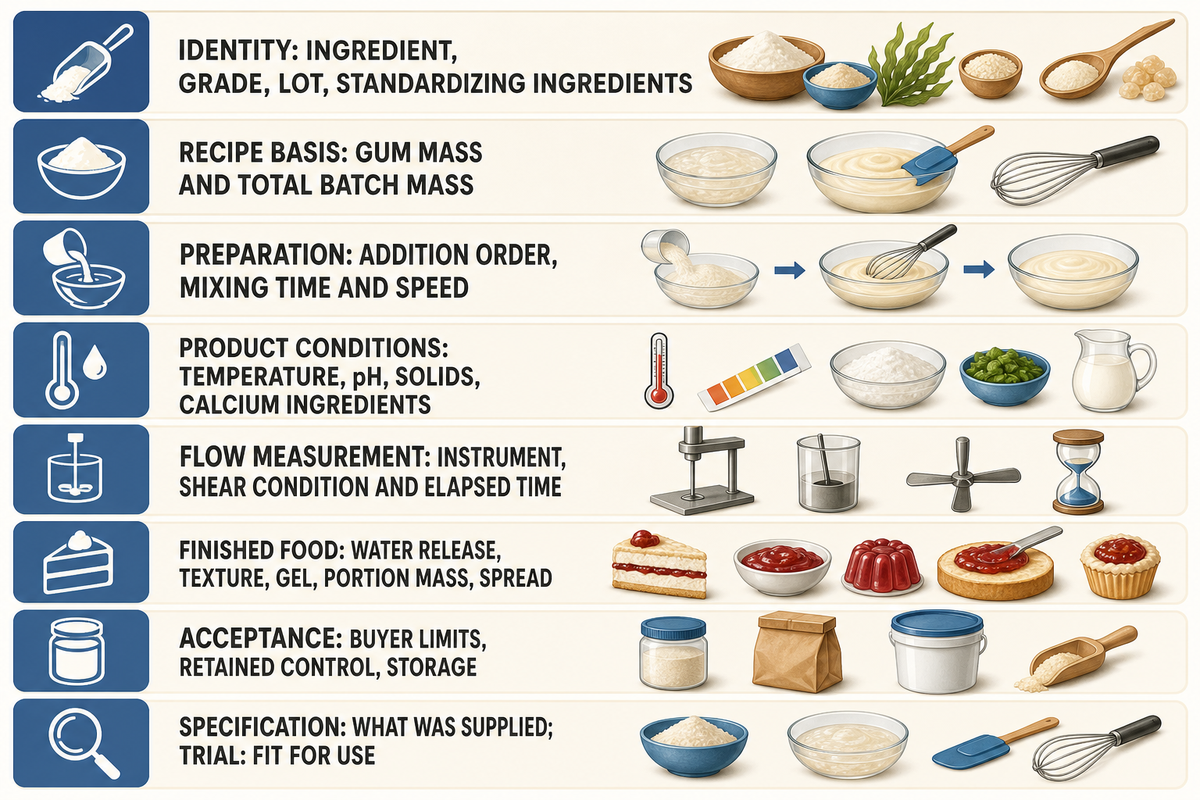
A hydrocolloid sample request gives the grade, intended use, complete recipe conditions and acceptance method. Quality staff need reproducible measures, production staff need workable handling and procurement needs comparable specs. Comparing two suppliers’ viscosity numbers measured under different conditions is of little value.
A precise example comes from 21 CFR 172.695(d)(2). Its xanthan viscosity specification test uses 1% gum plus 1% potassium chloride, stirred for 2 hours, with a minimum viscosity of 600 centipoises at 75°F. The stated instrument is a Brookfield LVF or equivalent, No. 3 spindle at 60 rpm. The same provision gives a 75°F-to-150°F viscosity ratio of 1.02–1.45. These are conditioned specification values, not a batter dose or target.
These areas should be noted on a request form, and agreed upon product-specific acceptance limits should be established before comparing results.
- Identity: ingredient, manufacturer grade, lot and any standardizing ingredients.
- Recipe basis: By recipe, gum mass in grams and total batch mass in kg. Flour-basis percentages should be identified separately.
- Preparation: Order of addition, mixing equipment, speed in rpm and mixing time in minutes.
- Product conditions: state measured product temperature and pH; state the solids and relevant calcium-containing ingredients.
- Flow measurement: Type of instrument, spindle or geometry, shear condition and elapsed time.
- Finished-food checks: Check the final food for water release after the intended cycle, crumb or gel texture, portion mass and spread.
- Acceptance: buyer-defined limits, a retained control and intended storage conditions.
Using hydrocolloids means separating ingredient identity from use case proof. A specification defines what was supplied; the trial determines fit for use. In the case of hydrocolloids including pectin and xanthan, the outcome of applications in food depends on this distinction. Consider a different carbohydrate ingredient in maltodextrin in baking for example, but don’t assume it can generally replace a gelling agent.
Key takeaway
Choose hydrocolloids by the job, then verify the grade in the full recipe. Match 3 decisions: the required function, the processing conditions and the finished-food acceptance test. A thick water sample cannot answer all three.
Prior to your next ingredient trial, detail what the defect is and what the outcome will be that justifies a purchase. Send this to your supplier along with the full conditions of the recipe, to enable them to advise an appropriate grade.
Frequently asked questions
Q: What are examples of hydrocolloids?
Examples include xanthan gum, guar gum, pectin, agar, alginate, carrageenan and gelatin.
Selected starches and cellulose derivatives also belong to the broader category used in food science. Their functions differ: some mainly adjust flow, while others build a gel under specific conditions. Ask for a food-grade product identified by ingredient and grade, then test it in the complete recipe. A shared category name does not establish a suitable replacement.
Q: What are the main sources of hydrocolloids?
Hydrocolloids come from plant tissues, seaweed, fermentation and animal proteins.
Guar comes from seed endosperm, pectin from fruit tissues, gum arabic from tree exudate, alginate from brown seaweed and xanthan from microbial fermentation. Gelatin is produced from animal collagen. Origin helps identify a food additive, but it does not specify hydration time, gel strength or suitability for a particular batter. Check the supplied grade and any blend ingredients.
Q: What is another name for a hydrocolloid?
Many food hydrocolloids are called gums, although the terms are not exact synonyms.
The broader hydrocolloid category includes protein ingredients such as gelatin and, in many classifications, starches. A supplier may describe a product as a thickener, stabilizer or gelling agent according to its intended role. Those functional labels do not identify its composition. Request the ingredient name, grade and preparation method rather than ordering a material described only as gum.
Q: What are some examples of food colloids?
Milk, whipped cream and jelly illustrate different food colloids.
Milk is an emulsion, whipped cream contains a foam structure, and jelly is a gel. These terms describe food systems. Hydrocolloids are ingredients that may help build or stabilize such systems; the two labels describe different things.
Q: How do hydrocolloids work in food?
Hydrocolloids interact with water and can change flow, build networks or help control physical separation.
Polymer chains can increase resistance to flow, while suitable chain interactions can create a gel network. Some grades also affect interfaces in emulsions. The result depends on chemical structure, concentration and surrounding ingredients. Sugar, salts, acidity and heating may change the response. The role of hydrocolloids in food processing should therefore be evaluated through the actual mixing, heating, cooling and storage sequence, with measurements that address the intended defect rather than viscosity alone.
Q: Can I replace one hydrocolloid with the same amount of another?
A same-weight substitution does not establish equivalent performance.
Different grades may hydrate or set differently. Compare supplier guidance and test the full recipe while keeping the concentration basis explicit. Accept the replacement only when its handling and finished-food properties meet the intended requirement.
Q: What is gum arabic?
Gum arabic, or acacia gum, is a plant exudate used in several food applications.
Its behavior differs from gums selected chiefly to make a liquid highly viscous. Certain grades help stabilize flavor emulsions and work as carriers or film-forming ingredients. Emulsion performance depends on the supplied material and the formulation, so the relevant purchasing question is the required function. Obtain a grade recommendation and test separation under intended storage and handling conditions. Do not assume that gum arabic, xanthan gum and guar gum are interchangeable because all are called gums.
References & Sources
- Hydrocolloids as thickening and gelling agents in food: a critical review Saha and Bhattacharya.
- Introduction to commercial seaweeds FAO.
- Pectins specification, Monograph 19 JECFA, 2016.
- Xanthan gum specification 21 CFR 172.695.
- Hydrocolloids in emulsions Huang, Kakuda and Cui, 2001; public preview.
- Caseinate and xanthan emulsion microstructure Moschakis and colleagues, 2005; abstract.
- Model pectins and calcium gel formation Yapo and Koffi, 2013; abstract.
- Guar hydration characteristics Parvathy and colleagues, 2007; abstract.
- Guar dissolution kinetics Wang and colleagues, 2003; abstract.
Scope of this formulation guide
Prepared for UDTECH, this article connects hydrocolloid function with batter handling and treats fruit fillings as a separate formulation example. The evidence comes from the cited literature, public specifications and attributed supplier guidance. The diagnostic tables are editorial synthesis, not proprietary gum recipes or client test results. UDTECH’s equipment context here is moulded waffle and pancake baking.