Dextrinization is the conversion of starch to dextrins as a result of the application of heat. It’s observed during the heating of flour, breads, and cereal products in the presence of relatively dry conditions. A brown crust is a useful observation. However, a brown crust can’t tell the amount of starch that’s dextrinized, or the type of reaction that resulted in the production of brown color.
Updated October 2026
Dextrinization changes starch chains during thermal treatment. Toast, roux and thin baked sheets offer familiar contexts, but their color also reflects other chemistry. Compare function under controlled conditions before changing a formula.
Key points
- Moderate heating can increase roux thickening before stronger heating reduces it.
- Starch conversion, gelatinization, Maillard browning and caramelization describe different changes.
- A matched flour trial compares practical function; it doesn’t measure molecular conversion.
- Purchased dextrin grades need their own specifications and intended-use checks.
What dextrinization changes in starch
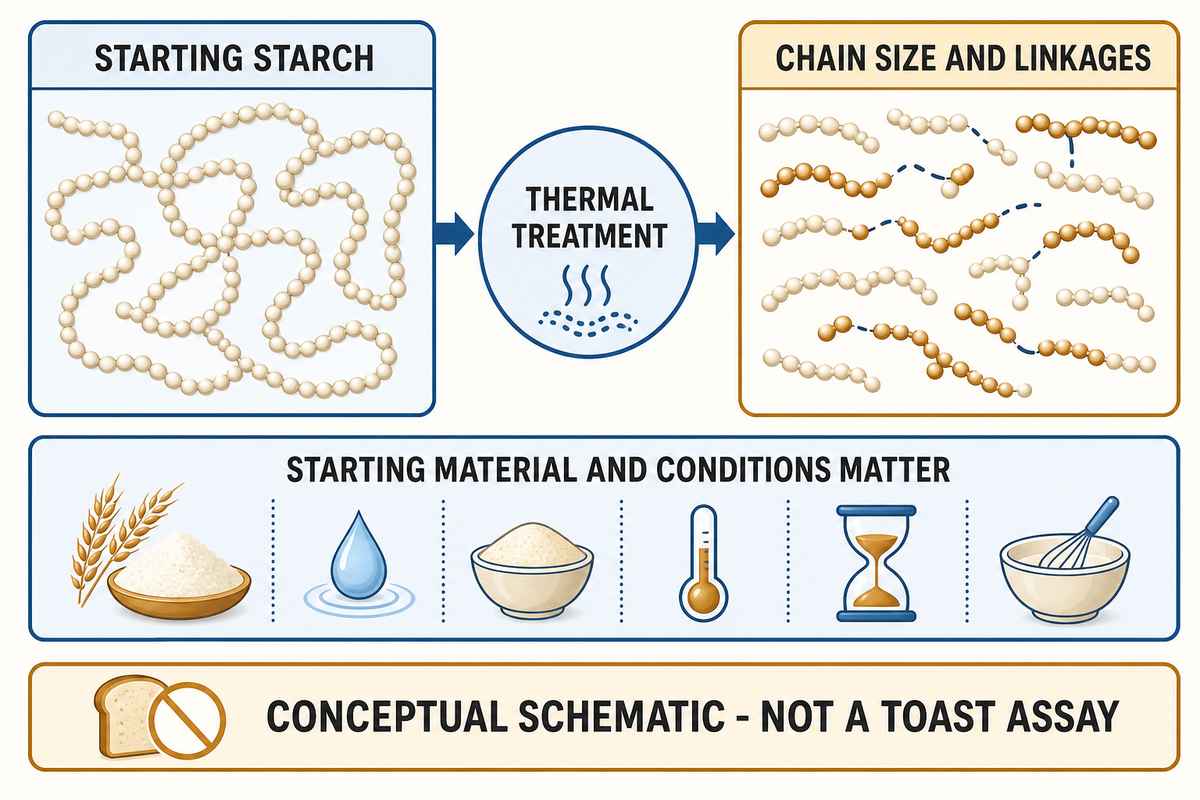
Dextrinisation (also known as thermal dextrinization) acts on naturally occurring starch molecules. A description limited to “starch becomes dextrins” doesn’t provide sufficient information. It depends on the starting starch and treatment used.
A starch molecule is made up of many glucose units and amylopectin and amylose vary in their branching patterns, so the description, “starch becomes dextrins,” is inadequate. Maltose is a disaccharide; an oligosaccharide contains a short chain of sugar units within the broader family of saccharides. Neither name describes each component of the mixture. Degree of polymerization, often abbreviated DP, describes chain length, while molecular weights describe molecular mass.
In a 2024 potato-starch study by Kapusniak and colleagues, acid pretreatment followed by controlled microwave heating produced resistant dextrins with new glycosidic linkages. It describes a more complex reaction than simple chain shortening. Similar conclusions can’t be drawn for a slice of toast.
What is dextrin in food?
Dextrin is a starch-derived ingredient or family of conversion products rather than a complete description of toasted flour. The US ingredient provision defines dextrin as an incompletely hydrolyzed starch. A food specification must still identify the material and its intended use; the name alone doesn’t describe the viscosity and cold-water solubility.
The provision on dextrin in 21 CFR 184.1277 describes methods of preparation and ways of use. Flour contains protein and other constituents, so a browned flour-and-fat mixture can’t be relabeled as a purified dextrin ingredient. Starch hydrolysis also can be enzyme-driven. During enzymatic hydrolysis, an amylase acts on a substrate, and thermal treatment introduces a different process history.
A buyer requesting lower molecular weight dextrins should ask how that distribution was measured. An ingredient name and its brown shade provide different information and so does that ingredient’s behavior in water.
Four processes that can share one baked surface
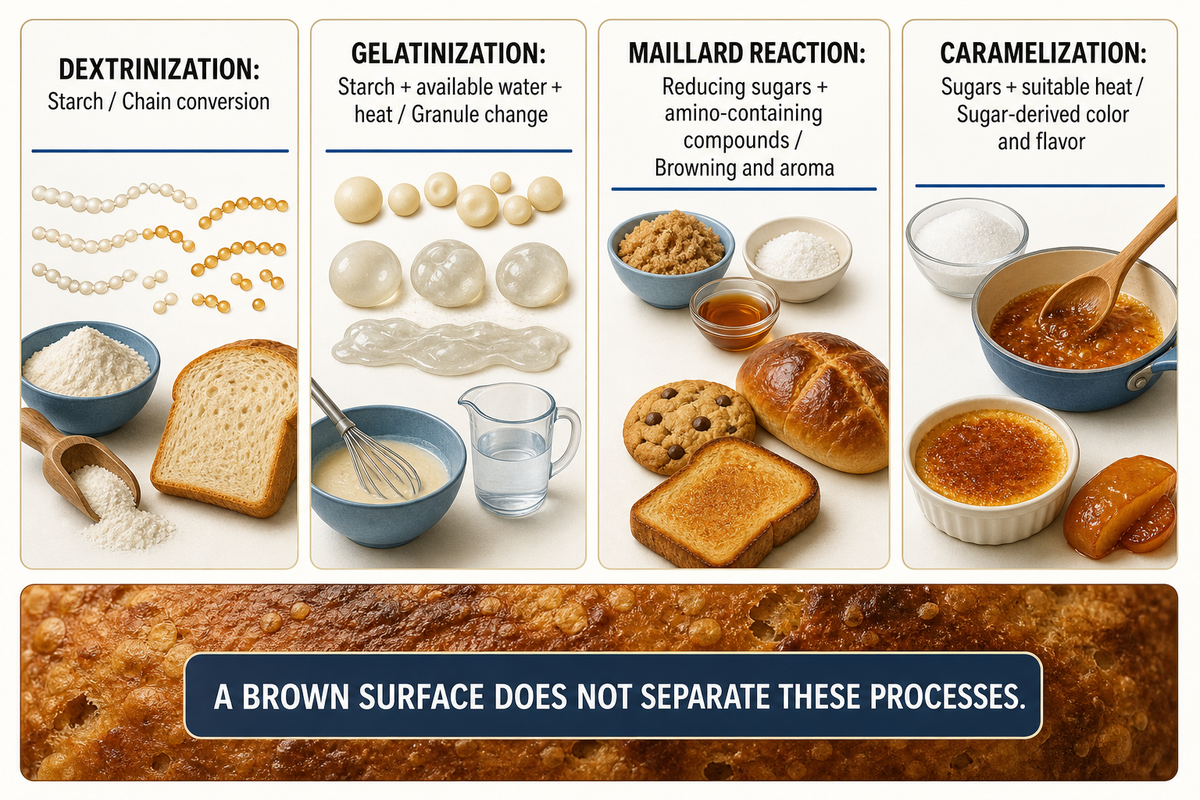
There are several changes that can occur on a baked surface when it’s heated. Dextrinization concerns starch-chain conversion; gelatinization concerns changes in hydrated starch granules. Maillard reaction concerns sugars and amino-containing compounds; caramelization concerns sugars, and the reactions depend on heat history and the recipe.
| Process | Main material or requirement | What changes | Limitation |
|---|---|---|---|
| Dextrinization | Starch under suitable thermal conditions | Chain size and sometimes linkage structure | Color alone does not measure conversion |
| Gelatinization | Starch with heat and sufficient available water | Granule order, swelling and pasting behavior | Swelling does not establish dextrin formation |
| Maillard reaction | Reducing sugars and amino-containing compounds | Color, flavors and aromas | Browning does not identify its share in a mixed food |
| Caramelization | Sugars under suitable heating conditions | Sugar-derived color and flavor compounds | No single oven setting establishes its extent |
The American Society of Baking’s gelatinization explanation describes loss of crystalline order in a starch granule as heat and water act together. Gelatinisation, the British spelling, refers to the same process. A gelatinised starch paste can become viscous without turning brown. Gelatinized starch can retrograde as its chains reassociate during storage, a process called retrogradation; a change in stored texture shouldn’t automatically be assigned to the original dry-heating step.
What is the difference between dextrinization and caramelization?
Dextrinization and caramelization are both processes that occur during the browning of foods and can be discussed within the context of browned foods, but their substrates differ. A flour-based recipe also contains proteins and sugars that can participate in Maillard chemistry, so the finished color cannot separate the processes.
We can compare the case of toasted bread and a thickened sauce to help illustrate the challenges in measuring conversion. The sauce may thicken as a result of hydrated starch without a lot of browning. Toasting bread may result in browning as the moisture evaporates. In the case of product problems, record the color and texture of the product and use the browning and moisture troubleshooting guide to organize observations.
In their 2011 roux abstract, Krasnow and colleagues reported color development for the wheat flour samples but not the corn starch roux. The authors attributed that browning mainly to Maillard reactions. That bounded comparison is more useful than treating all heated starch as one browning mechanism.
Why moisture, time and starch source change the result
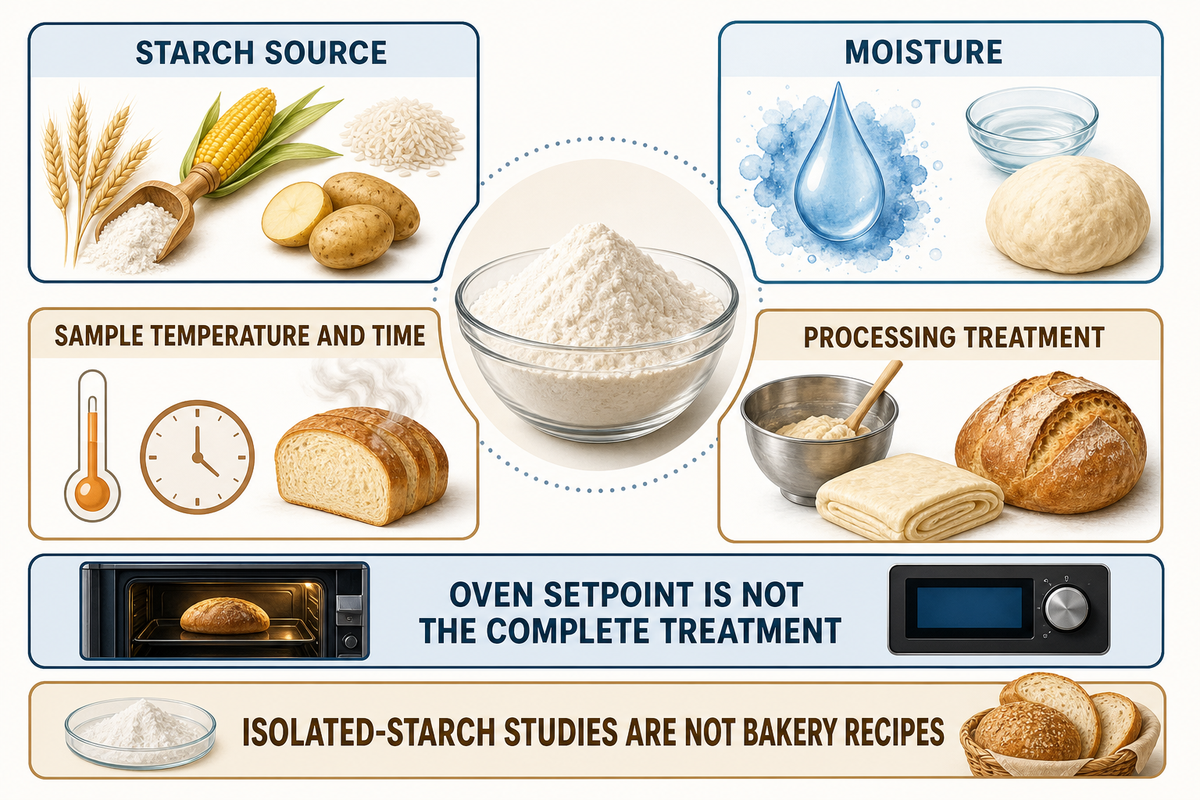
A dextrinization result is the consequence of a material and a treatment history. Starting material, moisture content, heating time, sample and oven temperatures, the presence of acids and other treatments affect a result. An oven setpoint doesn’t describe all those conditions, and a laboratory treatment of isolated starch doesn’t specify a bakery process.
Tsatsop and colleagues’ 2024 sweet-potato pyroconversion study used isolated starch with hydrochloric acid treatment. Its experimental design included 127–152 °C and 55–94 minutes. Color index, turbidity and saccharification were evaluated independently. Those conditions are a research example, not instructions for treating flour, batter or finished food.
Starch source also alters how we interpret results. Corn starch, tapioca and starches from wheat cannot be assumed to behave identically because they share a carbohydrate label. In Thomann and colleagues’ 2026 dry-heat study, two potato starches responded differently. Ordinary potato starch showed a decreasing peak viscosity, and a waxy potato starch comparison showed an increasing peak viscosity. The study evaluated dry-heat modification which shouldn’t be renamed dextrin manufacture.
Record
- Identify the starch or flour lot.
- Measure material moisture and temperature when the test requires them.
- State the functional endpoint being compared.
Avoid
- Transfer isolated-starch acid treatments into a recipe.
- Infer conversion from the oven display.
- Compare peak viscosity with final viscosity as if they were identical.
Thomann’s samples of ordinary potato starch illustrate the endpoint problem. Peak viscosity was decreasing, and final viscosity was almost unchanged. Specifying “lower viscosity after heating” wouldn’t identify which viscosity changed. State the measurement stage before deciding whether a supplier’s result meets your specification requirement.
What foods use dextrinization?
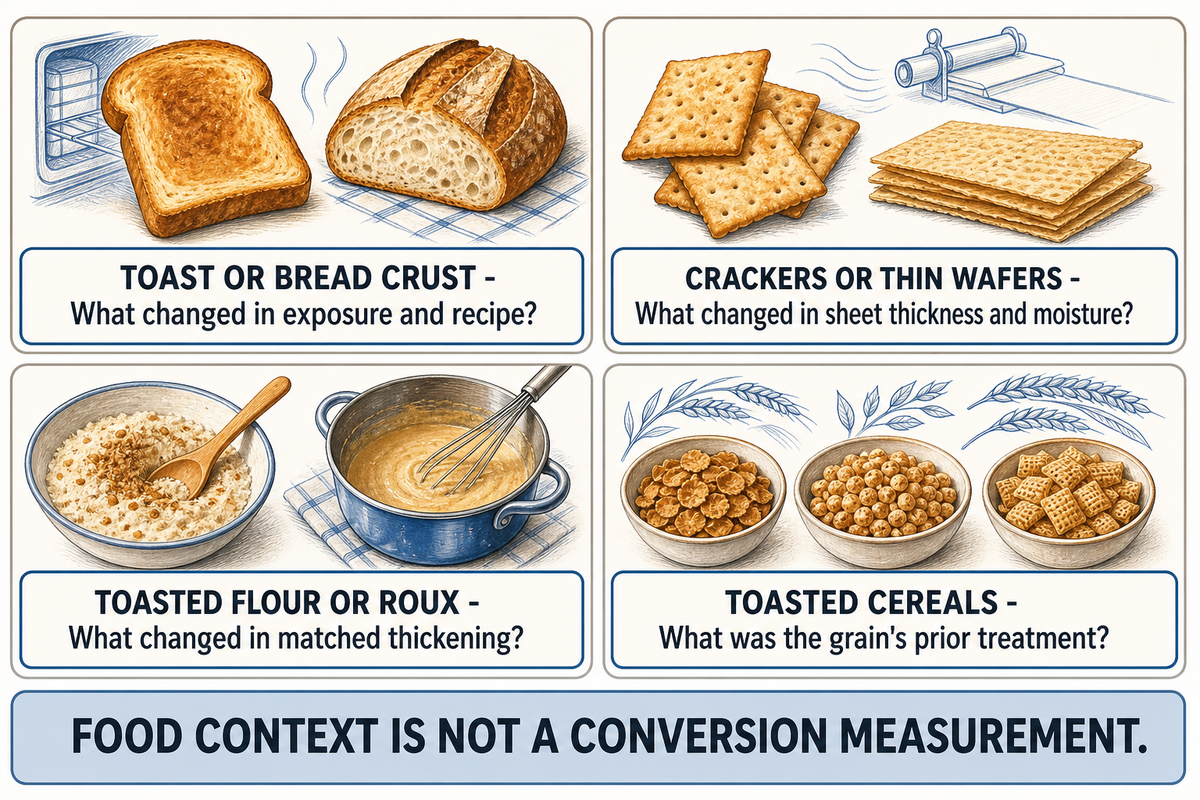
Thermal starch changes may be seen in the toasting of grains and cereal products. Such products are made of several components and may undergo several reactions. An example of such a product may not establish whether the process is the determining factor of the color, or whether a dextrin ingredient was added.
The teaching page of the Institute of Food Science and Technology offers toast as an everyday example. The distinction to be carried into practice is between an observed baked result and a measured chemical change.
| Food context | Observation | Useful next check | Limitations |
|---|---|---|---|
| Toast or bread crust | Drier, browned surface | Compare bake exposure and formulation | Crust shade is not a dextrin assay |
| Crackers or thin wafers | Color and crisp bite | Record sheet thickness, moisture and bake history | Drying and recipe effects also matter |
| Toasted flour or roux | Color, cooked aroma and changed thickening | Run a matched flour-function comparison | No fixed dose multiplier follows from shade |
| Toasted cereal products | Roasted flavor and altered texture | Identify the cereal and its prior treatment | Whole-grain changes are not purified-starch data |
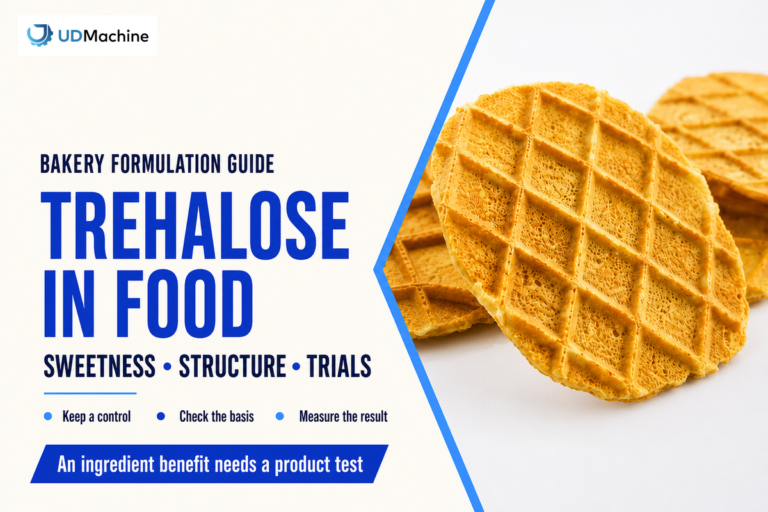
Thin-sheet baking helps to see process boundaries. The wafer roll baking and forming line cooks batter to a sheet and, while still hot, shapes it into a roll. Optional core-filling equipment functions complete the process. These equipment functions don’t establish isolated control of dextrinization. A wafer formats and ingredients guide provides a wider example of the product.
Depending on the flour, the history of how it was handled before it was dry-heated can also be important. In her 2025 Baking Business column, Purdue food scientist Senay Simsek explains how mechanical starch damage increases susceptibility to enzyme attack. Thermal conversion and amylolytic activity are different mechanisms. A cracker made with a different flour can develop a different texture without proving a greater degree of dextrinization.
Test thickening power at equal solids
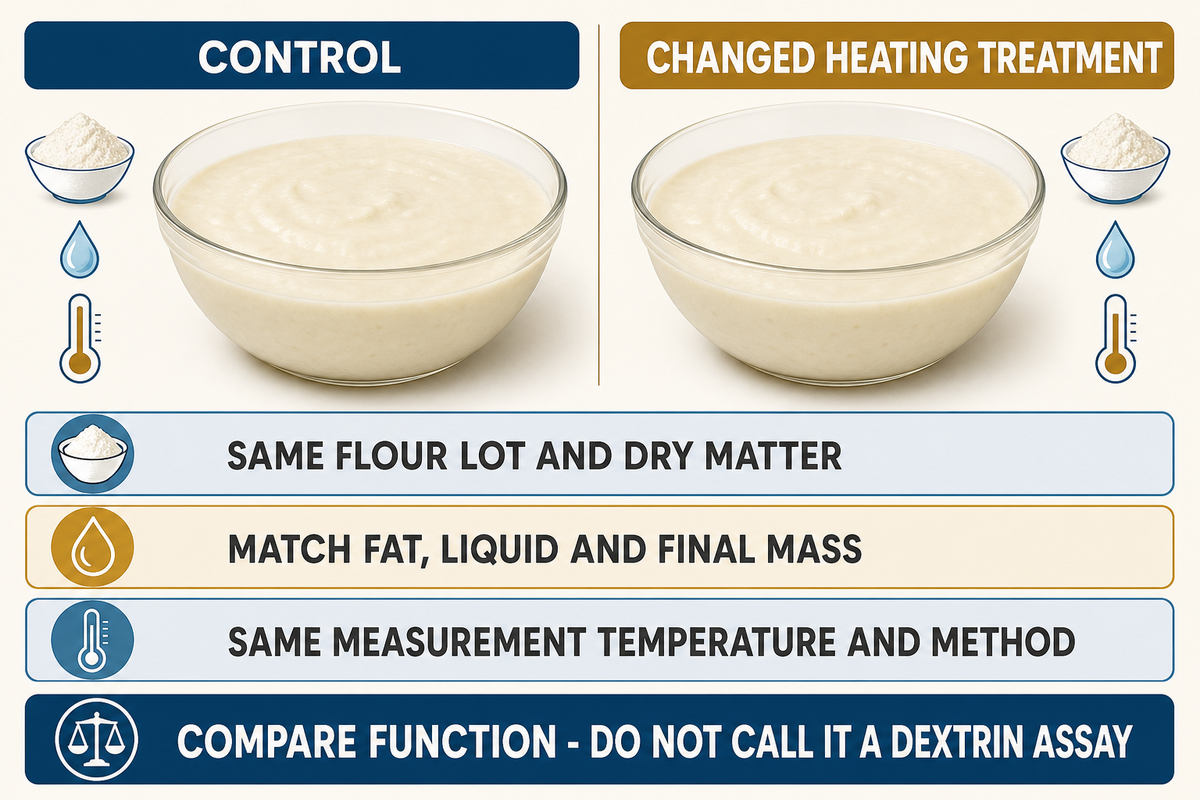
Useful thickening comparisons consist of holding flour source and composition constant while varying the kind and extent of a defined heating treatment. Equal weights of sample, in such cases, are inadequate. Match the relevant dry material, liquid and final mass, then compare flow at the same temperature. In such cases, dextrinization shouldn’t be considered measured, but the resulting outcome functionally assessed.
The Krasnow, Hirson and Shoemaker abstract provides a useful warning against a simple rule: moderate heating increased thickening, while higher temperatures reduced it. The accessible abstract doesn’t establish a universal “double the dark roux” dose.
“All roux showed an increase in thickening power on moderate heating.”
Equal-Solids Thickening Trial
This is an equal comparison of flour function, where the final mass and measurement conditions are controlled, and not a measure of dextrinization.
This editorial trial outline combines the studies’ material and endpoint cautions. It hasn’t been verified as a standard procedure. Use the same flour lot, match fat, and account for losses during heating and transfer. Equal flour masses don’t mean equal starch masses when dealing with different flours.
| Record | Hold or measure | Reason | Limitations |
|---|---|---|---|
| Material identity | Same flour lot | Reduce source variation | Different cereal starches are a separate comparison |
| Flour dry matter | Measured moisture; same dry-flour equivalent | Avoid comparing water as flour solids | Unknown moisture permits only an as-weighed screen |
| Fat | Same type and retained mass | Control formulation effects | Separated or discarded oil changes composition |
| Heating treatment | Record sample temperature and time | Define the changed variable | Pan or oven setting is not sample temperature |
| Transfer loss | Weigh retained material | Account for residues and evaporation | Unmeasured loss weakens the comparison |
| Liquid | Same liquid composition | Control the surrounding formulation | Water and milk are not interchangeable controls |
| Final mass | Match after cooking | Control concentration | Equal initial mass does not control evaporation |
| Mixing and cooking | Same addition order and schedule | Reduce lump and shear differences | A lumpy sample is not a clean viscosity comparison |
| Evaluation | Same temperature, rest period and flow test | Compare the same functional endpoint | Flow does not identify starch-chain chemistry |
For a hypothetical dry-basis example, suppose each test requires 10 g of flour dry matter in a 100 g final sample. If the measured moisture fraction were 12%, the starting flour mass is 10 ÷ 0.88 = 11.36 g. Both tests target 10% flour dry matter by final mass. Match their fat separately and account for retained material after heating. If a sample instead finishes at 90 g, its 10 g flour dry matter is 11.11% of final mass, so its apparent thickness is confounded by concentration.
A kitchen screen without a moisture measurement should be labeled equal-as-weighed, using one flour lot and documenting the limitation. Sensory notes should be documented separately. Keep sensory notes separate: floury taste, lumps, oil separation and flow are different observations. Avoid tasting uncooked flour mixtures. A controlled-change trial record can hold the observations before a formulation change is scaled up.
Separate the observation from the mechanism
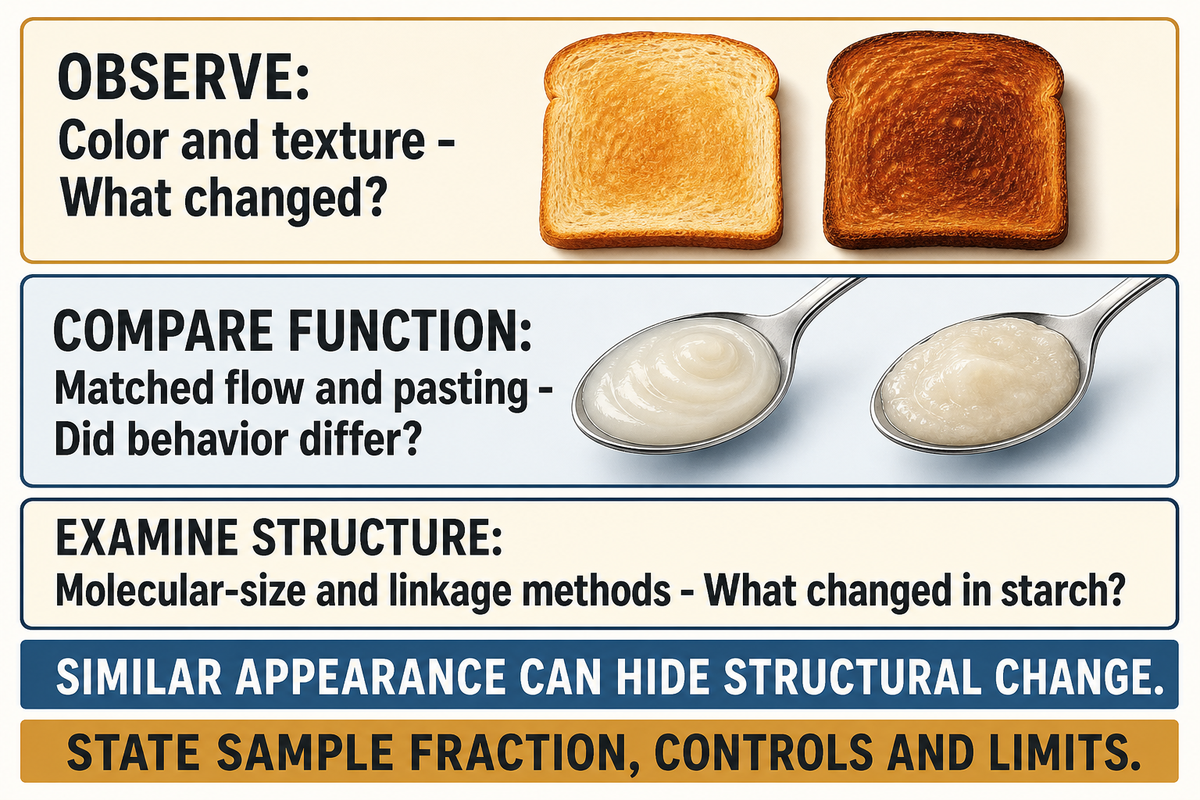
Generally speaking, evidence of a function in starch isn’t evidence of a molecular mechanism. Color and flow describe outcomes; solubility, reducing-sugar measurements and structural methods examine different parts of the material. A defensible interpretation identifies the sample fraction, control and measurement limits before assigning the change to dextrinization.
Observation-to-Evidence Ladder
A series of questions linking a food observation to a measurement and a concluding statement, with an explicit limitation to the conclusion.
| Observation or measurement | Useful question | Next check | Limitations |
|---|---|---|---|
| Surface color | Did appearance change? | Compare recipe and exposure | Several reactions produce brown color |
| Flow test | Did functional thickening change? | Match solids and temperature | Cannot identify the molecular cause |
| Cold-water solubility | How much enters the measured soluble fraction? | State concentration and separation method | Recipe sugars also dissolve |
| Turbidity | Did suspended material change? | Control dispersion and particle size | Cloudiness is not chain length |
| Reducing-sugar assay | Did assay-responsive material change? | Use matrix controls | Starting sugars can confound the result |
| Pasting profile | Which viscosity stage changed? | Compare peak, trough and final values | A peak alone can miss final-paste behavior |
| Microscopy | Did granule appearance change? | Pair with structural evidence | Unchanged appearance can miss molecular change |
| Molecular-size distribution | Did the recovered chain-size distribution shift? | Check extraction recovery and calibration | Only the recovered fraction is measured |
| Linkage analysis | Did branching or bond types change? | Define the structural endpoint | One structural metric is not every aspect of conversion |
Bai and colleagues’ 2014 original abstract reports a limitation: pyrodextrins made by acid-conversion of waxy maize (waxy corn) appeared similar to native starch under the study’s microscopy, although their structure had changed. A familiar starch grain outline may not rule out a molecular change. The finding is specific to that experimental observation, not a universal error rate for microscopy.
For a laboratory request, state the endpoint. Gel permeation analysis can compare recovered molecular size distributions, but filtration and fractionation determine which material reaches the instrument. Report recovery as well as molecular mass in dalton units; otherwise the missing insoluble fraction can disappear from interpretation. Inquire whether the result is for the entire sample or only for the soluble extract.
A hypothetical wafer team might observe the same color in two batches, but different flow in their test pastes. Repeating the matched comparison would check if the functional difference is persistent. Claiming a different dextrinization percentage would also take more analytical work. The separate structural and pasting measurements in the Kapusniak study show that these are indeed different questions.
Buying dextrin is different from toasting flour
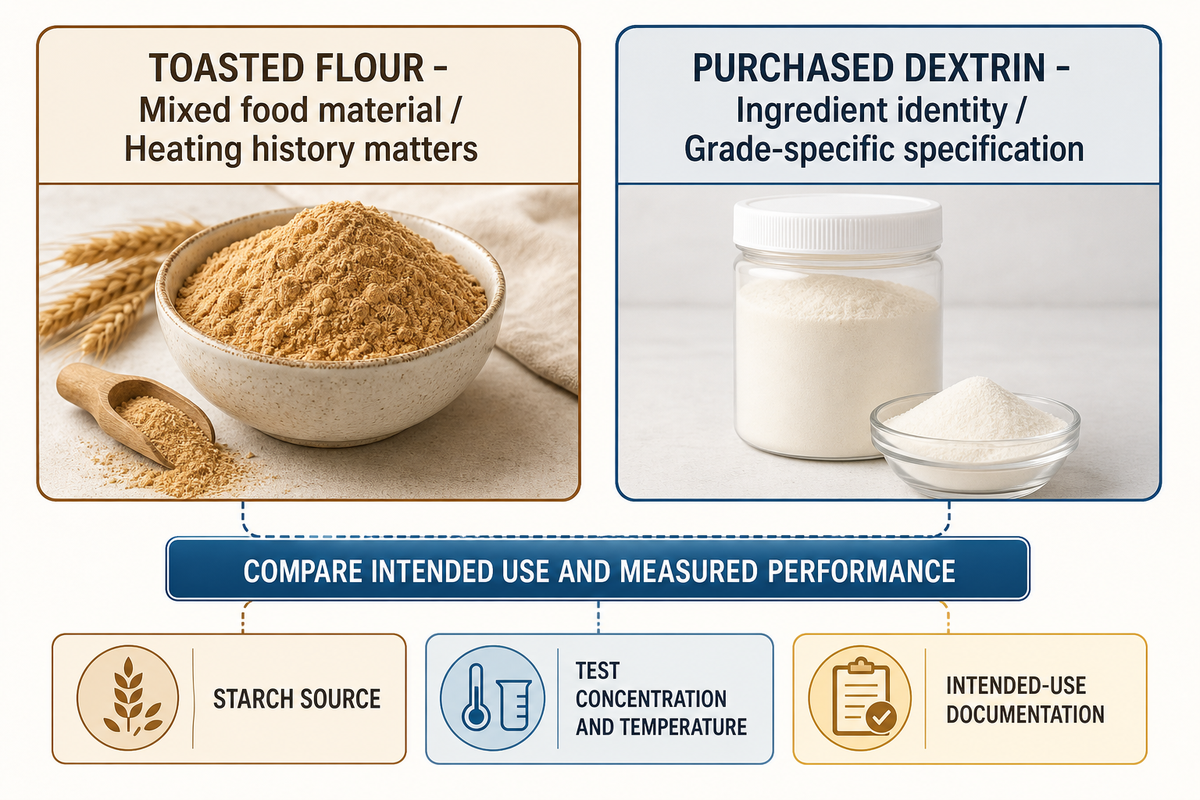
Purchased dextrin is an ingredient with identity and specification. Toasted flour is a mixed material with its own history of heating. Comparing them requires the intended application and condition-specific performance data. Similar color, botanical source or ingredient name doesn’t establish they’ll function equivalently in a formula.
Ask for the starch source, processing description and intended food use. Then request the results of solubility and viscosity tests for the samples at the test concentration and temperature. Dextrose equivalent describes reducing power under a defined analytical basis; it should not be treated as a complete description of branching, molecular distribution or performance. In the food industry, a statement about hydrolysis of the starch is needed with defined measurement, rather than assuming it with a label.
- Identify whether the material is a purified starch-derived ingredient or flour-based material.
- Separate thermal conversion from enzyme treatment and other starch modifications.
- Ask how moisture and sample preparation were controlled in the reported test.
- Confirm that specifications and intended-use documentation apply to the buying market.
- Trial the grade in the intended formula before substitution.
The US dextrin ingredient text provides a definition and use conditions; it doesn’t evaluate a supplier’s batch or capture all possible recipes. “Dry heat treated starch” is a broader description. Thermal inhibition is aimed at a different behavior of starch; therefore, a process name shouldn’t be substituted for a measured product identity.
When a substitution should wait
A trial can be deferred if the supplier discloses the viscosity of the product without its concentration and temperature, or if the buyer has a color description only. An emulsion problem should be evaluated on its own; the term dextrin doesn’t establish that the grade is a suitable emulsifier. Likewise, a more soluble product doesn’t necessarily mean a longer shelf-life. Other considerations, such as the finished formulation and storage behavior, still have to be tested.
For formulations that call for maltodextrin, use the separate maltodextrin in baking formulas guide. Treating every starch-derived powder as the same ingredient hides the very specifications needed for a useful comparison.
Choose the next check before changing the process
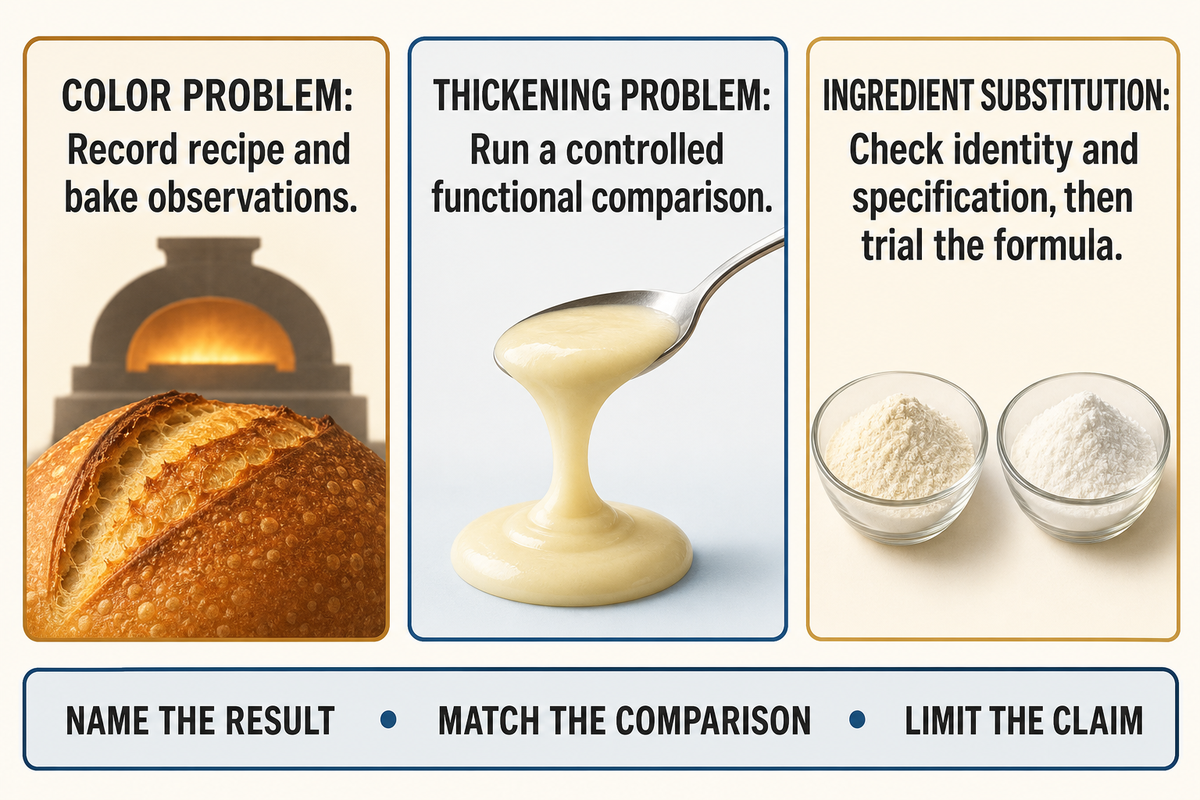
The next check should follow the result you want to change. A color problem begins with formulation and bake observations; a thickening problem begins with controlled functional comparison. A substitution starts with identity and specification. Using these routes helps keep a visible symptom from becoming an unfounded rationale of starch chemistry.
- Name the result. Specify color, crispness, flow or ingredient performance.
- Choose a matched comparison. Record the variables that could change that result.
- Set the claim boundary. Decide whether the evidence supports an observation, a functional difference or a molecular explanation.
The 2026 potato-starch results make this discipline practical: even peak and final viscosity can give different answers. A complete pasting profile can be more informative than one selected value. For baking trials, state the outcome you wish to achieve in a finished-product brief, then ask to change the ingredient or equipment.
Key takeaway
A controlled flour trial can compare thickening. Measuring dextrinization requires a defined molecular or analytical endpoint, suitable controls and an account of what the method cannot detect.
Frequently asked questions
Does dextrinization require heat?
Thermal dextrinization requires heat; enzyme-driven starch breakdown is a different process.
In cooking discussions, the term usually describes starch changes associated with relatively dry heating. The broader chemistry of starch breakdown includes other routes, so process descriptions need to be specific. Heating alone doesn’t establish the identity of the finished ingredient or tell you how much conversion occurred. Record the starting material and treatment rather than inferring a result from an oven setting.
Is dextrinization a form of gelatinization?
No. The two terms describe different changes in starch.
Gelatinization involves loss of ordered granule structure as starch is heated with sufficient available water. Thermal dextrinization concerns changes in starch chains under suitable heating conditions. A mixed food can encounter both processes in different regions or at different times. Observing a thickened starch slurry doesn’t establish thermal conversion, and observing a browned surface doesn’t establish how fully the hydrated starch gelatinized.
Can you give me some examples of dextrins?
White and yellow dextrins are commercial examples, but their names do not fully specify their properties.
A useful ingredient description also identifies the starch source, process and measured behavior under stated conditions. Different grades can have different solubility and viscosity, so request application-specific data. Calling toasted flour a dextrin overlooks its other constituents. A laboratory resistant dextrin also shouldn’t be used as the default model for every commercial grade or for starch changes in a baked food.
What is dextrinization in bread?
It refers to heat-related starch changes associated with baking, often discussed in relation to the crust.
Crust color also reflects other reactions and moisture loss. Its appearance can’t reveal how much starch became dextrin; that requires a suitable comparison and analytical evidence.
When does dextrinization occur?
It occurs when the treatment conditions allow thermal starch conversion; there is no universal bakery oven setting.
The result depends on the starting starch, moisture, heating time, material temperature and processing treatment. Controlled experiments can describe their own conditions precisely, but isolated starch results don’t transfer automatically to a mixed food containing sugars, proteins and fats. Decide which change you need to establish, then choose a measurement that can address it. A color reading can document appearance while leaving molecular conversion unresolved.
These explanations integrate published research with highly visible editorial comparison methods. No UDTECH starch-conversion experiment or laboratory-validated trial protocol is claimed. Proceed with the UDTECH baking science guides to correlate observations and completed product texture.
References & Sources
- Kapusniak et al., Molecular Structure and Properties of Resistant Dextrins from Potato Starch Prepared by Microwave Heating, original study, 2024.
- US Food and Drug Administration, 21 CFR 184.1277: Dextrin, eCFR text checked October 2026.
- American Society of Baking, Starch Gelatinization, technical explanation.
- Krasnow, Hirson and Shoemaker, Effects of Cooking Temperatures and Starch Source on the Gelatinization and Thickening Power of Roux, 2011; accessible abstract.
- Tsatsop et al., Process optimization in the pyroconversion of native sweet potato starch, original study, 2024.
- Thomann et al., Clean-Label Starch Modifications: Dry Heat Treatment in Combination with Ion Exchange, original study, 2026.
- Institute of Food Science and Technology, Carbohydrates: dextrinization, teaching resource.
- Senay Simsek, Understanding the role of damaged starch in cookies and crackers, Baking Business, 2025.
- Bai et al., Structural changes from native waxy maize starch granules to cold-water-soluble pyrodextrin, original study abstract, 2014.