A falling number on a flour certificate is a measure of time in seconds. It describes how a heated flour-and-water paste behaves, and bakers use it as an indirect indicator of alpha-amylase activity. The useful question is what that information means to the flour batch, recipe and product being produced.
A low result often suggests that there has been too much starch breakdown. However, low results can occur in the absence of elevated enzyme activity. Taking every result as an instruction for the recipe can lead to a mistaken flour rejection and/or the addition of an enzyme that exacerbates the problem.
What Falling Number measures in flour
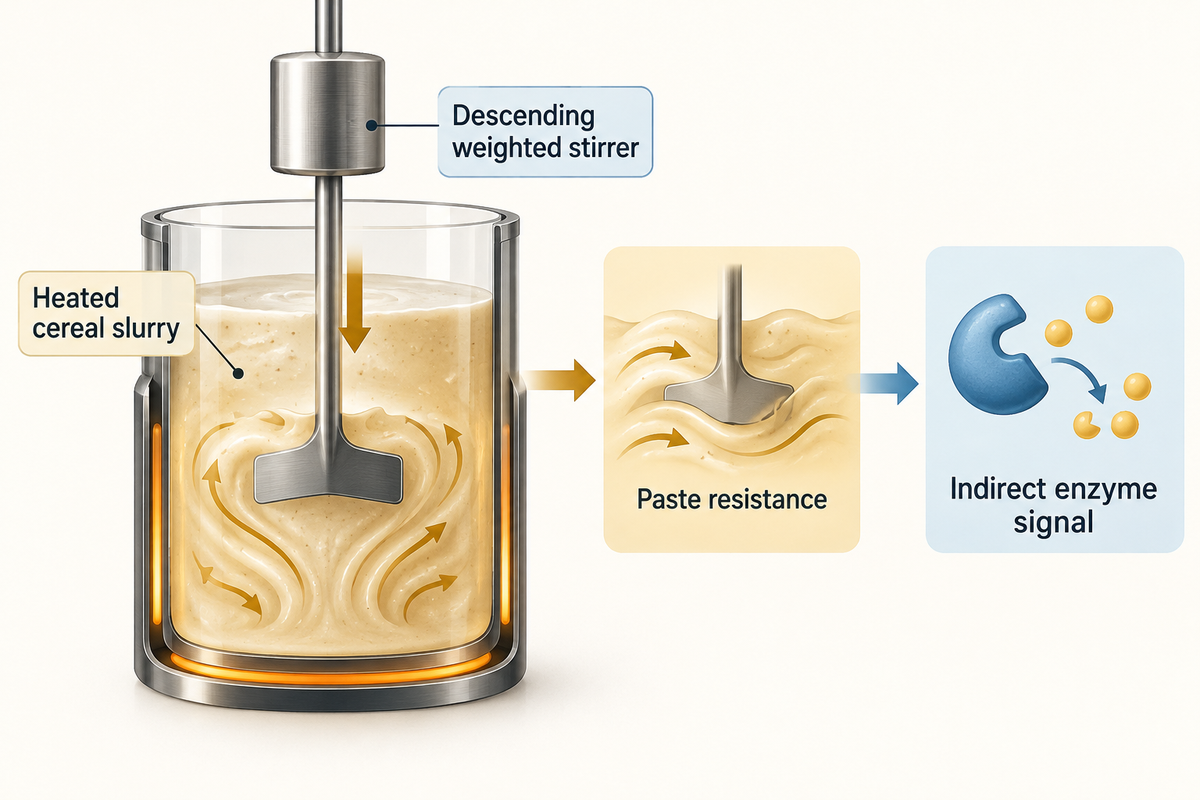
Falling Number is a measure of the resistance of a heated cereal slurry to a descending weighted stirrer. Alpha-amylase can break down starch while the paste is forming, thus higher activity generally leads to a thinner paste and a shorter time. The result is a viscosity effect rather than a concentration of the enzyme in the grain.
Think of a spoon sinking through thick porridge vs. a spoon sinking through thin soup. Heating causes starch gelatinization; the alpha-amylase enzyme can liquefy the paste through which the plunger must move. Other aspects of wheat and flour can also change that resistance. A laboratory enzyme assay answers a different question about the enzyme present. Reports may write α-amylase activity, with the Greek letter replacing the word alpha.
“The FN test indirectly measures the amount of alpha amylase enzyme present in grain”
For a pancake batter application, UDTECH pancake production line gives a target product to consider, while Falling Number is a flour-test result rather than a machine setting. Flour selection and the relationship between baking ingredients and texture belong beside the recipe trial. A certificate alone can’t set a depositing speed or oven profile.
A production team receiving a different flour lot should keep its approved recipe as the starting point. Tracing a difference in texture becomes difficult when both flour and process settings are changed together.
How the Hagberg Falling Number test works
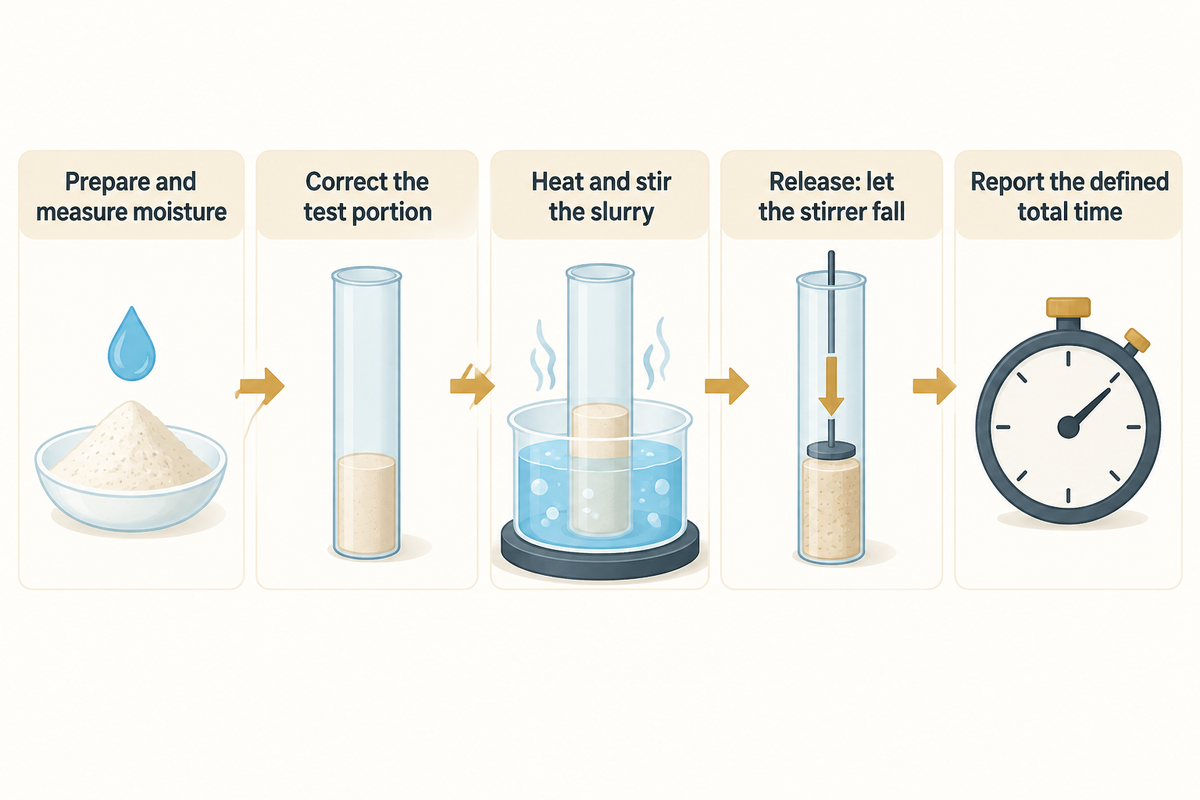
In the Canadian Grain Commission procedure, the reported time includes a 60-second stirring period followed by the stirrer’s descent. Its ground-wheat test portion is 7 g on a 14% moisture basis. Those details describe that published procedure; a laboratory follows the preparation and corrections required by its stated method.
A representative sample is prepared and its moisture measured.
The corrected test portion is mixed with water in the specified tube.
The tube is placed in a boiling water bath, and the stirrer mixes the slurry.
The stirrer is released. The instrument times the plunger to fall.
The instrument reports the defined total time in seconds.
The Canadian Grain Commission’s illustrated procedure makes the timing distinction clear. A reported 300 s result from this procedure isn’t 300 s of descent after stirring. Subtracting the stirring period from one report but leaving it in another creates a false difference.
What does a falling number test for wheat indicate?
A falling number test for wheat assesses the viscosity response of a prepared and heated sample and helps to evaluate starch-degrading activity. It’s useful in grain grading and flour sample testing. A mill then interprets the result with the wheat class, sample preparation and the buyer’s intended use, rather than reading seconds as a direct enzyme dose.
Whole-kernel sampling, grinding and finished-flour sampling are three different operations. A crop description like winter wheat is valuable background information, but finished flour still needs its own material identification. Keep the sample description attached to the result. Our flour moisture content guide explains why the water already in flour also deserves a separate record.
Reading low and high Falling Number results
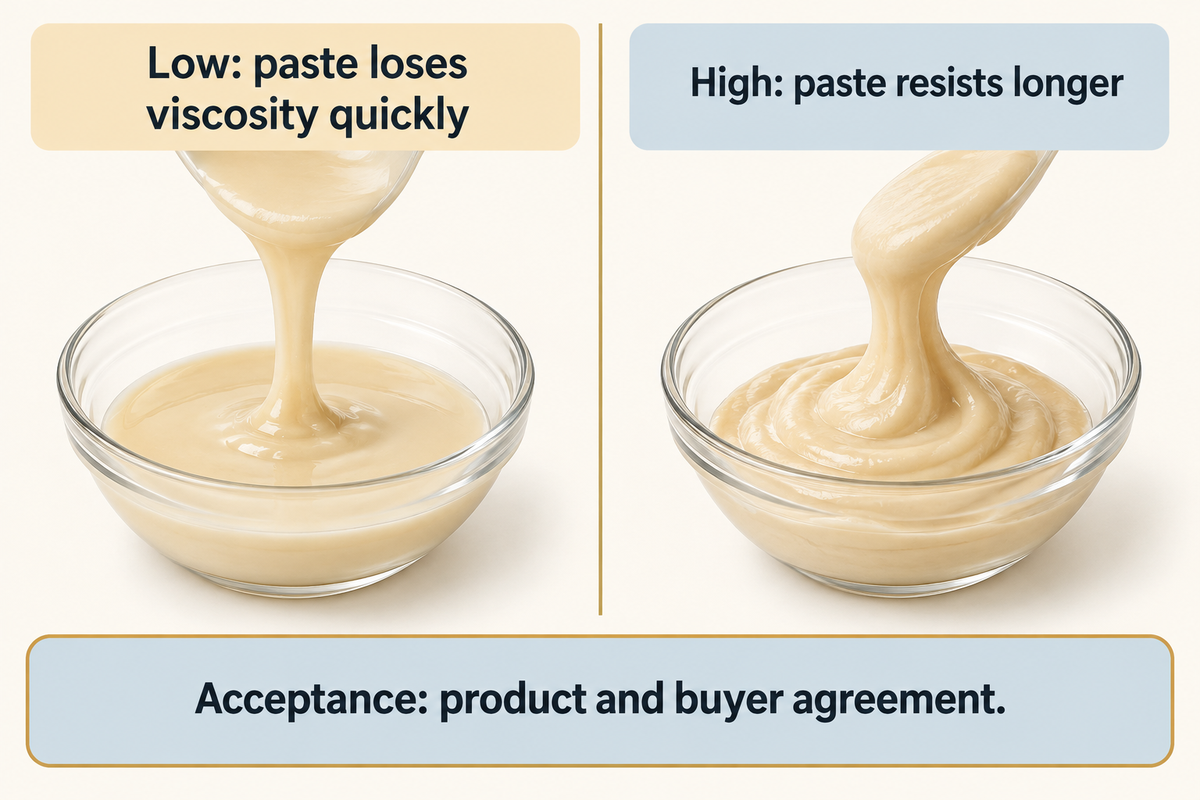
Low falling numbers generally mean that the heated paste loses viscosity quickly; high results mean it resists the plunger longer. Acceptance depends on the product and buyer agreement. A value used for wheat for bread can’t automatically become an optimum specification for a sweet batter, biscuit or other soft wheat product.
The American Society of Baking gives 250-280 s as a breadmaking example. This helps contextualize bread making and isn’t a universal pass band. Sugar level, fermentation and the desired crumb structure change the job that flour must do. Write FN specifications for that intended baking process rather than borrowing a wheat-trading limit.
At the high end, the USDA Soft Wheat Quality Laboratory’s older AACC 56-81B explanation notes that readings above 400 s reflect factors such as particle size as well as alpha-amylase. The best correlation is stated to be between 200 and 300 s. Extremely high readings therefore should not be ranked as an exact scale of enzyme deficiency across unmatched samples.
Cause-to-Use Flour Comparator
Work through the measured signal before choosing an adjustment. The rows move from receiving information to diagnosis and finally to product use.
A receiving and production decision matrix
Observation
What to examine
Practical next step
New supplier certificate
Lot, sample and named method
Match the purchased flour to its report.
Low value after wet harvest
Sprouting and enzyme activity
Separate cause testing from recipe changes.
Low value without visible sprouting
Other enzyme or starch effects
Use an enzyme-specific assay.
Low value with low enzyme activity
Possible NAIL pattern
Run the target-product trial.
High value and pale bread
Recipe, fermentation and malt declaration
Trial one controlled adjustment.
Very high value
Particle size and method context
Avoid precise enzyme ranking from seconds.
Different laboratory values
Preparation, correction and test dates
Use a concurrent split sample.
Proposed flour blend
Nonlinear mixture response
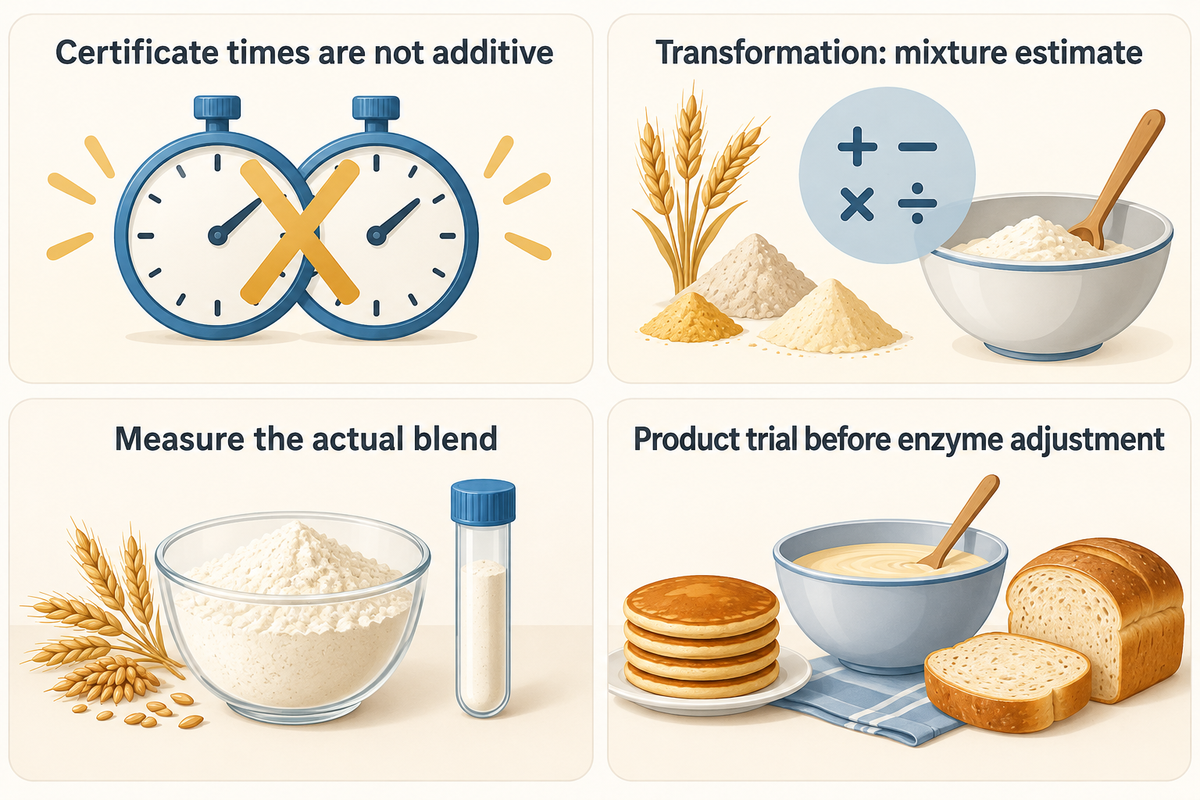
Measure the actual blend.
Acceptable laboratory result
Finished-product suitability
Compare against the approved bake or batter.
Assume a pancake maker with an approved flour and a replacement delivery. A lower certificate value triggers a controlled comparison, not immediate rejection. The team maintains the existing ratios and mixing sequence, labels each batch, and uses the same depositing and heating conditions. Spread, surface colour and cooled texture are recorded against the approved product. If the replacement behaves differently, next steps follow that difference: assessing the flour, enzyme, and processing conditions. If it performs well but misses a written purchase requirement, purchasing resolves the specification with the supplier before releasing the lot. Product performance and contract acceptance remain two separate decisions.
Why a low result may need a second explanation
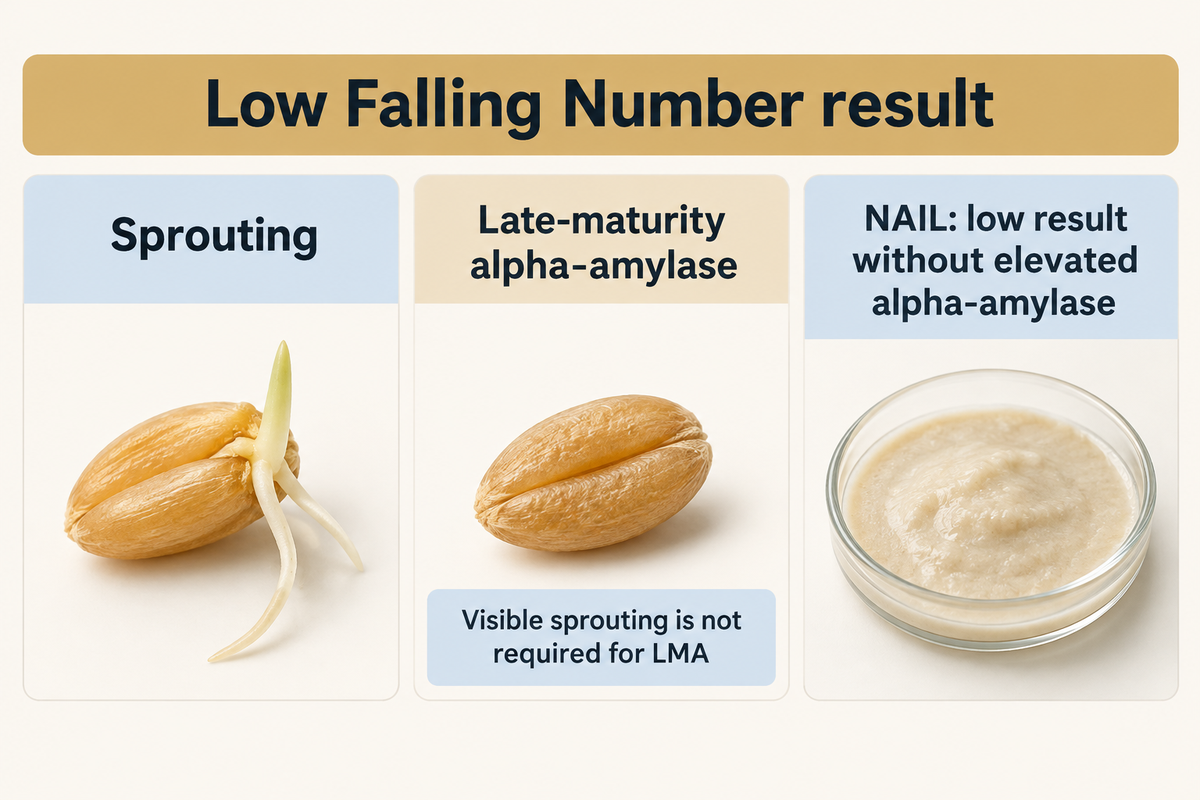
Different mechanisms can cause a low result and diagnosing the cause is important before making adjustments to the flour. Late maturity alpha-amylase (LMA) and pre-harvest sprouting involve enzyme activity. Non-alpha-amylase-induced low Falling Number, called NAIL, describes investigated samples with low readings without elevated alpha-amylase. The same laboratory signal can therefore lead to different production decisions.
What causes falling numbers in wheat?
Sprouting, late-maturity enzyme development and changes in the heated starch paste can cause low falling number in wheat. As kernels ripen, wet weather conditions and high moisture around harvesting can encourage a kernel to sprout before collection. Late-maturity alpha-amylase, or LMA, is a separate grain-development response; visible sprout damage is not required for the enzyme to affect the test.
A 2026 study by Soncin Alfaro and colleagues examined 2024 soft white wheat with low FN values and without elevated alpha-amylase activity. Japanese sponge cakes were acceptable and comparable to controls. Cake-volume directions differed between laboratories, so “lower values improve cake volume” would misread the finding.
The authors suggest low protein and starch properties as possible contributors. High levels of enzyme activity weren’t the explanation for those samples. It concerns the tested crop material and Japanese sponge cake, rather than approval of all low-value flour for pancakes or bread. Research by WSU, USDA-ARS and their collaborators belongs to these teams. Cultivar differences and flour composition also explain why enzyme levels in wheat can’t be read as a universal recipe rule.
Prior LMA baking research by Newberry and colleagues found that the relationship between enzyme signal and bread quality in that particular wheat population was limited. The prior research doesn’t prove sprouted grain to be safe. For an incoming low lot, enzyme testing helps identify the pattern; the target recipe determines whether the flour works.
Comparing flour lots before blending or adding enzymes
Falling Number values aren’t additive; therefore, averaging seconds on two certificates gives a poor blend prediction. A liquefaction number transformation may provide a blend estimate; however, a measured blend is the acceptance sample. Enzyme adjustment also needs the starting flour’s formulation and an actual product trial, rather than a fixed malt percentage.
Example: assume two compatible flour lots read 200 s and 400 s, and an equal-mass blend is being considered. The transformation reported in the 2018 soft white wheat study is LN = 6,000 ÷ (FN − 50). The two transformed values are 40 and approximately 17.14. Their equal-weight mean is approximately 28.57; reversing the calculation gives FN = 6,000 ÷ 28.57 + 50, which is approximately 260s. Averaging the original times gives a result of 300s. Neither the arithmetic mean nor the transformed value is a measured result for the proposed blend. Different causes of low viscosity, especially a NAIL pattern, need laboratory and product testing.
For a bench mixture, taking 500g of each of the assumed flour lots provides 1,000g at a 50:50 mass ratio. This mixture should be thoroughly blended prior to collecting a laboratory subsample. This illustrates the ratio; it doesn’t specify the test portion for each of the methods. AHDB’s technical review explains the impact of low-value material in a blend, and how it may not be accurately reflected by a simple average.
For a bread baker considering diastatic malt, the first check is whether the flour already contains malted flour or an added amylase enzyme. Activities of malt preparations vary. A pale loaf may also be due to conditions of fermentation or of baking. Use an unchanged control beside the supplier’s stated application rate, change one variable, and compare handling and cooled crumb before scaling up. A sticky loaf is no reason to add more enzyme automatically. It’s a good reason to revisit that trial.
There may be several reasons for a change in the consistency of batters. The batter and texture troubleshooting guide addresses production symptoms beyond a flour certificate.
Choosing a laboratory and resolving conflicting results
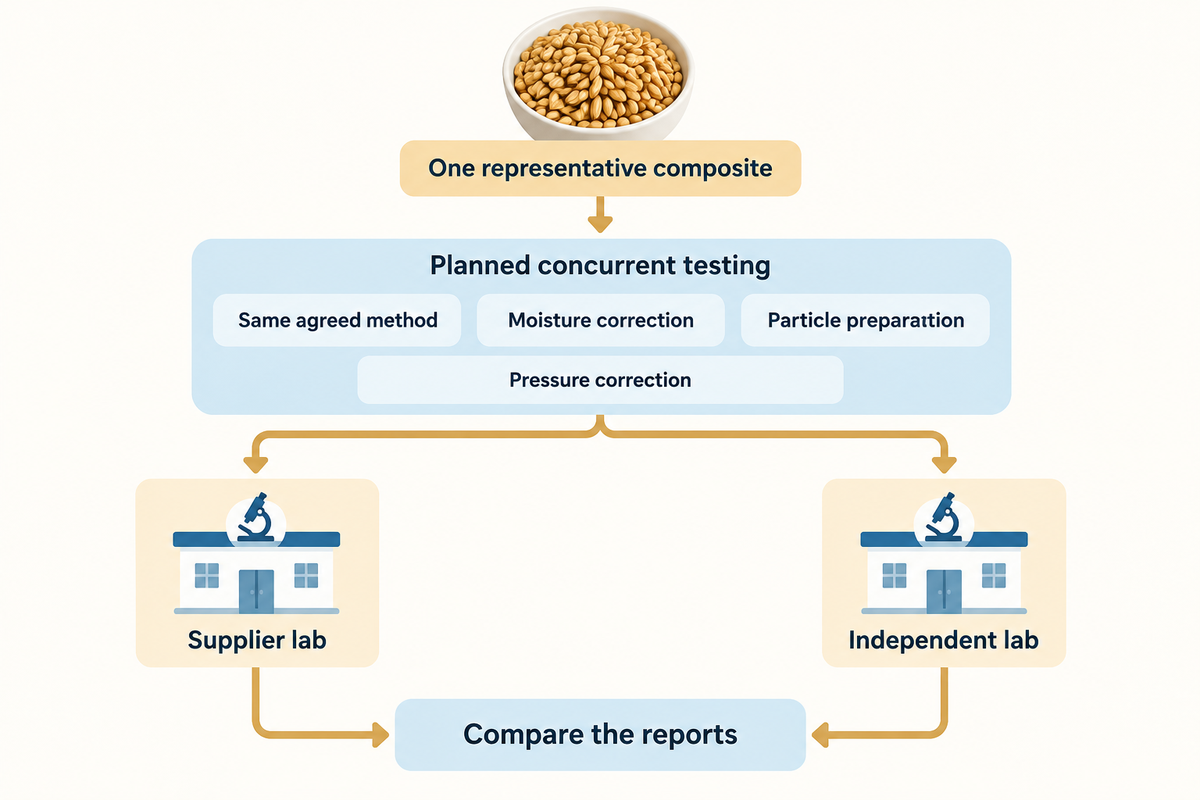
Results of a test can only be comparable if samples, methods and reporting conditions are comparable. Comparing a new, recently tested sample with an old, stored sample can confound storage effects with laboratory differences. Record moisture correction, particle preparation and pressure correction before deciding whether a laboratory difference represents a real change in the flour.
USDA research on barometric-pressure correction explains the mechanism: pressure changes the boiling point of the water bath and affects the measurement. Its wheat-meal study covered simulated elevations up to 1,524 m. A correction equation from that experiment shouldn’t be copied into an unrelated finished-flour procedure.
Same-Method Split-Sample Trial
Example record: A miller and a bakery compare one flour lot in dispute. The following record is a proposed trial design with many decisions still pending.
A filled comparison plan for one flour lot
Record field
Example entry
Reason
Material
Finished wheat flour, disputed delivery
Keep grain and flour results distinct.
Sampling
One representative composite, split together
Reduce sample-to-sample differences.
Laboratories
Supplier lab and independent lab
Compare the same material.
Method
Same agreed edition and procedure
Match the operating basis.
Moisture
Measured value and correction recorded
Keep portion basis visible.
Pressure
Lab correction status recorded
Control boiling-bath differences.
Timing
Concurrent dispatch and planned test dates
Avoid comparing different aging periods.
Retention
Sealed sample, storage conditions logged
Make later retesting interpretable.
Product trial
Approved recipe beside candidate flour
Link the lab question to production.
When disagreements occur between laboratories, begin with the same composite instead of sending unrelated bags from the delivery. The laboratory reports should show individual results as well as the repeatability of the method. Purchasing can then compare the agreed decision rule to the reports. Retaining a sample and testing it later (months, for instance) is a way to answer how the stored material is behaving at the time the test is performed. Both the earlier value and the later retest can be accurately measured. Recording packaging, storage temperature and test date prevents a storage change from being mistaken for poor laboratory work. No invented universal percentage tolerance is needed to start this comparison.
What newer alpha-amylase tests can add
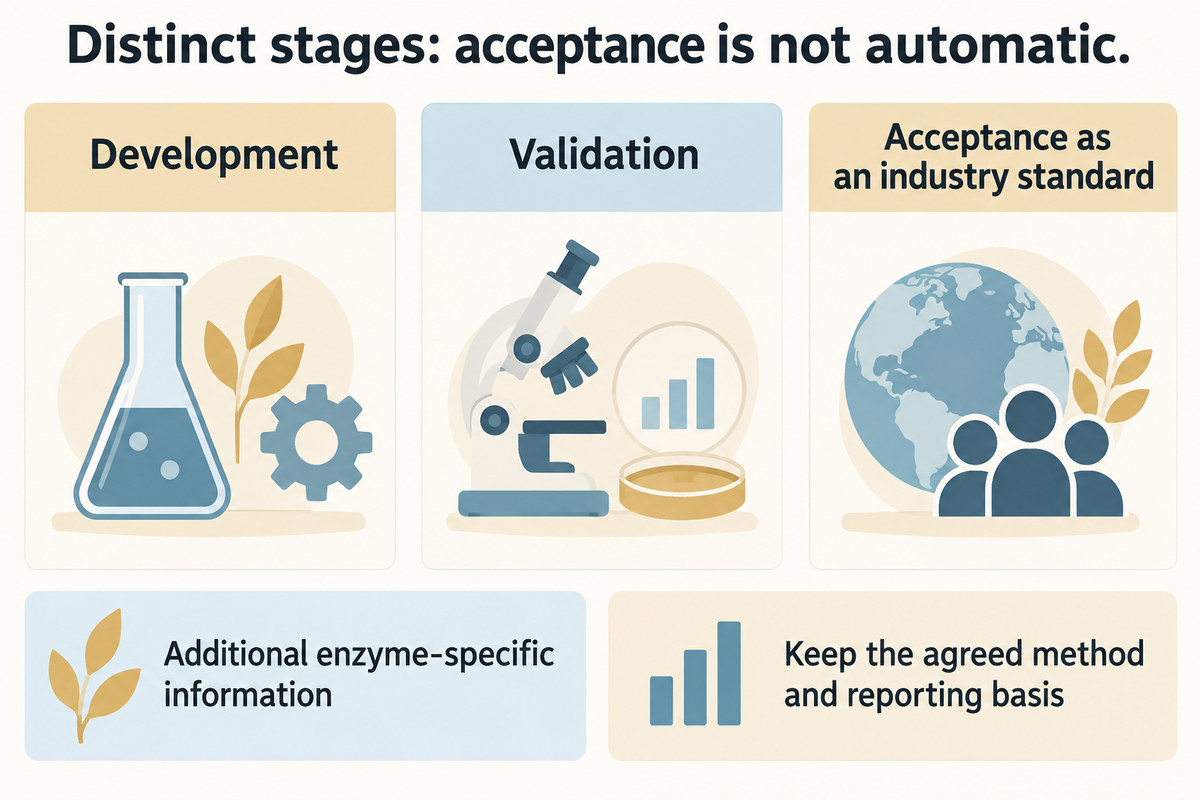
Enzyme-specific tests can help distinguish elevated alpha-amylase from other reasons for a low viscosity reading. WSU describes a rapid strip-and-reader test developed with EnviroLogix and industry partners. Its practical value is additional diagnostic information; the purchasing method still follows the agreement governing the lot, even when an alternative result is available.
The WSU explanation of rapid testing and NAIL links the new tool to this cause-separation problem. The associated FFAR-supported project includes validation across wheat market classes and environments. Development, validation and acceptance as an industry standard are different stages. The established literature also refers to AACCI and ICC methods; a report needs the specific procedure, rather than only an organization’s initials.
For a bakery, what’s useful in the lab is to see if extra testing reveals enzyme activity, paste profile, or end product performance. Answers to these questions lead to different next steps. A new test name alone does not release a flour lot.
Frequently asked questions
What does Hagberg mean?
Hagberg is the name associated with the Falling Number method; laboratories also use the fuller name Hagberg-Perten. The Hagberg Falling Number test reports a timed response from a heated sample. HFN is another abbreviation you may see. Keep the named method and its edition with the number so the supplier and laboratory interpret the certificate on the same basis.
Do Falling Numbers change during storage?
Yes, they can change. A 2026 study of three flours from one wheat batch observed rising values during storage at 22–25 °C and 55–60% relative humidity, with a plateau around 120 days. The study lacked direct enzyme assays. Record storage history and test date rather than assuming an older retained sample reproduces its original result.
No single interpretation fits every cereal. The ISO method covers cereal grains including wheat and rye, their flours, and durum products. Different materials have different starch and enzyme behaviour. Keep cereal identity and the laboratory procedure together, and use a product-relevant specification. A wheat flour purchasing limit should not be copied onto every other grain ingredient.
Is a high Falling Number the same as strong gluten?
No. Gluten strength concerns the protein network, while this test follows a heated starch-paste response. Grain protein quantity is also different from protein quality. Use the appropriate protein or dough-function test for strength and evaluate the resulting texture in the intended recipe.
Should a grain result be copied onto a flour specification?
No. Write a specification for the material actually purchased. Ground grain, wholemeal and finished flour differ in composition and preparation; milling changes the fractions entering the test. The certificate should identify the flour stream, sampling method and laboratory procedure. If a mill supplies a grain result as background, keep it labelled as grain data. Establish the finished-flour requirement with matched reports and the product trial before treating those seconds as a delivery acceptance limit.
Can a pancake oven replace a flour laboratory test?
No. An oven evaluates a recipe under its chosen heating conditions; it doesn’t produce a standardized Falling Number result. Use the laboratory test for the flour question, then a controlled batter trial for spread, colour and texture. Keep the two records linked to the same lot.
What should I keep from a flour trial for the next delivery?
Keep the flour lot identification, certificate, laboratory method and test date beside the exact recipe and process record. Preserve the control comparison, product observations and any enzyme addition with its supplier instructions. A clearly labelled retained sample helps with later investigation, provided its storage history stays with it. When the next delivery arrives, repeat the same comparison before changing several ingredients or process settings together; that makes differences easier to trace to a specific cause.
Put the number beside the product trial
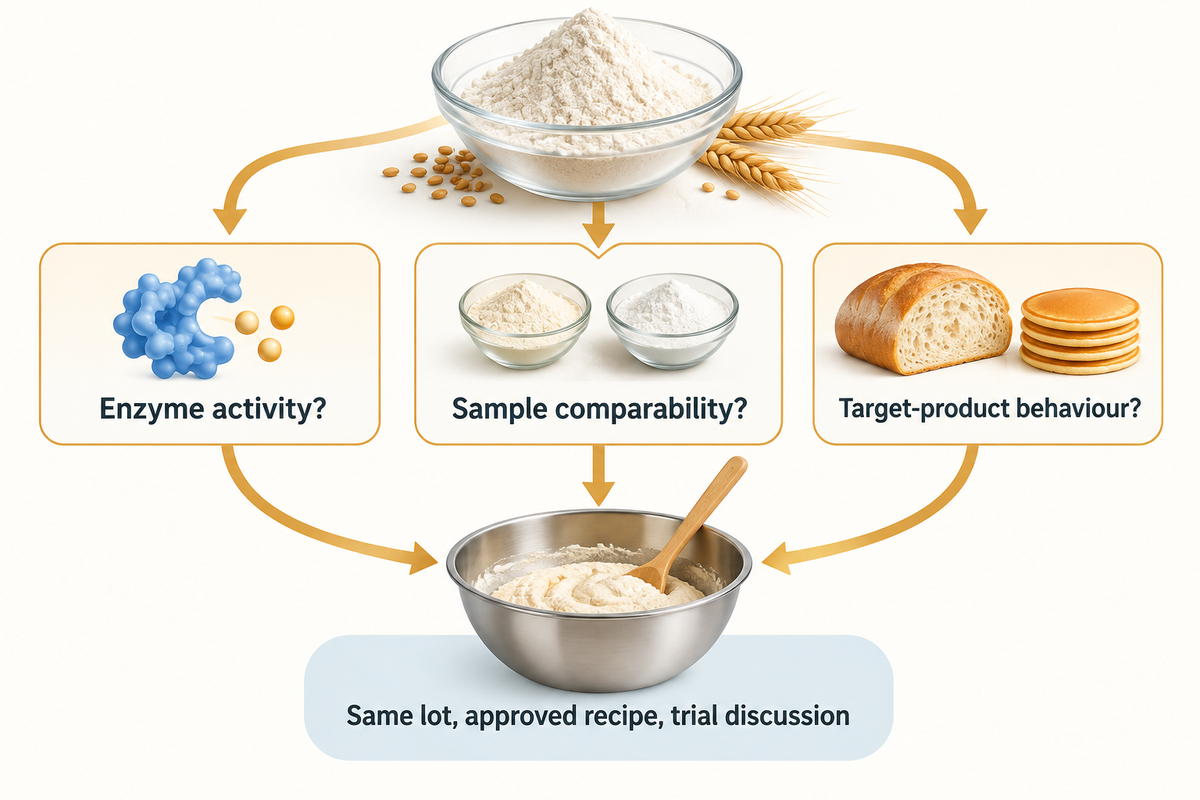
Use the flour result to choose the next question: enzyme activity, sample comparability or target-product behaviour. Decision Matrix and split-sample record give a common starting point for purchasing and production. Bring the lot report and approved recipe to the trial discussion, and keep texture observations tied to that same material.
UDTECH has been manufacturing food machinery since 2003. This is where we write down what we learn from product samples, trial runs and commissioning—the batter, the bake and the texture, rather than the sales sheet.
These guides help production managers, buyers and food entrepreneurs work through batter faults, sample runs, output targets and factory acceptance. When a question turns into an equipment question, the same enquiry form reaches our engineers.
OUR EXPERIENCE
Food machinery manufacturing since 2003, with practical experience from product samples, trial runs and commissioning across egg roll, wafer, waffle, biscuit and snack production.
OUR EXPERTISE
We work from real recipe and output conditions, covering process, product and machine specification questions. Technical enquiries are passed to the engineer responsible for that equipment.