Updated October 2026
Cream of tartar in baking stabilizes egg whites, helps control sugar crystallization, and reacts with baking soda to release carbon dioxide. It’s an acidic powder, not dairy cream. The right substitute depends on what job the recipe needs it to do: replacing an acid in a foam is a different task from replacing a complete raising mixture.
Cream of tartar is potassium bitartrate, a dry acid used in baking. It helps stabilize egg-white foam and limits unwanted sugar crystals. Combined with baking soda and moisture, it becomes part of a leavening system.
- The powder supplies acid; pure baking soda supplies the alkaline component.
- Egg-white stability, cake volume and finished texture are separate results.
- A liquid-acid swap changes water and flavor as well as acidity.
- A large bag saves money only when enough of its contents can be used.
What cream of tartar does in baking
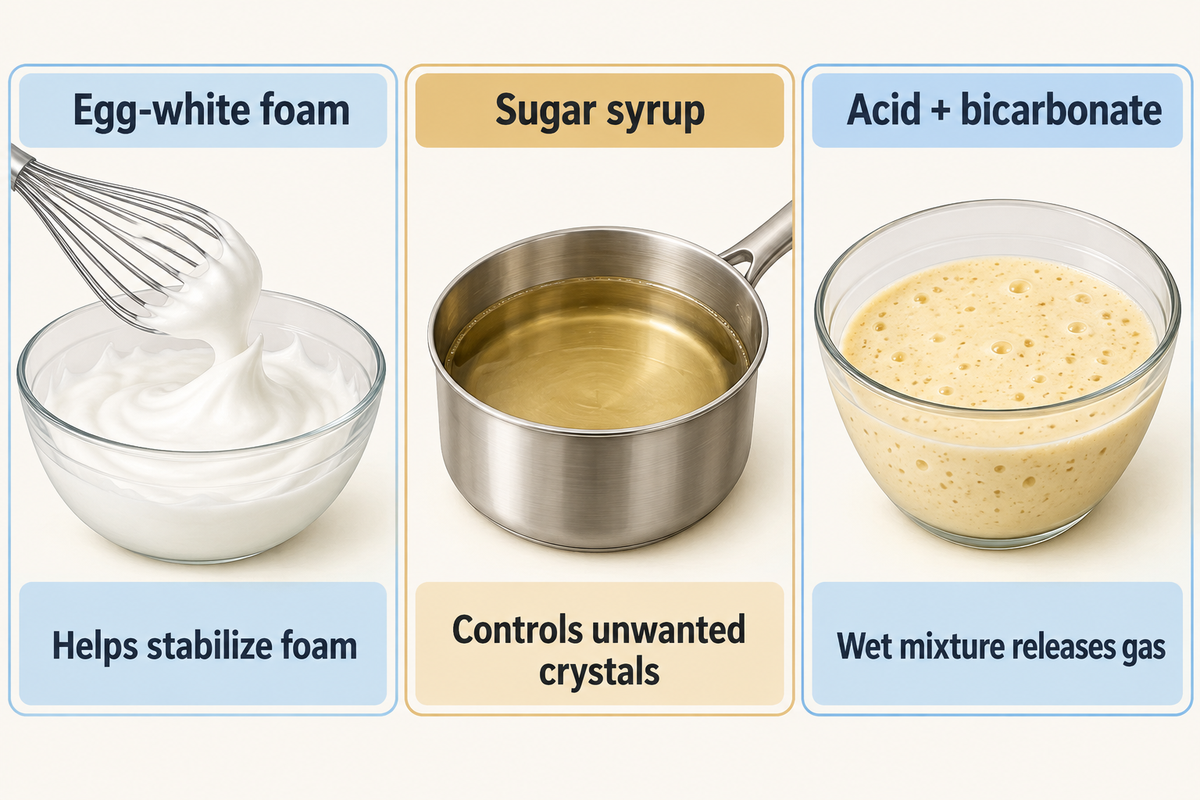
Potassium bitartrate has 3 jobs in baking: stabilizing egg whites, controlling unwanted sugar crystals and supplying acid for a bicarbonate reaction. In different baking systems, this ingredient works in different ways. Egg proteins, dissolved sugar or raising agents surrounding it determine the effect of its addition.
What is cream of tartar made of?
Its chemical name is potassium bitartrate, also called potassium hydrogen tartrate. It’s obtained as a byproduct of winemaking, and the dry white powder contains no dairy cream. Cream of tartar is the potassium acid salt of tartaric acid; the salt and free tartaric acid are different ingredients.
The official potassium acid tartrate definition states its identity and tells about its winemaking origin. Wine making leaves tartrate deposits that can be recovered and purified. A use label for baking and cooking says nothing about what a blend actually contains.
| System | Main function | Useful result to observe |
|---|---|---|
| Whipped egg whites | Acid helps the protein foam remain stable | Foam holds through waiting and folding |
| Sugar syrup or icing | Acid helps control sucrose inversion | Less unwanted graininess in the intended product |
| Acid plus bicarbonate | The wet mixture produces gas | Batter rises with the intended crumb |
The baking ingredients library files this dry acid alongside other ingredients with different structural roles. An emulsifier, a thickener and an acid can all impact texture, but act through different mechanisms. Use cream of tartar when the formula calls for its acid function; it shouldn’t be treated as a general-purpose texture improver.
Cream of tartar vs baking powder and baking soda
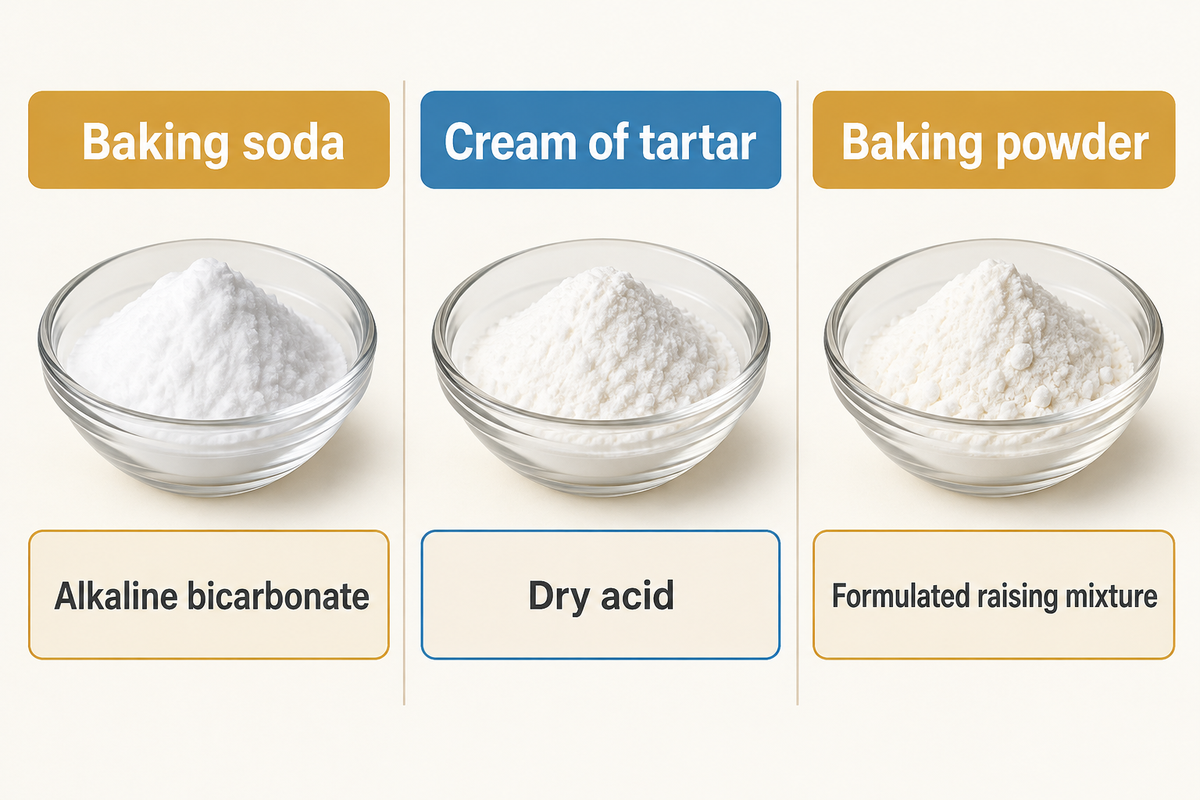
Baking soda is sodium bicarbonate, cream of tartar supplies acid and baking powder forms an acid-base system in a single product. These ingredients perform different roles. The USDA technical review mentions the acid and bicarbonate dissolving and reacting when wetted, producing carbon dioxide, which can expand the batter.
| Ingredient | What it supplies | What a swap changes |
|---|---|---|
| Baking soda | An alkaline bicarbonate | Gas potential and the acid needed to react with it |
| Cream of tartar | A dry acid | Acidity, foam behavior or sugar chemistry |
| Baking powder | A formulated raising mixture, usually with a starch carrier | Both sides of the reaction and its timing |
How much cream of tartar to use with baking soda?
The Illinois Extension suggests ¼ teaspoon baking soda and ½ teaspoon of cream of tartar as an emergency home-baking replacement for 1 teaspoon baking powder. The university cautions that the substitution won’t be perfect. This example is a household case, rather than an exact replacement for every commercial double-acting powder.
That example incorporates two parts cream of tartar with one part soda by volume. Baking soda and cream of tartar supply the two reacting components; the wet mixture becomes a leavening agent. Industrial formulation relies on mass and neutralizing value. According to the American Society of Baking’s leavening-acid table , a neutralizing value of 45 indicates that 100 g of this acid will neutralize 45 g of baking soda. Other acidic ingredients in the formula also contribute.
A matched acid-base quantity still leaves reaction speed to consider. Baker Richard Charpentier explains that temperature, mixing time, batch size and floor time affect gas release. Batter that isn’t deposited immediately needs to be considered as well. UDTECH’s waffle baking equipment is the equipment side of that discussion: batter delivery and baking must fit the selected product and process.
Stabilizing meringue and angel food cakes
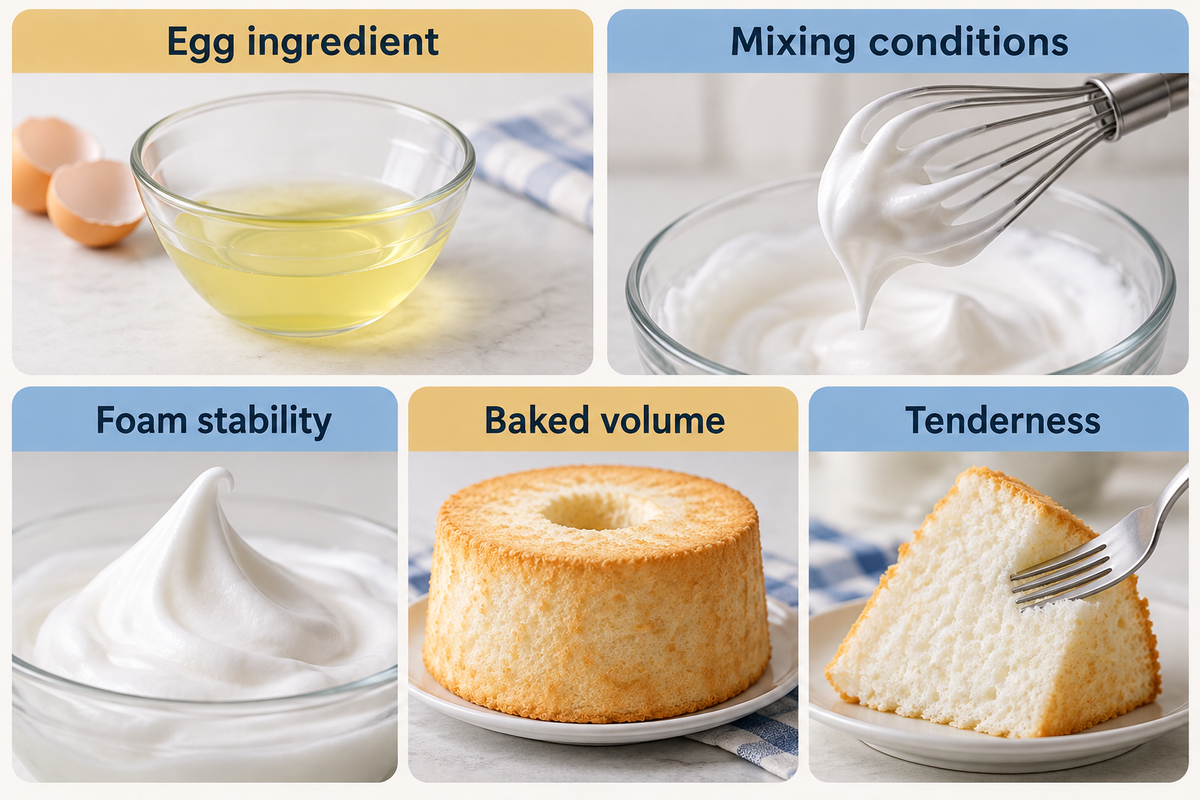
Acid helps stabilize egg-white foams and is used to alter their pH to help make them more stable. Recipes in which acid helps stabilize foams may still be functional without it, especially if the foams are used promptly. Whipped foams for cake and meringue cookies should both be monitored. Watching foam stability and the finished bake gives more information than targeting a specific stiff peak.
“stabilize egg white foams by lowering pH”
Adding the powder helps stabilize whipped egg whites but doesn’t always solve mixing issues. Undissolved regular sugar granules can also cause a gritty foam. Pastry chef Helen Fletcher discusses this problem in her meringue method. Adjusting the acid for a mixture that feels grainy may not solve the issue of dissolving the sugar completely. Crisp, melt-in-your-mouth meringue cookies also require the drying stage to be suitable for the recipe.
What will cream of tartar do to a cake?
In an angel food cake, the acid can alter the behavior of the foam and the baked crumb; in a cake raised with bicarbonate, it also partakes in the gas-producing reaction. These roles don’t suggest it’s absolutely necessary in every cake. A formula that already includes a balanced raising mixture requires a different adjustment compared to a formula built on whipped whites.
Oldham, McComber and Cox’s 2000 experiment tested 1/12, ⅛ and ¼ teaspoon per egg white at 2°C or 22°C. Higher acid changed several characteristics, including tenderness and crust color. These were conditions in one angel-food formula, not a universal dose for baked goods.
Consider a bakery changing its egg ingredient. In Singh and colleagues’ 2019 angel-food study, both egg treatments used ¼ teaspoon acid per 100 mL white. Adjusting the mixing improved the pasteurized-egg cakes, but the best treated batch was still 6.8% smaller in volume and 13% firmer than the raw-egg comparison. Acid quantity had not changed. A taller foam would have missed part of that texture difference. A practical comparison therefore keeps the formula fixed while recording mixing conditions, then compares the baked crumb and tenderness. For toppings served uncooked, FDA recommends pasteurized or otherwise appropriately treated eggs.
Why snickerdoodles and sugar cookies use it
Snickerdoodles use acid for their signature tang and if soda is present for the raising reaction. A sugar cookie recipe can use another acid balance or a raising mixture. To maintain the intended flavor and spread, consider the entire formula before removing the acid.
A recipe for snickerdoodle cookies is a good example showing why treating all cookies the same way can be misleading. Using baking powder instead of the acid changes the leavening agent. Using liquid to replace the acid changes the water content of the dough and alters the flavor.
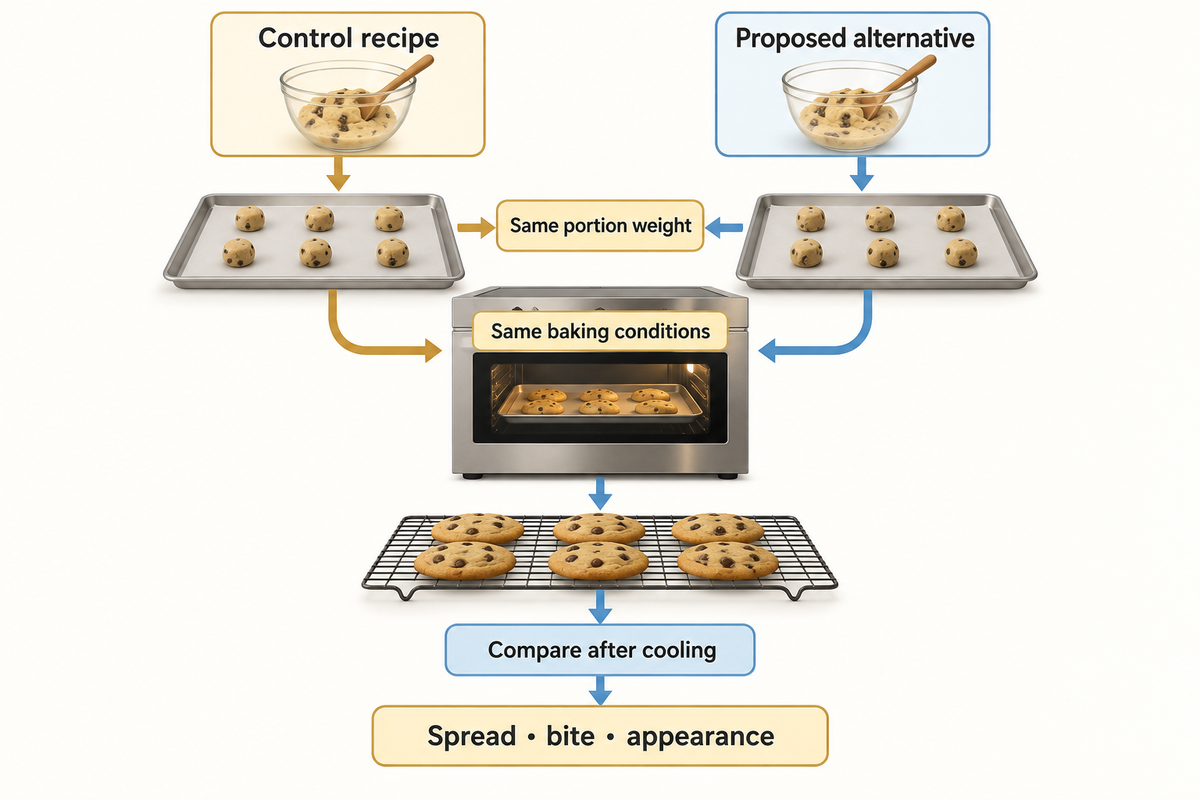
Consider making soft sugar cookies for a repeat order. Maintain the original recipe as the control, and alter only the suggested alternative in the comparison batch. Use the same portion weight and baking conditions. After cooling, compare the finished product with respect to spread, bite, and appearance. Other characteristics of a cookie, such as texture, are impacted by the type and ratio of fat and sugar used. An increase in acidity isn’t always a guarantee for a soft cookie. The Baking Business explanation of cookie leavening relates final pH to texture and color of the cookie. The ingredient function matrix can help to determine the roles of several ingredients prior to a trial.
Keeping syrups and icings smooth
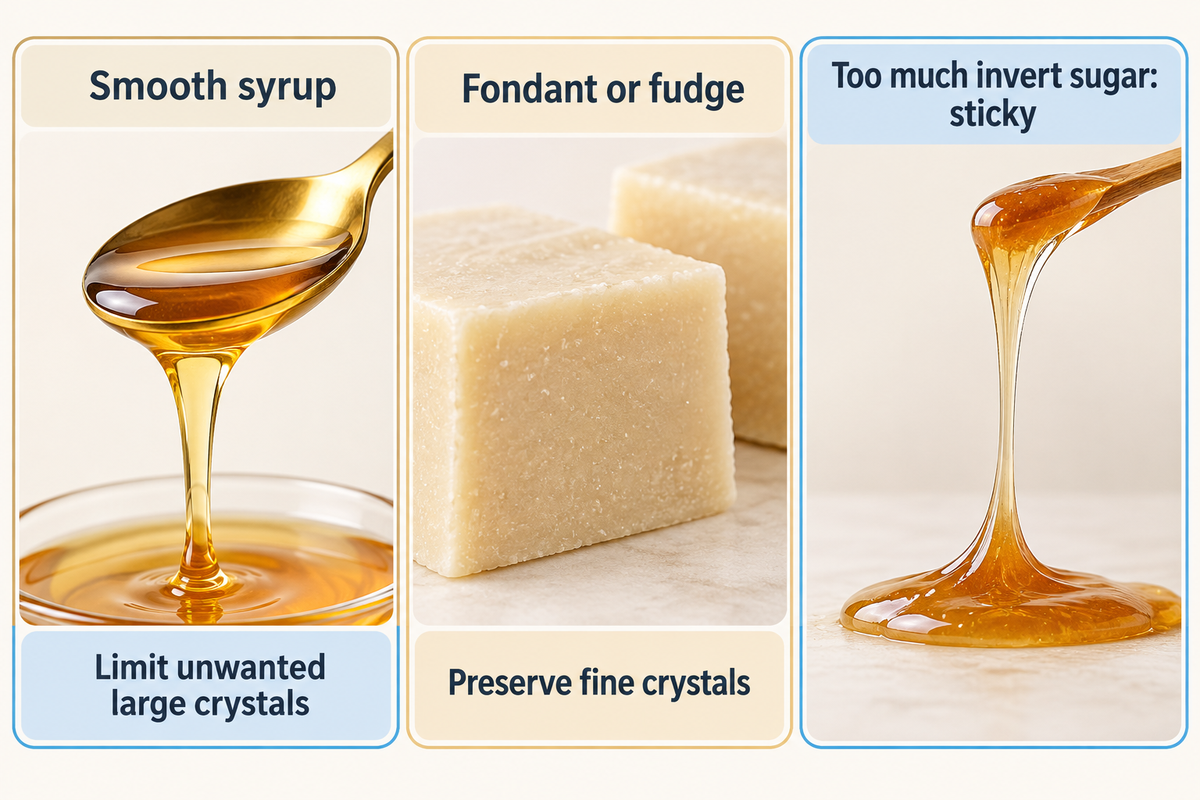
Acid helps prevent sugar from forming unwanted large crystals by promoting sucrose inversion in a heated sugar system. This can help a syrup remain smooth, but some confectionery requires controlled crystallization. For Fondant and Fudge, small crystals are needed to achieve the intended texture. Therefore, the objective isn’t to eliminate all the crystals.
The FAO sugar-confectionery guide indicates that too little invert sugar may allow the sucrose to crystallize, while too much invert sugar encourages a syrup to become sticky. So adding a powder to a sticky product may take the product further away from its goal. In a sugar process where this acid is called for, use it in recipes suited to that process, rather than adding it to all frostings.
A buttercream frosting based on whipped egg whites involves a foam prior to incorporating butter. Other buttercream recipes don’t have an egg-white stage. Whipped cream is another mixture. Match the stabilizer to a particular preparation. A smooth icing and a stable foam are different jobs.
Choose a cream of tartar substitute by its job
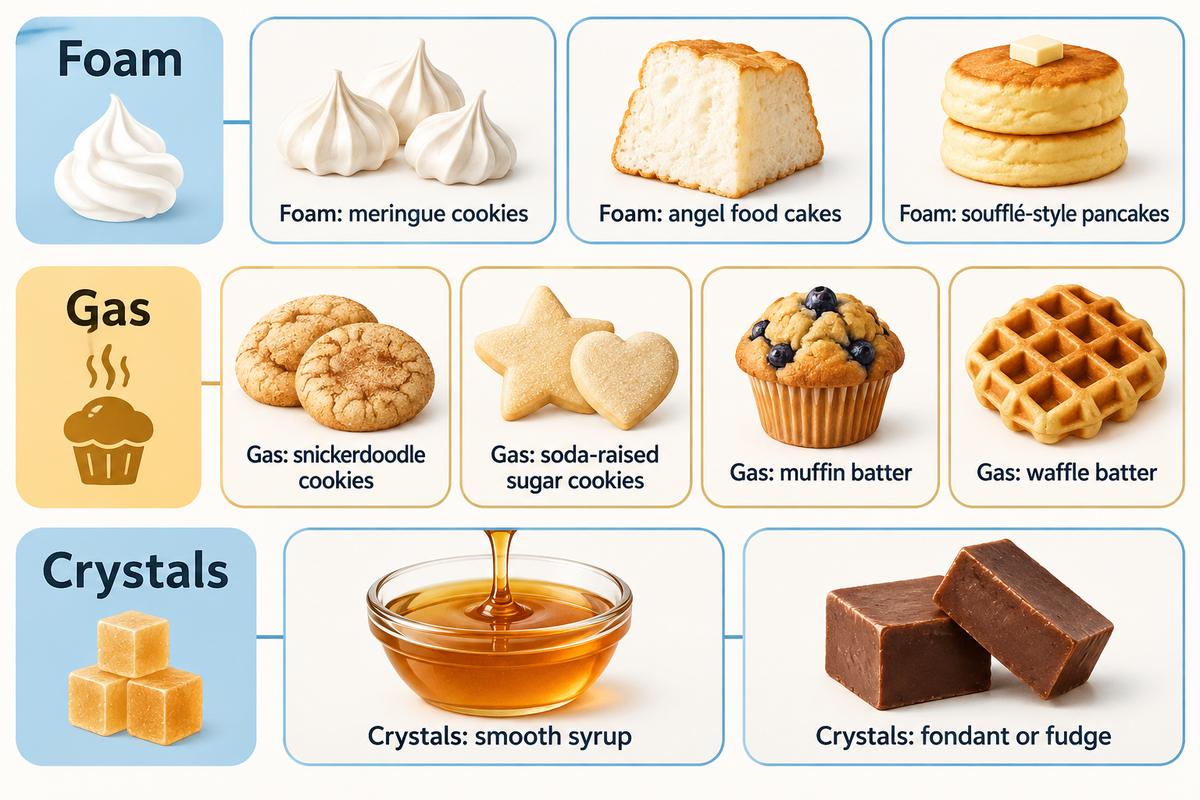
Some egg-white recipes call for acid, which can be supplied by lemon juice or vinegar. A prepared raising mixture may replace acid and soda. Choose the route by function. Liquid acids add water and flavor and a powdered blend may add other ingredients. What works for one dessert may not work for another.
How to substitute 1 teaspoon of cream of tartar?
There isn’t a direct substitution for all recipes that call for 1 teaspoon. A dough recipe that contains both soda and acid may require a raising mixture to replace both ingredients. For a recipe that calls for syrup, the substitution should suit the sugar process.
White vinegar and lemon juice differ from a dry powder in concentration, flavor and added liquid. Therefore, an acid used as a substitute for foam stability can’t be assumed to preserve the cookie’s spread or the final texture of the syrup. Cream of tartar and baking soda are used as a leavening agent together, and a premixed product, like baking powder, supplies its own acid-base combination. The industry formulation guidance separates neutralizing strength from the time of the reaction.
The 3-Route Acid Swap Map sorts substitutions based on the outcome the ingredient is intended to protect. Select the row for the recipe, keep the original version as a control, and compare the stated endpoint. Numerous recipes rely on multiple routes concurrently.
| Route and recipe | Replacement direction | Variable to keep in view | Compare after the change |
|---|---|---|---|
| Foam: meringue cookies | A tested liquid-acid recipe | Added water and sugar dissolution | Piped shape and dried texture |
| Foam: angel food cakes | A complete tested cake formula | Egg ingredient and mixing conditions | Baked volume and tenderness |
| Foam: soufflé-style pancakes | A tested foam-stabilizing alternative | Flavor and folding losses | Lift and structure after cooking |
| Gas: snickerdoodle cookies | A formula rebalanced for the new leavener | Residual acidity and gas release | Tang, spread and bite |
| Gas: soda-raised sugar cookies | Replace the raising system together | Total dough water | Spread and browning |
| Gas: muffin batter | Match the leavener to the formula | Reaction speed during waiting | Top shape and crumb |
| Gas: waffle batter | Balance acid and bicarbonate by formulation | Time between mixing and depositing | Piece height and baked texture |
| Crystals: smooth syrup | A tested acid or glucose-syrup process | Sugar inversion and moisture | Graining and stickiness |
| Crystals: fondant or fudge | Preserve controlled crystallization | Desired small-crystal structure | Fine texture rather than no crystals |
The baking-variable troubleshooter can assist in organizing a comparison when numerous things changed together. Be sure to document the original formula before altering the acid, changing the mixing conditions or rest time.
Dosing, dissolving and storage
According to the USDA review, the pure-water solubility of cream of tartar is 0.6 g per 100 mL at 25°C and 6.1 g per 100 mL at 100°C. That means the powder changes its behavior when added to hot or cold water. The figures are valid for water solutions; they aren’t a recommendation for a target addition rate or a target batter temperature.
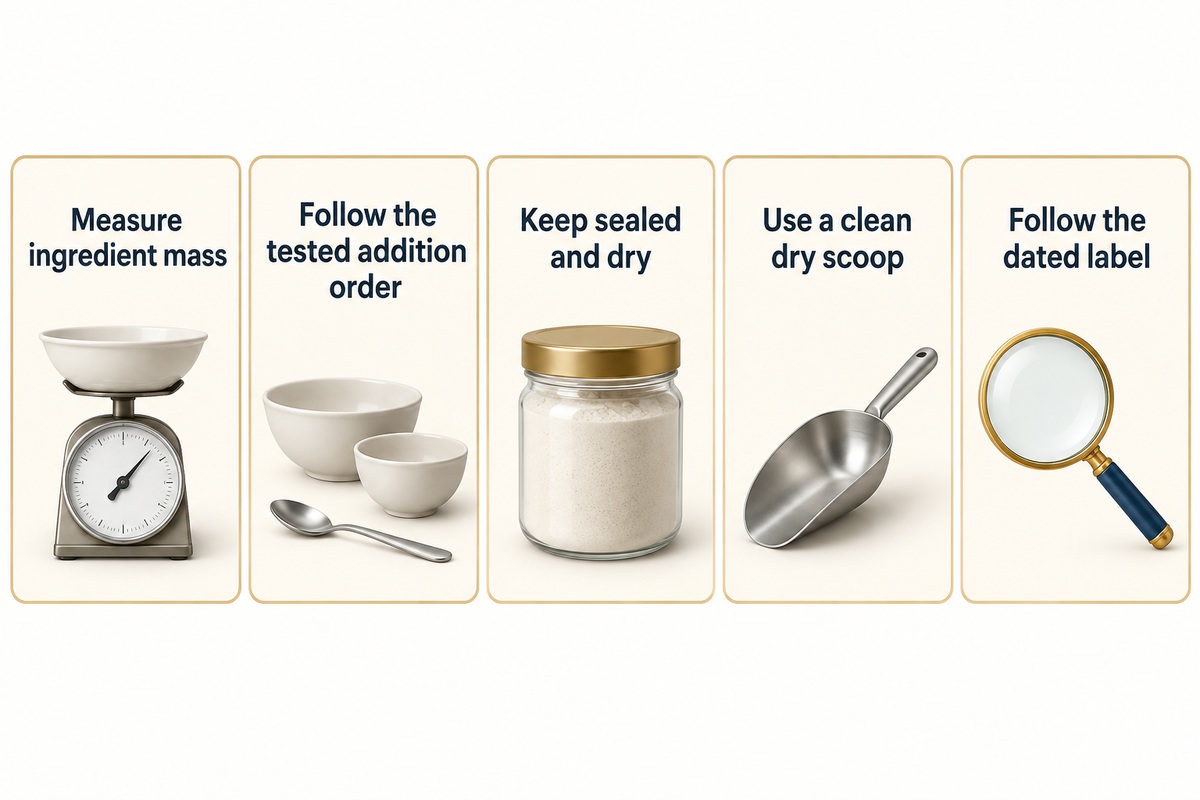
When the ingredient is mixed with water, its solubility affects how it integrates into the rest of the mixture. Follow the order of addition in the tested recipe. For a dry blend, add the powder to the dry ingredients. For a foam recipe, add the powder at the stage instructed in the method. Heating egg whites to dissolve the powder changes the process.
Repeated batches are more successfully made by measuring the mass of the ingredient, rather than by using rounded household spoonfuls. A recipe and process brief can integrate the weighing, mixing and holding stages of a recipe. Store the ingredient sealed and dry, and follow the supplier’s dated label. A clean and dry scoop should be used to measure out the ingredient from a sealed and dry container. Not all brands have the same shelf life.
Bakery outlook: buying for repeatable batches
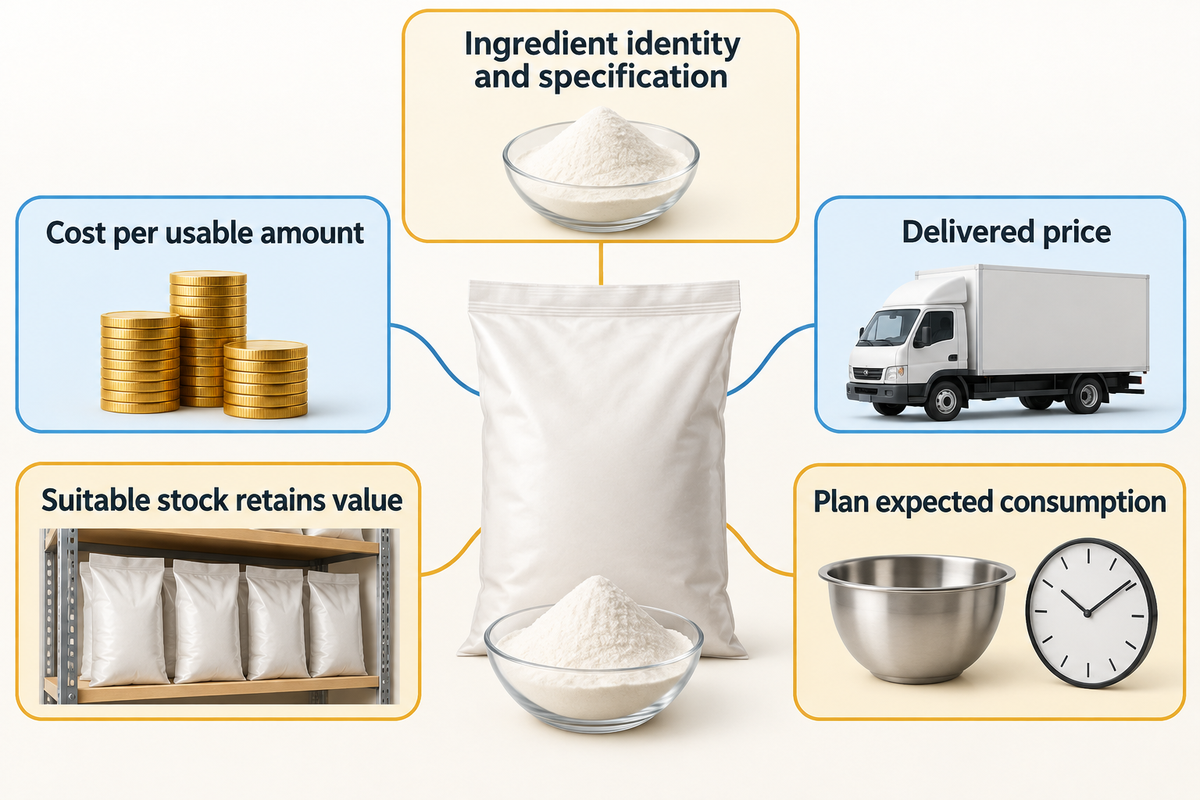
When buying the largest bag for a bakery, compare the cost of usable material and the consistency of the ingredient. A lower price per bought pound can turn into a higher price per usable pound, if a large part of the bag must be discarded. Suitable stock still has value for later production.
Public supplier sizes differ: Atlantic Spice lists a 50 lb bag, while Level7 Chemical lists 55 lb net. Keep the pack units consistent when comparing offers. For a worked comparison, Atlantic Spice’s page displayed $343.50 for 50 lb and $8.55 for 1 lb on October 21, 2026. These are that supplier’s listed prices, before shipping and taxes.
Example assumptions: the small packs are fully used. Compare the large bag over the period for which it is considered suitable for use in production. In each of the cases below, the loss part of the bag has no later use or recovery value. Suitable stock retained for later batches isn’t a loss. The $20 freight charge is an assumed extra cost for comparison.
| Purchase and use case | Cost allocated | Usable amount | Cost per usable lb |
|---|---|---|---|
| 1 lb small pack, fully used | $8.55 | 1 lb | $8.55 |
| 50 lb bag, fully used | $343.50 | 50 lb | $6.87 |
| Large bag with 5 lb unusable | $343.50 | 45 lb | $7.63 |
| Large bag with 10 lb unusable | $343.50 | 40 lb | $8.59 |
| Large bag with 15 lb unusable | $343.50 | 35 lb | $9.81 |
| Large bag with 20 lb unusable | $343.50 | 30 lb | $11.45 |
| Full use plus assumed freight | $363.50 | 50 lb | $7.27 |
| 40 lb use plus assumed freight | $363.50 | 40 lb | $9.09 |
| 30 lb use plus assumed freight | $363.50 | 30 lb | $12.12 |
At these inputs, $343.50 ÷ $8.55 gives a break-even usable quantity of about 40.18 lb. Including the assumed freight raises it to about 42.51 lb. The above comparison is to evaluate pack choices; it is not a prediction of loss of ingredient. Finance can use expected consumption, while production records the opened-bag date and quality staff decide whether remaining stock is still suitable.
Supplier comparisons need the exact ingredient identity and food-use specification, net pack weight, lot documentation, storage conditions and delivered price. Also, include the behavior of the ingredient in a production process. Gas release depends on batch size and processing conditions, including the batter’s waiting time before depositing.
Compare formulas with UDTECH’s ingredient guides and bring the batter method and the finished texture to the equipment discussion.
Frequently asked questions
Is cream of tartar necessary in baking?
Only when the recipe needs the function it provides.
Many baked products use other acids, a prepared raising mixture or a different structure-building method. Removing it from an established formula can still change acidity, foam stability or sugar behavior. If the ingredient is already specified, keep it for the control batch and compare a complete tested alternative rather than assuming that omission leaves the product unchanged.
Is cream of tartar vegan?
Pure potassium bitartrate is compatible with vegan ingredient choices.
The compound is a byproduct of the wine industry, and its chemical identity contains no dairy cream or other animal ingredient. A finished blend can contain additional ingredients, so the actual product label matters. Where a bakery needs a vegan declaration or another product-specific assurance, obtain the supplier’s declaration for the purchased material rather than treating the ingredient’s common name as a certification.
Does baking powder have cream of tartar in it?
Some formulations do, but other baking acids are also used.
A prepared powder supplies a raising system, usually with bicarbonate and a dry carrier. Manufacturers can choose different acids to adjust when gas develops. That’s why the package ingredient list and the intended recipe matter: two powders can raise a batter through different reaction patterns, and neither should be assumed to reproduce every foam-stabilizing or sugar-control use of a standalone acid.
Can I use expired cream of tartar in baking?
Follow the product’s date and storage directions.
Replace damp, contaminated or unidentifiable material. For commercial work, use stock accepted under the bakery’s ingredient controls rather than judging suitability only by whether a spoonful looks white.
Does cream of tartar dissolve in water?
Yes, with limited solubility in cold water.
Solubility rises with temperature. A recipe’s distribution and mixing method still matter, because batter contains other ingredients and behaves differently from pure water.
This guidance draws on attributed recipes and baking science. There’s no UDTECH ingredient trial reported in this guidance.
References & Sources
- Electronic Code of Federal Regulations: potassium acid tartrate identity.
- USDA: Potassium Acid Tartrate Technical Evaluation Report, 2017.
- Jenna Smith, Illinois Extension: Baking soda vs. baking powder, 2024.
- American Society of Baking: Leavening Acids.
- Oldham, McComber and Cox: Effect of Cream of Tartar Level and Egg White Temperature on Angel Food Cake Quality, 2000.
- Singh et al.: Can acceptable quality angel food cakes be made using pasteurized shell eggs?, 2019.
- Food and Agriculture Organization: Sugar confectionery.
- FDA: What You Need to Know About Egg Safety.
- Kirk O’Donnell: Leavening agents bring lift to baked goods, 2015.
- Richard Charpentier: Chemical leavening in baked foods, 2022.
- Charlotte Atchley: Reducing sodium through chemical leavening, 2021.